One of the most important thing that I do as a teacher is help my students understand why the flies the way it does or accurately read their ball flight. As a young (younger, haha) instructor, I was trained in the nine ball flights (possibilities)and the 5 ball flight laws. It stated that the a. path that the clubhead was traveling determined the starting direction and b. the face angle created the curve of the ball or deviation yet having a smaller influence on the flight pattern. This is NOT TRUE. Which brings us to the “D Plane“.
THE D PLANE FOR GOLF: This is a term that was coined by Theodore Jorgensen in his book “The Physics of Golf.” In his book he says something to the effect that two intersecting lines determine a plane. Basically this is where the(true) club face angle and the (true) path the club head is traveling create this plane. He calls it the D plane because of it is description of the collision between the club head and the golf ball. The D Plane shows that the ball almost starts where the club face is pointing (approximately 85% of the direction) and only curves if the path is going a different direction than the club face. In simpler terms, if the club face is a bigger influence on the starting direction than the path. The D plane also illustrates that the trajectory of the ball will be slightly lower than the true effective loft of the club. Have you ever hit a shot that started to the left of your target only to look down and see that your divot is pointing way to the right. You probably thought that you swung the club outside/in, right? The truth is, your d-plane was pointing too much to the left or your club face was pointing way to the left. This is what I have often called club face override. When the club face is closed or open approximately twice as much as the direction that you are swinging. So why is this so important? It explains true ball flight and this will help you to truly diagnose why you ball does what it does. Now you still will need an educated instructor to help to swing the club the way you need to and get you the ball flight you want. Check out the diagram below for further visual explanation. Two things we are assuming are: 1) you are making solid contact and 2)you are hitting the ball at the bottom of your swing arc which is very difficult. Check out the illutration below. You see the target line, the true path(club head direction for a perfectly low point strike), club face normal(3 dimensional direction face is pointed) and initial ball directon(horizontal ball velocity direction). You can see that the true path(club head direction) is to the right of the club face and the initial ball direction is just right of the club face normal. This is a D Plane for a push draw. This is enough for you to chew on for now. Click to Enlarge for Better View

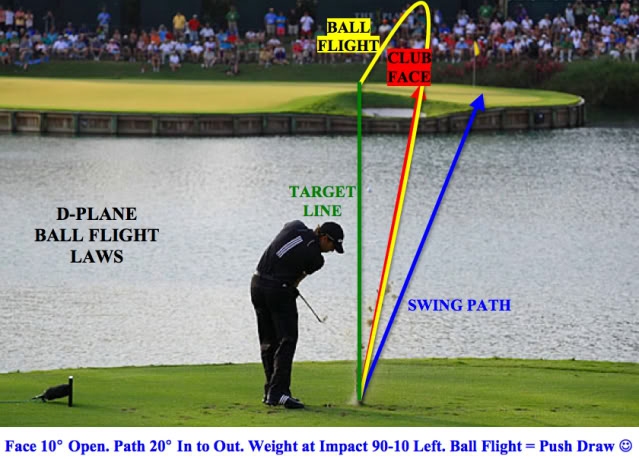
Here is a picture of Sergio Hitting a push draw and a great visual of the D Plane in action.
See you on the lesson tee,
Guru

 The Golf Guru Show
Good stuff – this adds a lot of additional color to what you have described during our lessons. I look forward to seeing you again in a week or two.
LikeLike
Can you assist me with these questions please.
The club head velocity used in the D Plane discussions – is this the club head velocity at separation? As you have mentioned many times the club head velocity at impact is somewhat different both in speed (maybe 10 to 20% less due to “impact deceleration” as Homer calls it section 2-E page 25) and direction (maybe 1 degree due circular path at the end of the endless belt). Do you know what Trackball measures?
The references you have pointed me towards suggest that the initial direction of the ball on separation is between the club face perpendicular and the club head velocity direction but quite a bit closer to the club face perpendicular. To me this is fine as the ball velocity direction is simply the vector sum of club head velocity and the “bounce” velocity. I have been assuming that the “bounce” velocity direction is perpendicular to the club face (- do you know if this is correct?) and since the bounce velocity magnitude (speed) is about 70% of club head impact speed (see section 2-E page 25) and the club head separation speed is around 80% of the impact speed I expect the vector sum of the two to closer to midway between the two vector directions rather than closer to the club face perpendicular direction as suggested in the articles.
LikeLike
That is correct, the ball will start approximately in the direction that the club face points at seperation. Don’t get caught up in the terminology and get confused. What is going to ultimately help your ball striking is knowing that the clubface has a greater influence (85%) than the path of the clubhead. Change the face first and then work on the shape of your swing and you will get better.
Thanks for the comment and question
Jason
LikeLike
I’m an atheist. Can you still help me?
LikeLike
Sure. Jesus died for for us all. How can I help
LikeLike