Do your putts ever bounce or get airborne? How do those putts turn out? Not so good, huh. When I teach putting, I stress the importance of solid contact in order to control distance. Solid contact is second only to club face control in the order of importance in a good putting stroke. The question is,”Should you hit up on the ball or hit down to achieve the best roll?” About 10 Years, I had the same question, so I decided to put a video camera on the ground to see what impact characteristics produced the best results.
What did I find? A ball hit with a shaft that leaned toward the target slightly produced a ball that had a small skid and then a consistent roll. The ball that was struck with a neutral to backwards leaning shaft tended to hop or bounce. Which way is going to be more consistent, the forward lean of course.
The worms eye view:
Even though the golf ball weighs slightly less than an ounce, on a soft putting green it creates a slight depression on the ground (a hole perse). If you hit a putt on the upswing, you will drive the ball down into the front of the depression and the ball will hop.
A Forward Press Helps:
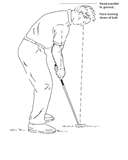
A typical putter has 3 to 5 degrees of loft on it. In order to get a consistent roll, the last thing you want to do is add more loft. Good putters tend to be neutral or take loft away at impact. This is why I like to see a slight forward press at set up. This means that your hands will be positioned just ahead of the club face. I use high-speed video when I teach putting and I have found that 4 to 5 degrees of forward shaft lean seems to produce the most consistent roll and contact. The more I use “The Kure” putting solution training aid, the more I like it because it forces you to get your handle forward at impact in order to make the green light to come on. So why not go ahead and start there.
Hit Down Not Up:
If you have always hit up on your putts for whatever reason, when you lean the shaft forward you will have the sensation of hitting down. If you are topping your putts, you are doing one of three things. 1) your lead wrist is breaking down 2) your weight or your head is too far behind the ball 3) your ball position is too far forward. Start with placing the ball a putter head length inside your lead foot.
A drill to find low point in your putting stroke
Place the grip end of a golf club about 6 inches behind your putter as you set up to hit a putt. Hit putts as you miss the grip in your backstroke. You will feel your stroke swinging from high in the backstroke to low in the follow through. This will help get your hands ahead at impact.
This something that you can work on in the house on the carpet. Best of luck and I will
I would like to welcome one of my fellow teaching professionals, Nancy Harvey to Guru TV. She is an outstanding teacher and coach and I am fortunate to be able to teach with her every day. I promised all of you, teachers and students some feedback on my new training aid, “The Kure”. I have given about 5 lessons using the aid from 2 tour players (who both loved it), to a wide range of students. I start my lesson by watching the student roll a few putts with the naked eye and make my initial assumptions on aim, set up and stroke mechanics. I proceed into the video room and put them on the camera where I share with them what I like and don’t like. I make the necessary adjustments to their setup and stroke and then introduce the Kure indoors first until they can aim effectively and hit some solid putts. Then I take them outside to finish the lesson so they can see the feedback and make some putts. Here is some excellent feedback given by a student that I worked with today……………………….
Roger’s Comments: Had the opportunity to spend an hour with Jason this afternoon trying out The Kure. At first glance it resembles the floor safety sensors for your standard automatic garage door and opener, just shrunken down a bit. One sensor for your putter and the other over your line or the cup. Line ‘em up and a yellow light pops on. Make a good stroke all the way through and a green light comes on. Who doesn’t love immediate feedback? I was literally sinking putt after putt while using this thing. I saw only 2 very minor issues with the tool, both very subjective; 1) I have a ping anser series putter. Its pretty light compared to some of the hardware I see people pull out on the greens these days. I felt it added a little too much weight to my club. I could see it being barely noticeable, if at all, with one of the heavier, say, odyssey 2 ball putters or a belly putter, but would like to see it refined to a smaller, lighter version. 2) I caught myself wanting to look to the hole as I was putting rather than keep my head down. I was searching for the green indicator that signaled a good stroke. Jason made a great suggestion that they add sound to the device in addition to the indicator lights. Or I could just keep my head down….. This is a great training aid. And for the lefties out there….I’m a lefty! Works equally well on both sides of the ball. Coupling this great tool with a great instructor like Jason WILL make you dangerous on the greens.
Now that is great, honest feedback! Thanks for the comment, Roger.
If you feel this is a product that might help you with your putting. You can order one by calling 1.888.952.PUTT. Use the discount code PCD10231 to get $20 off your order.
Leave a comment or question. I would love to hear about your experience or drills that you use (teachers) below.
See you on the lesson tee,-704-542-7635 or email me @golfgurutv@gmail.com
How is your green reading ability? Do you hit putts on the line that you perceive as the one you are aiming at only to look up and the ball breaks a lot more than you imagined? You are not alone. When I give a putting lesson, there are 2 parts to successful putting. 1)Proper Mechanics that allow you to start the ball on the line that you are aiming and 2) Reading enough break to allow the putt to have a chance to go in. For a sake of this post, I am going to assume that you can start the ball on your intended line most of the time but are having trouble with reading breaks. I am going to give you some ideas and a process that will help you make more putts and lower your scores.
In 2004, I was fortunate enough to work with and spend some time with Sea Islands’ putting expert, Mike Shannon. A lot of what I teach I stole (or borrowed) from him. Mike has worked with many of the players on the P.G.A. tour so this information has been tested and it works. The first thing that you have to do is discover how you process information and how your vision works. There are two types of putters: LINEAR AND NON-LINEAR.
I don’t have enough time to go extensively into each but I will tell you that 85% of all tour players are Non-Linear. In simplest terms…….Linear putters (left brain) see straight lines and putt to spots. Non-Linear putters see breaks and curves (right brain)
To start my green reading lesson I always start with: 90 PERCENT OF ALL AMATEUR GOLFERS UNDER READ PUTTS (MISS ON THE LOW SIDE)
Lets see if we can get that more like 50/50. So here is the process that I want you to try the next time you read a putt.
1. Start reading the putt from a big picture perspective as soon as you get out of the cart. Visualize where the water would drain, highest side/low side.
2. Once you have an idea of the direction the ball is going to break, walk to the low side of the putt about halfway in between the ball and the hole. (ex. right to left putt, walk to the left side)….This will give your eyes a great look at the true distance of the putt. Key: It will allow you to achieve your first objective…..see if the putt is uphill or downhill or both (speed elements)
3. Go to the back of the hole for a quick look (this is the most accurate view)
4. You should by now have an idea of the break. Now To The Time Part
5. INSTEAD OF PICKING A SPOT ON YOUR LINE OF PUTT….TRY THIS. IMAGINE THE THE HOLE IS A CLOCK. THE FRONT OF THE HOLE IS 6 OCLOCK. (get the picture). On a right to left putt, if the ball will enter the cup at 4 Oclock…..Instead of picking a spot on the line of your putt, USE YOUR INSTINCTS AND EYES TO ADJUST YOUR AIM TO start the ball enough to the right to make the ball go in at 4 oclock. I am telling you, the first time you do this it will be a freeing experience. No more getting locked in to a spot that has nothing to do with the target. Your speed has to come first and I guarantee it will improve. Start playing enough break and work on your speed and you will be holing big 40 foot snakes before you know it. See my putting archives (putting boot camp) for additional drills to help you with your speed.
****Incorporate some rehearsal strokes while looking at the entry point. This will enhance your spacial awareness and depth perception.
We often talk about the importance of putting but I don’t think we fully understand what it takes to be reach our goals. Aimpointgolf.com was developed by Mark Sweeney and is the technology that you see used on the PGA Tour to show the actual break line of a putt. This is a chart that I found interesting and might make you think about what is really important in achieving your golfing goals. I want to thank my good friend, John Graham which is a certified Aim Point Instructor and a great resource for golf instruction and information for making me aware of this wonderful technology. Check his site out at johngrahamgolf.com. I will be checking into getting more info about the green reading information developed by AimPoint to help my students and peeps of Guru Nation. I hope you enjoy the post and enjoy the Masters.
Steve Stricker takes a six shot lead into the Northern Trust Open, shoots 70 and hangs onto a 2 shot victory over Luke Donald. This moves him into the 2nd place in the world rankings and is currently the best player in the world that is actually playing golf. I have heard that Tiger is out of sex rehab and is making his début at the World Match Play but can anyone confirm this? I don’t know? Phil Mickelson continues to be a little rusty as he shoots 73 in the last round and finishes 45th. Phil currently has Butch on speed dial as well he should. Will this be the year that Stricker wins his first major? He is full of confidence and with this positive attitude and his steady game, I would not be surprised if he won several more tournaments and even a major. What major would his game be suited for? Masters, U.S. Open maybe? As simple as his golf swing appears, he really held it together coming down the stretch with a wonderful short game and rolling the ball beautifully. So what can we learn from Steve Strickers technique?
Here is my analysis of why his swing works: 1) A simple one-piece takeaway with a very late wrist hinge. His shoulders and torso must rotate properly to set the club at the top. Great shoulder turn and perfect spine angle tilted slightly away from the target. But this is only the half of it.
2) An excellent transition as his body unwinds in the proper sequence in the forward swing. Lower body starts as the upper resists and hands remain passive. This is his key to success. If Strick had a passive body rotation or the upper body was too fast, the club head would surely pass the handle too soon and he would lose power. So mental note: One piece takeaway with limited wrist hinge must be coupled with a strong body rotation in the forward swing (his main power source).
Strickers Pitching and Putting:
Steve incorporates his one piece move in his pitch shots as well. He controls his distance with the length of his swing on both sides (symmetrical) with passive hands. The Key Move: He leads with his lower body and allows the arms and hands to follow suit. Without this key move, he would break down at impact. Again, you must have a good body pivot to be an effective pitcher of the golf ball but especially if you have none or limited wrist hinge.
Putting: Strick is a straight line putter. This is not my preference but it works for him because he does too things: 1. sets up with his wrists arched and the heel of the putter off the ground. This sets the shaft more vertical to the ground which is critical for this type of style. 2. rocks his shoulders a little steeper than most players on tour which creates a straight line path.
So the number one thing we can learn from Mr. Stricker is to match your style to what your body will allow. Be consistent from full swing to short game to putting. But the most important thing is to be Confident and To Own It. See you next time and don’t forget to breathe, preferably in your backswing like Steve Stricker or when you hold the trophy over your head. Oh and don’t forget to thank your instructor in your victory speech.


 The Golf Guru Show