This is a custom two day school that I do for James Donnelly, Todd Halpin, Kevin Clark and Chris Caso every year. I thought I would just turn the camera on, let it run and see what came out of it. This is a talk that I give my students in how to get their changes from the lesson tee to the golf course. In part 2, listen for the ball flight question from JD, a very educated golfer asks these questions. Our customers are getting smarter and more educated so you have to be ready. Let me know what you think of this impromptu look at what I do on a daily basis. Here is part 1:
Here is part 2:
Please share this if you think it is useful and leave a comment at the bottom
follow me on twitter @twitter.com/onplanegolf
To schedule a lesson with the Guru please call 704-542-7635
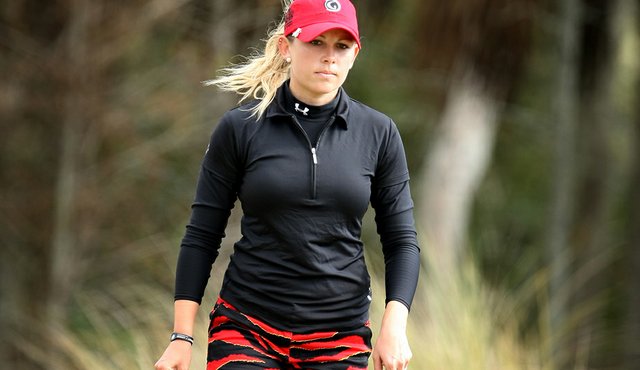
Caddy programs at golf courses are not the norm any longer but if you ever get the chance to play a round of golf with a caddy, I highly recommend it. Professional golfers are used to having someone carry their bag during a round but a good caddy can mean so much more to the performance of the player. Recently, Sara Brown (big break star) made it through q school to earn
The Golfers Brain
her LPGA Tour card. For those who don’t know this, her boyfriend, Derek Radley is one of my good friends as he used to work with me at the golf school. Derek has been by Sara’s side through the grind of playing the futures tour and ultimately making the big jump to the tour by caddying for her. Here is an article that I found that highlights an instance where Derek had to make a tough call as a caddy (and a nervous boyfriend) coming down the stretch. click here to read the article. Congratulations to Sara and best of luck on the tour in 2011.
So how important is a caddy? Does the decisions they make, what they say or how they say it make a difference to the performance of their player? Absolutely. This is where it is important that they know the players tendencies, moods, mannerisms so that they know when to say something and also when to say nothing. This is why the best players tend to have caddys that have been with them for a long time. The most notable are Phil Mickelson and “Bones Mckay” and Tiger and “Steve Williams”. Here is a great article about Bones that I found. click here
A good caddy has the ability to help his or her player focus on the shot at hand with a simple phrase like “pick a good target” or “smooth swing big guy”. The caddy can also be a sounding board for venting frustration after a bad shot. So caddying is more than just getting a correct yardage, handing the player a club or raking a bunker. We have seen many instances where the caddy plays a big role in a young players first win by keeping them focused coming down the stretch. So what can the average player do on the weekend when they don’t have a caddy to talk to them or calm them down after a bad shot. WE MUST BE OUR OWN CADDY AND PLAYER COMBINED! SO HOW DO WE DO IT? HERE ARE SOME KEYS TO BEING YOU OWN CADDY:
THE CADDY PRE-SHOT ROUTINE AND SELF-TALK
A pre-shot routine should last around 40 seconds. The first half of that is what I call the caddy stage. This would include: 1)planning the type of shot you want to play, 2) getting a yardage, 3)choosing a club, 4)assessing the conditions…lie of ball, wind, up hill or down hill etc. The POST ROUTINE is also very important. I teach my players ANCHORING techniques. How you react to a shot is critical in the success of the next shot, good or bad. example: When a Sorenstam shot 59, in order to keep her emotions even keel, her coach Pia Nilson told her to giggle to herself after every shot (good or bad). Obviously anchoring is easier after a good shot so let’s focus on the bad ones. I give my players 6 seconds to get upset before they have to let it go or when ever they put the club back in the bag (whichever comes first). Self Talk is also important (the caddy in you). How many times have you beat yourself up, called yourself a bad name (big dummy or worse)…. How did that work out for your next shot. Let it Go, brother. How many times have you stood over an importance shot and a thought popped into your mind like, “just DON’T HIT IT IN THE WATER!” where did it go…….The water. The subconscious mind can not differentiate between positive and negative commands. So you just hit the ball where your brain told your body to hit it. Next time how about asking the question,”Where’s My Target?”
Not to get into a whole mental discussion but you must be your own best friend, like Bones or Stevie. Be kind to your self and use self talk to pump your self up or motivate not to annihilate.
The play our best golf when we allow our subconscious (the garden) mind take over. The conscious mind (the gardner) seems to always get in the way. Thats enough for today so I will leave you with some food for thought, some bread for the head. Before every shot, we plant something…..seed of hope or doubta …………we can choose to plant flowers or we can plant weeds……….Champion Golfers plant beautiful flowers
Ryan Palmer outdueled Aussie Veteran Robert Allenby down the stretch at the P.G.A. Tour’s first full field event. The Sony Open was a very entertaining and interesting tournament chalked full of top players and veterans hitting great shots and holing big putts. We had the likes of Steve Stricker, Davis Love, Retief Goosen and Carl Petterson all trying to track down maybe the hottest golfer on the planet (Allenby), playing with a bad ankle believe it or not, and Ryan Palmer who is not a household name and finished 150th on last years money list. So what can we learn from watching this weeks event, other than the fact that it does pay to keep the flag stick in while pitching (true). In my continued journey to make all of you educated viewers of golf, not just entertainment, but as a venue to dissect and learn something that will help you with your own game. One of the most frequent questions that I get asked from my students is,”During a round of Golf, how do I keep my swing together for the entire round?”. We have all had rounds that begin great and the wheels fall off or vice-versa, you start poorly and suddenly turn it around. So how do we hold it together and make strings of great swings under pressure. The answer to the question is Continue reading “Meaningful Rehearsals Are Only Second To Exagerrated Ones”
As we look at the first P.G.A. Tournament of the season, after we get past the fact that we would love to be in Hawaii, we take a closer look at what champions do and how golf is played at the highest level. As I continue my quest to make you a more educated viewer of golf tournaments in attempt to learn something to help your own game, let’s see what we can learn from the final group in the SBS Championship. We have two top players that have both won U.S. Opens and had an excellent 2009. So why did Geoff Ogilvy shoot 67 and Lucas Glover stumble to a 76 after leading the tournament after 3 rounds? Continue reading “SBS Championship- A Tale Of Two Routines”

 The Golf Guru Show