20 Days With the Guru, Day 10: How Important Is The Caddy To a Player and How to Be Your Own Luper

Sara Brown

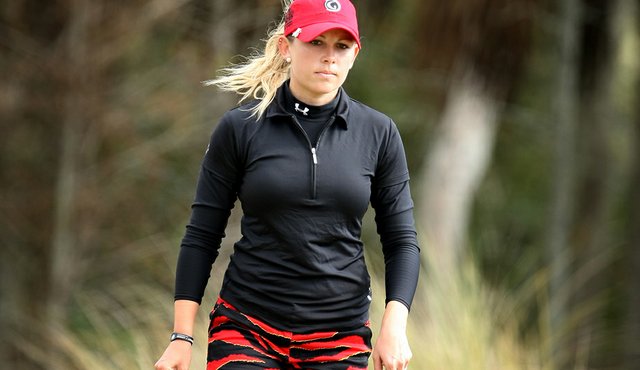
Caddy programs at golf courses are not the norm any longer but if you ever get the chance to play a round of golf with a caddy, I highly recommend it. Professional golfers are used to having someone carry their bag during a round but a good caddy can mean so much more to the performance of the player. Recently, Sara Brown (big break star) made it through q school to earn

The Golfers Brain

her LPGA Tour card. For those who don’t know this, her boyfriend, Derek Radley is one of my good friends as he used to work with me at the golf school. Derek has been by Sara’s side through the grind of playing the futures tour and ultimately making the big jump to the tour by caddying for her. Here is an article that I found that highlights an instance where Derek had to make a tough call as a caddy (and a nervous boyfriend) coming down the stretch. click here to read the article. Congratulations to Sara and best of luck on the tour in 2011.
So how important is a caddy? Does the decisions they make, what they say or how they say it make a difference to the performance of their player? Absolutely. This is where it is important that they know the players tendencies, moods, mannerisms so that they know when to say something and also when to say nothing. This is why the best players tend to have caddys that have been with them for a long time. The most notable are Phil Mickelson and “Bones Mckay” and Tiger and “Steve Williams”. Here is a great article about Bones that I found. click here

A good caddy has the ability to help his or her player focus on the shot at hand with a simple phrase like “pick a good target” or “smooth swing big guy”. The caddy can also be a sounding board for venting frustration after a bad shot. So caddying is more than just getting a correct yardage, handing the player a club or raking a bunker. We have seen many instances where the caddy plays a big role in a young players first win by keeping them focused coming down the stretch. So what can the average player do on the weekend when they don’t have a caddy to talk to them or calm them down after a bad shot. WE MUST BE OUR OWN CADDY AND PLAYER COMBINED! SO HOW DO WE DO IT? HERE ARE SOME KEYS TO BEING YOU OWN CADDY:

THE CADDY PRE-SHOT ROUTINE AND SELF-TALK
A pre-shot routine should last around 40 seconds. The first half of that is what I call the caddy stage. This would include: 1)planning the type of shot you want to play, 2) getting a yardage, 3)choosing a club, 4)assessing the conditions…lie of ball, wind, up hill or down hill etc. The POST ROUTINE is also very important. I teach my players
ANCHORING techniques. How you react to a shot is critical in the success of the next shot, good or bad. example: When a Sorenstam shot 59, in order to keep her emotions even keel, her coach Pia Nilson told her to giggle to herself after every shot (good or bad). Obviously anchoring is easier after a good shot so let’s focus on the bad ones. I give my players 6 seconds to get upset before they have to let it go or when ever they put the club back in the bag (whichever comes first). Self Talk is also important (the caddy in you). How many times have you beat yourself up, called yourself a bad name (big dummy or worse)…. How did that work out for your next shot. Let it Go, brother. How many times have you stood over an importance shot and a thought popped into your mind like, “just DON’T HIT IT IN THE WATER!” where did it go…….The water. The subconscious mind can not differentiate between positive and negative commands. So you just hit the ball where your brain told your body to hit it. Next time how about asking the question,”Where’s My Target?”

Not to get into a whole mental discussion but you must be your own best friend, like Bones or Stevie. Be kind to your self and use self talk to pump your self up or motivate not to annihilate.

The play our best golf when we allow our subconscious (the garden) mind take over. The conscious mind (the gardner) seems to always get in the way. Thats enough for today so I will leave you with some food for thought, some bread for the head. Before every shot, we plant something…..seed of hope or doubta …………we can choose to plant flowers or we can plant weeds……….Champion Golfers plant beautiful flowers

Let’s connect: to follow me on twitter @twitter.com/onplanegolf

See you on the lesson tee,

Jason

Guru’s Keys To Breaking 80:”How To Join This Elite Club”


The Bullet Proof Vest For Golf

Every golfer has goals. Mostly of breaking one of three scoring barriers: breaking 100, breaking 90 or breaking 80. The lower you get the more difficult this achievement becomes. According to NGT Research, there are over 60 million golfers in the world today and less than half of them will never break 100.  33% will break 90.  However, only 5% will ever break 80.  That’s 3 million people out of 60 million golfers. So this makes breaking 80 an elite club for sure. If you have done it once in your life, congratulations. For those of you who follow the guru’s blog already know my formula for breaking 100 and breaking 90. Recently, one of my twitter friends posed the question,”What are your keys to breaking 80?” So after some thought and a bit of research, Here are my keys to success. Building from my list of breaking 90…………..

1. Drive the ball in play and average 230 yards. I am assuming that you are shooting in the low 80’s from the back tees at this point.

2. Most Important: You must average 8 greens in regulation. Assuming you make at least 2 of 8 birdie putts and don’t three putt. This leaves 10 greens that you have to chip, pitch and hit bunker shots.

3. Get it up and down an average of 40 percent of the time. This leaves us a few shots to play with

4. Limit three putts and average 32 putts per round. 2nd most important stat.

Get in the habit of keeping your vital statistics of your rounds of golf. FIR, GIR, Putts/round and up and down pct. If you are looking for a website to keep stats and track your progress, I suggest ShotbyShot.com.  This will give you starting point and show you how close you are to reaching this barrier that most golfers can’t cross. Of course, this is just my opinion and there are many factors that go into a golf game that help make up the level of player but this is a great place to start. Here are a couple of ideas that just might get you over the hump if you are trying to turn 81 into 79.

1. Use the 80/20 rule. If you do find trouble, don’t be Phil Mickelson and try to hit the career shot. If you can’t pull it off at least 80 percent of the time, play it safe. Punch it out and make your bogey.

2. Aim for the middle of the green. Refer to my past post of the stop light theory. There are very few green lights out there, proceed with caution and hit more greens.

3. Work on your mental side. Focus on pre-shot routine and TARGET and quit playing golf swing. Ask yourself 2 questions before every shot……”Where’s my target?” and “How do I want to play this shot”…..Sure beats standing over it saying, “Just don’t hit it in the water”

Best of Luck with your golf and enjoy the journey. I will see you on the lesson tee.

Are you tweeting? Friend me up @twitter.com/onplanegolf and get use the @sign to join the conversation.

Guru……….. call 704.542.7635 to schedule a lesson or check out our website at danarader.com

Masters Recap and Video from my day at Augusta


Wow! What a great Masters tournament this year. I am glad they are now setting up the course so that the players can make birdies and eagles and go low again. The roars are back at Augusta and it was very exciting once again. Here are my observations and some video that I shot. It is a bit rough but I hope you enjoy it. If you have never had a chance to go to Augusta, you must go at least once. It is like no other place and is one of my favorite places on earth.

1. Great to see Phil be courageous and actually pull it off. The shot on 13 was phenomenal.

2. My childhood idol, Fred Couples gave us some hope and nearly won at 50, wow that would have been a story.

3. Tiger continues to amaze at how he can get the most out of his round with his C swing, incredible. I hope he comes to Charlotte.

4. Anthony Kim seems to have his form and head on straight, great to see.

5. Biggest Disappointments were Jim Furyk, Ernie Els and Charl Schwartzel.

6. Lee Westwood officially gets the label of the best player without a major. He will win the British Open.

Give me your thoughts on the Masters. It was one for the ages.

See you on the lesson tee: to schedule a lesson call 704-542-7635 or visit danarader.com,

Guru

Stricker Wins NTO as Mickelson Struggles


Steve Stricker takes a six shot lead into the Northern Trust Open, shoots 70 and hangs onto a 2 shot victory over Luke Donald. This moves him into the 2nd place in the world rankings and is currently the best player in the world that is actually playing golf. I have heard that Tiger is out of sex rehab and is making his début at the World Match Play but can anyone confirm this? I don’t know?  Phil Mickelson continues to be a little rusty as he shoots 73 in the last round and finishes 45th. Phil currently has Butch on speed dial as well he should. Will this be the year that Stricker wins his first major? He is full of confidence and with this positive attitude and his steady game, I would not be surprised if he won several more tournaments and even a major. What major would his game be suited for? Masters, U.S. Open maybe? As simple as his golf swing appears, he really held it together coming down the stretch with a wonderful short game and rolling the ball beautifully. So what can we learn from Steve Strickers technique?

Here is my analysis of why his swing works:  1) A simple one-piece takeaway with a very late wrist hinge. His shoulders and torso must rotate properly to set the club at the top. Great shoulder turn and perfect spine angle tilted slightly away from the target. But this is only the half of it.

2) An excellent transition as his body unwinds in the proper sequence in the forward swing. Lower body starts as the upper resists and hands remain passive. This is his key to success. If Strick had a passive body rotation or the upper body was too fast, the club head would surely pass the handle too soon and he would lose power. So mental note: One piece takeaway with limited wrist hinge must be coupled with a strong body rotation in the forward swing (his main power source).

Strickers Pitching and Putting:

Steve incorporates his one piece move in his pitch shots as well. He  controls his distance with the length of his swing on both sides (symmetrical) with passive hands. The Key Move: He leads with his lower body and allows the arms and hands to follow suit. Without this key move, he would break down at impact. Again, you must have a good body pivot to be an effective pitcher of the golf ball but especially if you have none or limited wrist hinge.

Putting: Strick is a straight line putter. This is not my preference but it works for him because he does too things: 1. sets up with his wrists arched and the heel of the putter off the ground. This sets the shaft more vertical to the ground which is critical for this type of style. 2. rocks his shoulders a little steeper than most players on tour which creates a straight line path.

So the number one thing we can learn from Mr. Stricker is to match your style to what your body will allow. Be consistent from full swing to short game to putting. But the most important thing is to be Confident and To Own It. See you next time and don’t forget to breathe, preferably in your backswing like Steve Stricker or when you hold the trophy over your head. Oh and don’t forget to thank your instructor in your victory speech.

God Bless,

Guru

Time To Get Your Groove On


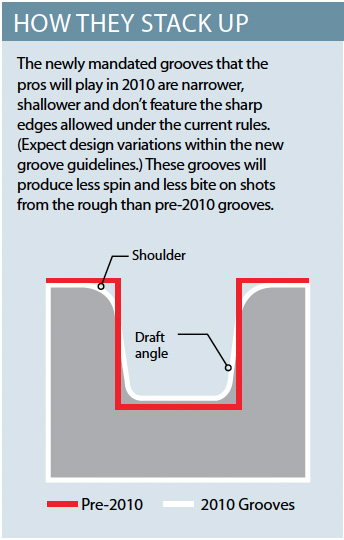
With all the talk this weekend about” Groovegate” and some professional golfers getting called cheaters, I thought I would weigh in on this new groove situation. Do you understand the rule?What is this loophole that Ping is involved in? What does all this mean for the recreational golfer. I will attempt to answer all of these questions as I see it and help to simplify it for all of you players out there in Guru Nation. First off, The new grooves essentially cut down on the amount of spin that a player can create out of the rough. This will put a premium on straighter driving rather than the old “Bomb and Gouge.” The new condition of Competition concerning grooves applies to play on the professional tours and a small selection of other elite tournaments in 2010. For the vast majority of the golf played around the globe, the grooves in your current clubs are authorized by the ruling bodies until at least 2024. So unless you are reading this and are playing a professional tour, you can relax for a bit longer.

THE LOOP HOLE– As you probably already know, The Ping Eye 2 wedges before 1990, are considered legal because of the box groove law suit won be Karsten in 89′. This is what some of the pros have in their bags (namely Mickelson) because they are considered legal for the time being. I think that Mr. Karsten should just go ahead and write the letter allowing the USGA to make these illegal as well, just my opinion (and apparently Johnny Miller as well). Make it equal across the board and lets see who is the best. It was nice to see that Scott Macarron did apologize to Phil about calling him a cheater for using this wedge. He is not using it this week however. It will be interesting to see if and how this changes the game. One thing is for sure, we will see the pros working on there short  game and their driving. Here is a picture of the difference in the old and the new grooves to give you a better understanding of what we are dealing with. See you on the lesson tee and oh, don’t forget to breathe.

God Bless,

Guru