7 Days With “The Kure”: A Passionate Golfers Journey, Day 1

The Kure Putting Solution
As the Guru takes a few days to catch his breath after my 20 day “blogging binge”,(I am sure there is a 12 step program for this sort of condition), One of my long time students, Alan White has been gracious enough to chronicle his exploits into his putting practice with “The Kure Putting Solution” training aid. I can assure you that we have not conspired about what he is going to write. All I can tell you is that Alan is a very passionate golfer that is a very straight shooter. What I am saying is that this will be a very honest, forthright assessment on this training aid that I have been talking about for  a few months. So if you are on the fence about purchasing one, this is sure to sway you one way or the other. I hope you enjoy the posts and thank you Alan for taking the time to share your perspective from an amateur golfer. I am sure many of you will be able to relate to this diary of sorts.

Well GURU nation a conspiracy has been under foot. It seems a certain golf instructor had passed along a gift wish of mine to Santa (a.k.a the wife) this year. I am now the proud owner of the KURE putting system and I must say they did a great job of keeping it a secret. I was certainly surprised. I know a lot of you out there have been curious about this device so I thought I would share my experiences as I work with the KURE over the next week. I will give you both the good, bad and the ugly so to speak.

Day 1.
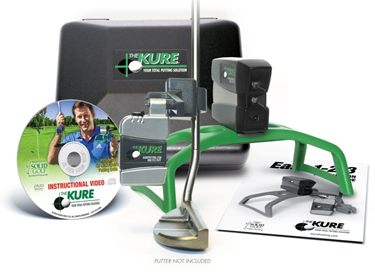
    Just unpacked the KURE inspected it and installed the batteries that were provided. The KURE comes packaged in a nice little plastic case that houses the KURE putting system and a short instructional video featuring Sir Nick Faldo and Mike Shannon from the Sea Pines resort. Mike gives the promotional side with Sir Nick covering the use and providing some drills to use. This video is NOT a putting lesson it just covers the basic use of the KURE and its benefits.

    The KURE system itself consists of 3 components.
        First is the “Target Module and Stand”. It is powered by 3 AA batteries (included). The stand is 4 legs and the module sits on top of the stand. When assembled it resembles a spider that sits over the hole or the target of your choice. Going forward I will refer to it as “The Spider”. Second is the “Aiming Module” this is a lightweight plastic part that attaches to your putter shaft. It is powered by one of the small coin batteries (included). The last component is a small “Laser module” It is powered by 2 AAA batteries (included) and clips to the Aiming Module after it is attached to your putter. The module outputs a laser so you can precisely align the aiming module square to your putter face.

Setup
    Setup is straight forward and took about five minutes the first time. I can easily be done in about minute once you understand the basics. The only issue I had initially was the laser module did not turn on. A set of fresh batteries were installed  and that took care of the issue.

The KURE in action.
    Before we get to far into the actual performance of the product. Let me clarify the basic use and feedback of the KURE. The aiming module (after attachment/alignment to your putter shaft) has a small green light built into the top of it. This green light provides feed back on your head/eye position. If your eye is directly over the target line the light will show bright green, as you move your head off the line the light will actually appear to blink then grow dim the further you eyes get from the intended line. The Target Module or “Spider” has  light two lights in the front of it. A yellow light and a green light. When your putter face is correctly aligned the yellow light will turn on to let you know you are correctly aligned.  The green light comes on after you stroke the putt if the putter face was square to the target at impact. So the sequence goes something like this. Step into your address position and line up the face so the yellow light will come on (it will stay on as long as your putter face stays in alignment). Double check the green light on the aiming module to verify eye position. Make your stroke. If the Green light on the spider comes on you know that your stroke resulted in a square putter face at impact.
    OK here we go with a real try at using the KURE. First let me say that currently my misses with the putter are almost always to the left. “Crap I pulled another one” is usually heard a lot during my rounds of golf. Anyway I set up a small target in the living room, placed the spider over it, dropped 1/2 dozen balls on the carpet 7-8 feet away, got into my address position, aimed the putter at the target and…….I did not get the yellow conformation light. Heck I say… The hole is only a couple of steps away so I back up, reset, and move back into the ball, aim the putter and……still no yellow light. This time around I rotate the putter until I got a yellow light and guess what. I was originally aimed ~3 inches to the left of my target. I repeated this a couple more times to confirm and sure enough I was consistently aiming left of my target. So now I move my body around until the yellow confirmation light came on and WOW I felt like I am aimed way to the right of the target. Now I am in denial, as I honestly did not believe I could be that far off on a putt of that length. So what do you think I did next?….Still in denial I re-checked the alignment and placement of the aiming device on the putter shaft because THAT had to be wrong. It was not. Still in denial I went back and re-tried addressing and aiming the putter….with the same results as before I was still aiming left of the target. Still in denial I enlisted the aid of a lovely assistant (my wife). I had her aim the putter face until she got a yellow light and I laid down on the floor behind the putter to confirm that it was aiming at the target and guess what???? It was aimed directly at the target::: 🙂
    I am not in denial anymore…..I can say it now…..I have not been aiming the putter where I thought I was. I have run out of time for today’s session but I will be back tomorrow and pick up where we left off today. Just a final thought ,maybe, just maybe those putts that I was “pulling” were not getting pulled after all…..

Best,

Alan White
20 Days With the Guru, Day 15: Head Movement and Body Pivot Part 2


Stuart Mackenzie: Look at the size of that boy’s heed.
Tony Giardino: Shhh!
Stuart Mackenzie: I’m not kidding, it’s like an orange on a toothpick.
Tony Giardino: Shhh, you’re going to give the boy a complex.
Stuart Mackenzie: Well, that’s a huge noggin. That’s a virtual planetoid.
Tony Giardino: Shh!
Stuart Mackenzie: Has it’s own weather system.
Tony Giardino: Sh, sh, shh.
Stuart Mackenzie: HEAD! MOVE!


Stuart Mackenzie: I’m not kidding, that boy’s head is like Sputnik; spherical but quite pointy at parts! Now that was offside, wasn’t it? He’ll be crying himself to sleep tonight, on his huge pillow.

I know, I know,  I’m a freak…….(crickets) but I had to post that for those of you who didn’t get the original title, laughing now? The average adult head weighs about 15-21 pounds, so you better be careful as to where it goes during your golf swing.  

Yesterday I posted a blog on different style body pivots and head movement. Thank you for all the comments that I received from coaches and friends. This is a great discussion topic that could go on for a while. What are the pros and cons of each style (a 2 pivot point move) or (a neutral, centered approach). Once again the genius in expert teaching is for the coach to design a pivot and a style that  works for the student and not fit the student to the style or method. A lot of golfers cannot fit into a centered pivot due to physical limitations and immobility in their hips and lack of rotating ability. So we have to allow them to move off of the ball a bit in order to gain sufficient power. This puts a huge importance on training the hands and arms to create speed and an impact position that can allow them to hit the ball first and reach low point. There are many more factors that we could discuss that could affect these things (ball placement, set-up, posture, swing shape etc.) that we can save for a later time. In the meantime, since I didn’t have time to do a Guru TV episode this soon, I got permission from my friend and mentor, Chuck Evans to use a few segments from a webinar that he did that demonstrates this topic perfectly. Leave your comments below and thanks for all your feedback as I am learning so much from all of you. I am evolving as we speak. Enjoy the video.

http://video.medicus.com/video.php?id=485 – video describing the two different pivots

http://video.medicus.com/video.php?id=491 – video describing the pivot that promotes less back pain.

Remember: Everything we teach is borrowed or stolen from our teaching ancestors, communicate it clearly and watch the language that we use. Be careful of what you ask the student to do, they might just do it – Manuel DelTorre

follow me on twitter @twitter.com/onplanegolf or friend me up on facebook.com/onplane golf

See you on the lesson tee,

Jason

Head Move (Or Not)-“So I Married A Teaching Professional” (Archive deux)


Something that I have been thinking a lot about lately as I have been giving hundreds of lessons is lOW POINT, HEAD MOVEMENT AND BODY PIVOT. As not to make this a full on debate amongst coaches (although that would be ok), I want to give the students a few ideas about how to improve the consistency of your contact. When we talk about the low point in the golf swing, we are referring to the bottom of the swing circle, just before it starts to elevate up and to the left. This point is typically even with your lead shoulder. This is why when you see a good player take a divot, it is usually 2 to 4 inches long on the target side of the golf
ball. If you are hitting the ball fat or thin, then your low point is not
as it should be so we have to look at a few areas that might give us
some insight into why this is happening. I am going to attempt to convey this in an understandable way for as I have alot of thoughts on this matter. Understanding is the easy part for most, it is application and what to apply that golfers struggle with. So question becomes: Should the head move in the golf swing? If so how much? How does the body pivot affect this idea? and Does head size make a difference? That was a joke.

HEAD MOVEMENT

                                                                                                                                                                           Early in my teaching career, I must have picked up a Jimmy Ballard book and read it (the 7 common denominators) because I allowed my students to shift there weight behind the ball, then turn, shift back to center and swing. As I have seen this method work for many players over the years. Rocco Mediate, Hal Sutton etc. It seems to require a lot of timing. So in the last 10 years, I have allowed no more than 1 half a head to the right as my guideline. To clarify what we mean by head movement: typically most teaching pros will draw a box or a circle around the head when looking at video. Any side to side or up and down motion will be easy to see when this is done. As I have been studying the teaching methods such and “stack and tilt” and “The Golfing Machine”, they like to see the head stay centered. The golfing machine calls it “the tripod”. I always struggled with this idea because I thought it changed the spine angle too much in a reversing manner to achieve an on plane downswing or to create power. After studying massive amounts of video on players that adhere to these methods I found that it these things were achievable. As long as lower center (naval area) is slightly ahead of upper center (sternum) you can find achieveable plane.  You just have to have the right components in place. In order to keep your head completely still or might I describe as “steady”, you must keep your shoulders rotating on top of your hips and a bit steeper than normal. The right hip absolutely cannot slide to the right at all or you will get a reverse spine angle. I more lateral move off of the ball might have a flatter shoulder plane.  So which is the right way? I think it depends on the students characteristics and athletic ability.

                                                                                                                                                                                                       I asked my friend and top 100 teacher, Chuck Evans about head movement and he said,”it must stay still, period. I then asked if it does move, does that change low point and the answer is absolutely. If you head is too far behind the ball, then your left wrist becomes low point. What percentage of golfers, your students, you, yeah you……….have a bowed left wrist at impact? Not as many as we want to admit, right. It can be more on top of the ball and still work.  So this makes the head steady idea make sense to me and has helped my students improve their contact even if impact isn’t perfect. When I move a player into a steeper shoulder plane with a steady head, the first reaction is it feels like a reverse pivot. When I show them on video that they still have a neutral or slightly tilted spine away from the target, they understand. The player with too much head movement to the right will feel this way because it is a big change. When they hit that first shot more solid, they buy into it pretty quick. I will hook up some video examples of my students to help make sense of all this.

MATCHING COMPONENTS

I have always been fond of a lower, flatter arm plane but have some students with high hands if they show the ability to successfully drop the club on plane. When you work with a more neutral pivot, to avoid getting too steep on the downswing, your arm plane should be a little flatter. If you tend to move off of the ball and tilt your spine more away from the target on the downswing, you can use a higher hand position. It is all about your ability to consistently find the plane line and low point that is important.

STEADY BUT NEVER IN FRONT

I think we would all agree that we don’t like to see the head forward of its original position at impact. This typically causes a loss of lag or club head throwaway. Another reason a steady head might be easier. If you shift too far off the ball, you must shift forward to recenter and could slide too far in front.

So in conclusion. Everyone wants more distance. If you load up on your backside and coil, you might give yourself a chance to hit it farther but you might sacrifice a consistent low point and your contact will suffer. I have found that for most players, SOLID CONTACT IS WAY MORE IMPORTANT. I have a saying,”Speed without contact is useless”. Think about it. So if you are struggling with solid contact, try a more neutral, head centered pivot and I think you will find that ever illusive LOW POINT and might even take make a target side divot. I will do a video on this in the near future that will help explain better. I hope this made sense.

P.S. remember these swing ideas are examples of A way to swing a golf club not THE WAY….Good teachers have a few tools, great teachers have MANY.

See you on the lesson tee,

Jason

20 Days With the Guru, Day 10: How Important Is The Caddy To a Player and How to Be Your Own Luper


Sara Brown

Caddy programs at golf courses are not the norm any longer but if you ever get the chance to play a round of golf with a caddy, I highly recommend it. Professional golfers are used to having someone carry their bag during a round but a good caddy can mean so much more to the performance of the player. Recently, Sara Brown (big break star) made it through q school to earn

The Golfers Brain

her LPGA Tour card. For those who don’t know this, her boyfriend, Derek Radley is one of my good friends as he used to work with me at the golf school. Derek has been by Sara’s side through the grind of playing the futures tour and ultimately making the big jump to the tour by caddying for her. Here is an article that I found that highlights an instance where Derek had to make a tough call as a caddy (and a nervous boyfriend) coming down the stretch. click here to read the article. Congratulations to Sara and best of luck on the tour in 2011.

So how important is a caddy? Does the decisions they make, what they say or how they say it make a difference to the performance of their player? Absolutely. This is where it is important that they know the players tendencies, moods, mannerisms so that they know when to say something and also when to say nothing. This is why the best players tend to have caddys that have been with them for a long time. The most notable are Phil Mickelson and “Bones Mckay” and Tiger and “Steve Williams”. Here is a great article about Bones that I found. click here

A good caddy has the ability to help his or her player focus on the shot at hand with a simple phrase like “pick a good target” or “smooth swing big guy”. The caddy can also be a sounding board for venting frustration after a bad shot. So caddying is more than just getting a correct yardage, handing the player a club or raking a bunker. We have seen many instances where the caddy plays a big role in a young players first win by keeping them focused coming down the stretch. So what can the average player do on the weekend when they don’t have a caddy to talk to them or calm them down after a bad shot. WE MUST BE OUR OWN CADDY AND PLAYER COMBINED! SO HOW DO WE DO IT? HERE ARE SOME KEYS TO BEING YOU OWN CADDY:

THE CADDY PRE-SHOT ROUTINE AND SELF-TALK

A pre-shot routine should last around 40 seconds. The first half of that is what I call the caddy stage. This would include: 1)planning the type of shot you want to play, 2) getting a yardage, 3)choosing a club, 4)assessing the conditions…lie of ball, wind, up hill or down hill etc. The POST ROUTINE is also very important. I teach my players
ANCHORING techniques. How you react to a shot is critical in the success of the next shot, good or bad. example: When a Sorenstam shot 59, in order to keep her emotions even keel, her coach Pia Nilson told her to giggle to herself after every shot (good or bad). Obviously anchoring is easier after a good shot so let’s focus on the bad ones. I give my players 6 seconds to get upset before they have to let it go or when ever they put the club back in the bag (whichever comes first). Self Talk is also important (the caddy in you). How many times have you beat yourself up, called yourself a bad name (big dummy or worse)…. How did that work out for your next shot. Let it Go, brother. How many times have you stood over an importance shot and a thought popped into your mind like, “just DON’T HIT IT IN THE WATER!” where did it go…….The water. The subconscious mind can not differentiate between positive and negative commands. So you just hit the ball where your brain told your body to hit it. Next time how about asking the question,”Where’s My Target?”

Not to get into a whole mental discussion but you must be your own best friend, like Bones or Stevie. Be kind to your self and use self talk to pump your self up or motivate not to annihilate.

The play our best golf when we allow our subconscious (the garden) mind take over. The conscious mind (the gardner) seems to always get in the way. Thats enough for today so I will leave you with some food for thought, some bread for the head. Before every shot, we plant something…..seed of hope or doubta …………we can choose to plant flowers or we can plant weeds……….Champion Golfers plant beautiful flowers

Let’s connect: to follow me on twitter @twitter.com/onplanegolf

See you on the lesson tee,

Jason

20 Days With the Guru, Day 4: A Forward Leaning Shaft (Even For Putting)


Do your putts ever bounce or get airborne? How do those putts turn out? Not so good, huh. When I teach putting, I stress the importance of solid contact in order to control distance. Solid contact is second only to club face control in the order of importance in a good putting stroke. The question is,”Should you hit up on the ball or hit down to achieve the best roll?” About 10 Years, I had the same question, so I decided to put a video camera on the ground to see what impact characteristics produced the best results.

What did I find?
A ball hit with a shaft that leaned toward the target slightly produced a ball that had a small skid and then a consistent roll. The ball that was struck with a neutral to backwards leaning shaft tended to hop or bounce. Which way is going to be more consistent, the forward lean of course.

The worms eye view:
Even though the golf ball weighs slightly less than an ounce, on a soft putting green it creates a slight depression on the ground (a hole perse). If you hit a putt on the upswing, you will drive the ball down into the front of the depression and the ball will hop.

A Forward Press Helps:
A typical putter has 3 to 5 degrees of loft on it. In order to get a consistent roll, the last thing you want to do is add more loft. Good putters tend to be neutral or take loft away at impact. This is why I like to see a slight forward press at set up. This means that your hands will be positioned just ahead of the club face. I use high-speed video when I teach putting and I have found that 4 to 5 degrees of forward shaft lean seems to produce the most consistent roll and contact. The more I use “The Kure” putting solution training aid, the more I like it because it forces you to get your handle forward at impact in order to make the green light to come on. So why not go ahead and start there.

Hit Down Not Up:
If you have always hit up on your putts for whatever reason, when you lean the shaft forward you will have the sensation of hitting down. If you are topping your putts, you are doing one of three things.
1) your lead wrist is breaking down
2) your weight or your head is too far behind the ball
3) your ball position is too far forward. Start with placing the ball a putter head length inside your lead foot.

A drill to find low point in your putting stroke
Place the grip end of a golf club about 6 inches behind your putter as you set up to hit a putt. Hit putts as you miss the grip in your backstroke. You will feel your stroke swinging from high in the backstroke to low in the follow through. This will help get your hands ahead at impact.

This something that you can work on in the house on the carpet. Best of luck and I will

See you on the lesson tee,

Jason

A Guest Blog Post From The Golf Geek: Conviction


Not the type that follows a “guilty” verdict, but instead the virtue. Having the courage of one’s convictions is indeed laudable, but perhaps not something a casual observer would identify as a core requirement for a golfer who intends to improve.

Nothing could be further from the truth, as I’m starting to discover. It manifests in so many ways, and even if you’re a confident, determined and positive person, you have to be on guard at all times as the fear and negativity of others can be both pervasive and persuasive.

I recently completed a round with a new playing partner, there had been a space on the board, and we both took advantage. I admire this player- he plays off 13, despite being of senior age, and despite a swing that could be charitably described as idiosyncratic, and a resultant ball flight that, remaining in charitable vein, was a bit of a slice. He golfed his ball in excellent fashion around the course, and had at least 7 up & downs throughout the round. I learned a lot, not least that whatever I think about my swing, it’s not what is currently limiting my scoring. Short game, putting and strategy (I’ve been working on my putting, so this is the correct order of descending importance at time of writing), and forgetting about trying to think technically on the course. I’ve also realised that, while a good looking golf swing would be nice, an effective, repeating and above all predictable swing would be nicer.

The last few sentences are all very well, but what do they have to do with conviction? Not a lot, in themselves. But this player, who sets up with all clubs like he’s about to play a forward defensive stroke to an in-swinging yorker and before starting his swing rotates his left hand through 70 degrees to a much “stronger” position, saw fit to critique my swing all of the way around the course. I must admit it amused rather than irked me, as although I started a bit disappointingly I settled into my rhythm and felt happy with my swing. It’s a funny situation after all- one might think that a player with such an individual style might have enough experience of unsolicited swing critique by “Expertise-less Experts”- but no. And he’s by no means the only one, the most voluble or the highest handicapper doing this. Marc Solomon, the uncompromising New Jersey pro behind Golf Made Simple, frequently disparages this, and divides golfers into “players” & “monkeys” ( the former reserved those who have a plan, the others following latest fad or magazine craze like the “Tilt into the Xfactor Stack Square to Toe up”) An amusingly vitriolic rant of his can be found here , with many more here. It takes a strong person to withstand this constant barrage of well intentioned mostly unhelpful advice, and even if we were to stumble across that which we need to improve consistency, we wouldn’t have the requisite faith or conviction and we would be likely to discard it when we’re offered still more advice at the first signs of struggling.

It’s also difficult to maintain the requisite conviction in one’s long-term plan. Golf clubs are full of those who have been at the same level for years, and they don’t want to acknowledge that improvement is possible, as this then reflects poorly on them for not having managed to do it themselves. This is their own judgement; I’m well aware that my interest in golf borders on obsession, and others may not be so driven, or have so many commitments that their weekly round and beer afterward is all the time they can spare. The idea of players they can beat comfortably beating them interferes with their sense of self, and they react with negativity to try to dissuade you from your lofty ambitions.

Conviction is also necessary in practice and preparation. I’ve read a lot about golf, and particularly on how to practice (the answer to this is to practice deep and deliberate practice- see The Game Before the Game and Neil Plimmer’s Open Mind Golf blog and in particular his ideas on driving range practice for long game), but it’s very difficult to do this when everyone around you is doing very different things, and when you’re unconvinced, it affects your motivation & you’re therefore much less likelyto practice. This happened to me when I first started stretching, I wasn’t convinced it was helping until I saw Karen Young. As soon as I had faith, I regained my motivation.

Conviction is therefore necessary, and can be difficult to come by and easy to misplace. I’m countering this by making sure my coaches and mentors are people I hold in high regard who are happy to be consulted, and by resolving never to follow blindly unsolicited advice. In fact, I’m going to pretend Mrs Geek is talking about wall coverings & soft furnishings, which ought to ensure absolutely none of this information will make it into my brain.

I’m hopefully playing again on Saturday, so normal service should be resumed! Let me know if you enjoyed this, and whether more like this to supplemnent my round reports would interest you.

Posted by The Golf Geek at 15:27
 
Thank you for your outstanding blog post “Golf Geek”. He is one of my good friends from the UK and can be found on twitter @The_Golf_Geek@twitter.com.  To read more from the Geeks blog go to http://thegolfgeek.blogspot.com
 
Let me know if you want to see more of these guest posts or if you want to be a guest blogger…..contact me at jasonsuttn@aol.com
 
See you on the lesson tee,
 
Guru

GURU TV – How To Release The Club Part 2 (HD Remastered)


What’s Up Guru Nation. I don’t think we can talk enough about impact how to achieve it. Producing a solid impact position which should include a flat lead wrist, a forward leaning shaft and a square clubface with an efficient body pivot is the most important position in the golf swing but also the hardest to achieve. As long as golfers try to lift or scoop the ball off of the ground, I WILL ALWAYS HAVE A JOB. At the golf school, we call this job security. SO STOP SCOOPING! I understand that there is more to creating impact than what the hands and arms are doing but educating the hands, wrists and arms with small swings is where it starts. Then you can add the body pivot and tie it all together. Good Luck with your impacts and schedule a lesson so we can get to work on these key elements of the golf swing.

To work with the Guru, please call 704-542-7635 or visit our website @www.danarader.com

See you on the lesson tee,

Guru