Every year as I compose my goals for my life and career, I also update a list that I started about 15 years ago called my life list. A bucket list of sorts that included things that I wanted to do in my career. Several of them involve working with other top coaches. If you want to be at the top of your profession or field like I want to someday be, you must get around people who you admire or that have accomplished similar things that you aspire to do. Tony Robbins calls this modeling. I call this building relationships that will make you better with like-minded people. Today I am glad to say that I can mark one of those items off of my list as I got to spend the day coaching with one of the best short game coaches in the world. Mr. Todd Sones (@toddsones). I have been fortunate in the last few years to build a relationship with Mr. Sones as he has kind of taken me under his wing and mentored me in many areas of the teaching business and life. So when he emailed my boss and asked if he could come to our golf school and partner with me and do a scoring game school I was very excited. An opportunity like this does not come along very often for me to work alongside a top 50 teacher and observe how he works with average players. I assembled 8 of my students to experience working with myself and Mr. Sones for a great day of learning about putting and the short game. We started off with a presentation about Todd’s philosophy and what the students should expect for the day which I recorded for your viewing pleasure (pending). I wish I would have had someone video the whole thing because I couldn’t process everything that I was witnessing as I was trying to teach and also follow behind my mentor as we went through each student.
We started with putting for the majority of the morning which included a set of stations for the students to work (drills and practice) as I filtered each student to Todd to assess and also fit for a coutour putter which is Mr. Sones putter company where he can build high quality putters that fit the student properly. Getting students into proper posture and then fitting them is the only way to go. Out of 8 students, only 2 of them had putters that were even close to what would allow them to putt to their potential and one had been fit by me. Needless to say, once we put putters into their hands and they could see the results immediately…..they all bought new putters. The great thing about Todd is that he has that ability to help the students and also educate other teachers as well. Myself along with some other staff members and one PGA pro who drove in from Virginia, were privy to observe and pick the brain of one of the best as he did his work. I had seen Todd present his philosophy many times and had many conversations with him about teaching putting but until you see a guy work one on one with a student, you just don’t get the full effect. To see how he could make simple adjustments to their setup, explain it to the student and have them understand it and implement it quickly was great to see. After 3 hours of putting instruction, the students were all able to tell us what we had worked on and how they will practice their changes which I feel is the true sign that the student really gets it.
We ended the last couple of hours by working on shots from the edge of the green and back to about 40 yards which is so crucial in the scoring zone. Mr. Sones believes, as do I, that the terms “pitch” and “chip” are terms that don’t fully describe short game shots. These terms are often misused and confuse the average golfer. So the cool thing about what he teaches is the different language that he uses for each shot. We taught the students these shots:
1. bump and run – short shot played with a putting grip and stance (pw, 8iron)
2. bump and spin – same shot only played with a sand wedge to spin it
3. hinge and hold – played from the rough using an early hinge action to create a steeper angle of approach
4. low toss shot – 25 yards off the green
5. high toss shot – same shot with a higher trajectory
He uses a different way of getting into setup which start by setting the club for the shot at hand and then “standing to the handle” which positions the butt of the club in the middle of your body. This sets the proper ball position without even mentioning it which is one less thing for the student to think about.
Mr. Sones says” A good short game can be summed up in one word, “descend!” and a poor short game can be described as “ASCEND.”
There were plenty more nuggets that I picked up as we talked in between and after the session that I will have to share later or you will just have to hit me up on twitter or come and take a short game lesson. Better yet, come out and get fit for a Coutour putter that will help me teach you better.
Because today I am a better coach than I was yesterday and that is what it is all about…..Am I Right? I can’t believe that I get paid to do this. Thanks for reading my blog and share this with someone who needs help with their short game. You can find me at the Dana Rader Golf School on the both sides of the building….not just the range. or on twitter @twitter.com/golfgurutv
This year, make your lesson plan include at least 50 percent short game and putting and you will thank me later.
*****Special thanks to my friend Todd Sones for a great day and sharing his knowledge with me and my students.
Great putting wins major championships. It couldn’t be more important to the players trying to win at Augusta National this week. Very tricky undulating greens require expert speed control and green reading to boot. Here are some keys to being a great putter and a video that explains the basics of the setup and stroke.
List of keys in order of importance
1. club face control – great putters have very little face rotation in their stroke. Grip in the palm helps with this.
2. posture – straight legs with shoulders tilted over the ball with the back of the neck parallel to the ground to allow hands to hang under the shoulder line.
3. connection – upper arms connected to the shoulders with elbows in for a shoulder controlled stroke is essential to path control
4. eyes over or just inside the ball – allow you to see the line and aim the putter face
The winner of this years Masters will be the best putter and will have to hole some key putts coming down the stretch. Enjoy the tournament and get out and work on your putting stroke.
For many of you, the week of the Masters constitutes the start of your golfing season. Even if the weather isn’t great where you live, after you watch the tournament it makes you want to go play. As this is the 25 years after the greatest Masters Tournament, the 1986 Masters, it brings me back to a philosophy that many legendary coaches bring into the start of any season. Revisiting the basics. Every year, Jack Nicklaus would go to his coach, the legendary Jack Grout and say,”Let’s start over and review the basics.” Grip, Posture, Ball Location and alignment. The great UCLA basketball coach, John Wooden would start every season by showing his players how to properly put on their socks as to not create blisters early in the season and jeopardize valuable practice time. Coach Halas, the Green Bay Packers coach started every training camp by introducing his players to,”Guys, this is a football.” No one is too good for a spring brush up. My mini-tour players and advanced tournament players always start the season by asking me to check their grip and posture because they understand that without these things being in place, the rest of the swing is working on a faulty foundation. So this is a call to action for all of you golfers out there getting ready to start your season. Before you start to practice and in grain some bad habits, go to your coach and ask them to begin with the basics and work from there. You will be glad that you did. Here is a video that I did last year that will give you a head start to checking your grip and posture. Two of the most important basics that will help you put the ground floor on the house of your 2011 golf swing.
To schedule your lesson with the Guru and get your season started off right call 704-542-7635.
Day 2 With The KURE
Good evening Guru Nation here is day two’s installment on the KURE.
I did not remove any of the KURE components from my putter overnight but I did re-check everything again before I started today. I even enlisted the help of my assistant again and had them aim the putter until they got the yellow light then visually checked from ground level behind the putter. Nothing had changed overnight. The KURE was still spot on.
With the base line set I was ready to begin. Also unless otherwise noted all of this was done in the 6-8 foot range. First I will talk about a few “general discoveries” on the KURE that I have learned over the past two sessions.
1. Settings on the aiming module. The module has 3 different levels of difficulty, Beginner, Amateur and Pro. The range of acceptance gets progressively narrow as you move up in difficulty. I played with the Beginner level for a few minutes and felt that it was a little too lenient and the Pro level a little to hard for my skill at this time. I settled on using the Amateur mode. I can tell you that the Pro setting is VERY critical and I look forward to working my way up to it.
2. Putter feel. For you perfectionist out there (I tend to lean to that side myself) when you attach the aiming module to your putter, the putter “feel” definitely changes. To me, it deadens the feel of the ball coming off of the face. After a couple dozen putt’s I was able to acclimate to the feel but I wanted to get this point out there. The feel of your putter will change! But hey this is mostly about getting the putter face aligned correctly so this is certainly not an obstacle to be overly concerned with.
3. Side to Side variation. In a perfect setup the practice ball would be on a line that extended straight out from the Spider (target module). What I found out is that the KURE will work just fine with balls that are placed 1 foot to either side of that exact target line (I suspect that it would work with balls placed even further out but the space in my hallway did not allow any testing beyond the 1 foot to either side, maybe tomorrow I will try this). To me this is a very important point because it allows me to place 3 balls each a foot apart when I am practicing. This allows me to aim to the same target from a slightly different spot each of the 3 times. This prevents me from getting into the habit of just pulling balls into the same spot each time. If you are like me it is easy to repeat the aiming process it you never move your feet/body and just pull a new ball into place. To me this is a BIG plus.
4. Working Distance. In the video and manual it talks about using the KURE in the 6-8 foot range. This is fine because this is where alignment really starts to have a large impact, but I used the KURE in my hallway to a distance up to 25 feet with no issues and only one exception. That was with the KURE set on the Pro level, it is just a little to sensitive at that distance to be effective. BUT it worked beautifully on the Beginner and Amateur settings.
Now on to today’s practice session. Today’s practice focus was on what I term the “Rock In”. Everyone does this differently but it is the process of setting the putter behind the ball and have it aimed at the target. The goal is to have the putter on the target line when it is set behind the ball (yellow light goes on). If you remember from yesterday, what my “eye” perceives as pointed at the target was actually a couple of inches left of the target on an 8 ft. putt. Well nothing changed overnight and on my first try I was only able to get 3 yellow lights out of 10 tries. All my misses were left. I went through 4 more repetitions of 10 each. My best score for the night was 7/10 on the last rep. With every miss being to the left.
In summary, Since my initial surprise on how far to the left I was aiming I have tried to “catch” the KURE in a lie. I have had no success in that endeavor. My mind is struggling with what a correctly aimed putter looks like and wants to believe that the KURE is somehow wrong. I have checked, checked and double checked the KURE and have found no deviation in its operation. If the yellow light comes on the putter is aimed at the target. More to come tomorrow. Wish me luck on my road to recovery.
Thank You to all of you that have been with me on this blogging journey of 20 days in a row (I’m exhausted,whew!) and Merry Christmas to you and yours. On day 20, I have a treat for all of you. It is with my great pleasure to introduce my friend and the other half of TEAM GURU, Mark Kane (kanetraining.com). He is one of the best in the business of physical fitness in golf, physical therapy and injury prevention. He is very knowledgeable and you will be hearing great things in the future from this guy. Enjoy the post:
Right off the bat I would like to thank the Guru, Jason Sutton, for allowing me the opportunity to express my views on his blog. Jason is one of the finest golf instructors in the country and it is a pleasure to contribute to his Guru Nation readership.
In today’s blog I would like to cover a topic that plays a huge role in your overall health and golf game…Mobility. Unfortunately, many people associate mobility with only flexibility which is incorrect. Simply put, mobility is the ability to move freely without restriction or compensation during a pattern of movement.
In addition to flexibility, mobility also includes joint mobility, soft tissue mobility, coordination, and stability. All of these attributes contribute synergistically to the common goal of the golfer…the ability to produce a smooth, effortless swing. How many of you in the Guru Nation can lay claim to having a smooth, effortless swing that produces a square club face at impact?
As we reach the end of 2010 I’m quite sure that many of you are going to make golf fitness a priority. Goals for the New Year could include increasing your power, getting stronger and being more cardiovascular fit. Unfortunately all of these goals are based on assuming that you have the ability to move freely in a multitude of directions. Noted physical therapist Gray Cook states that mobility should form the base of your fitness pyramid. If mobility is not addressed first then we are putting fitness on top of dysfunction. Having clean, authentic patterns of movement should form the basis of any sport or fitness program. If not, you will join the millions over time who have become adept at movement compensation.
After reading the first few paragraphs of this blog you may be wondering if you do indeed move well during your golf swing. The only way to find out is through some form of an assessment. As part of the Titleist Performance Institute (TPI) family my role is to assist the golf instructor in determining if there are any physical limitations that may be contribute to the client’s swing faults. TPI has developed a golf specific physical assessment which will expose any movement limitations that the client may possess. Additionally, these movement limitations can correlate to specific swing compensation(s) found in the typical golf swing. For example, if you don’t meet the range of motion requirements for the Seated Trunk Rotation Test then odds on your swing will demonstrate a Sway as a compensatory motion.
Once a mobility issue is identified then it is simply a matter of using the appropriate corrective strategy to address that particular weak link. A holistic approach to problem solving may include a foam roller program for soft tissue mobility, an exercise to increase pattern range of motion and finally working on that particular motion as it pertains to the golf swing.
So, if you want to improve your golf game start with an assessment from the Guru. From there, take the time to have a TPI Professional assess your golf specific mobility and make it a priority to move more efficiently and make mobility the cornerstone of your golf fitness program.
You have heard the saying,”It is hard to make a putt with hour hands around your neck,” we have all been in situations where we get nervous or uptight on the golf course. It usually involves a first tee or a shot that applies pressure because it has a special meaning to us. It could be a final putt or a drive in which we have a chance to break a career low barrier or win a big tournament. Our mind and our thoughts become our worst enemy. We can sabotage a great opportunity to succeed by tightening up our muscles, owe mouth gets dry and we can’t swallow or what?………….Breathe dawg, breathe! That was my caddy bringing me out of my coma on the last hole. We have all heard how important a sound pre shot routine is to transferring a skill that is easily executed on the practice range by ourselves, yet being able to pull it off under pressure become quite difficult.
Several years ago, I attended a teaching summit where I saw a popular sports psychologist, Dr. Dick Coop speak on this very subject. Dr. Coop coached the likes of Payne Stewart and Corey Pavin. He went through all the physical fundamentals of a good routine such as starting from behind the ball, picking an intermediate target etc. The thing that I found interesting was where he said to breathe. Yes, you heard me. Breathe! It seems simple but so important. It is amazin how we forget sometimes Here is what Dr. Coop said: THE 3 PLACES TO BREATHE 1.Standing behind the ball as you visualize – this is where the tension starts and the fear creeps in. Take a cleansing breath as you picture your shot. It will help you think clearly and keep your rhythm. 2. As you walk into the ball- The pace that you walk into the ball will dictate the tempo of your swing. (sing your favorite slow song in your head). 3.As you waggle and get ready to pull the trigger- This is where most players choke. A deep cleansing breath will help alleviate the tension and ward off any negative thoughts that might creep in. Also, if you focus on breathing you won’t have room for these sabotaging thoughts.
The Importance Of Breathing and the Lympathic System
In order to help my students with there breathing and to learn more about the importance of it, I found a cd program from Tony Robbins, one of my favorite success coaches, that I found most helpful in explaining how and why to breathe. I share this will all of my students as I do a playing lesson or work on pre-shot routine. Here is a exerpt from Tony Robbins program, Enegise for Life :
There are many benefits that arise from making deep breathing a part of your daily routine, most of which are due to the fact that deep, cleansing breaths give your lymph system a helping hand in clearing out the toxins from your body.
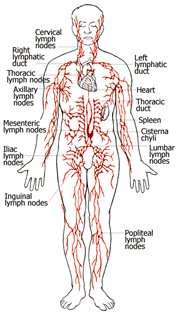
What is the Lymphatic System?
The lymph system is commonly referred to as the body’s sewerage system. It works by acting in harmony with the blood, surrounding every cell in the body and protecting each one by removing dead cells, blood proteins and any other toxins and excreting them from the body. The toxins are then removed from the body through our waste products, mucus, or our skin.
The body is hugely dependent upon the lymph system, to the point whereby if the lymph system was shut down for 24hrs you would die as a result of the trapped toxins and proteins surrounding our cells.
In addition to deep breathing, rebounding can be a further way to stimulate your lymphatic system.
The lymph that is collected around the body drains through two ducts into the blood, which are located at the base of the neck (around the thoracic duct). By breathing we stimulate the flow of the lymph, and through deep breath we can encourage the flow to be both cleansing and powerful. Once we breathe, the duct sends the lymph into our blood flow, then onto the liver where it metabolises and then onto the kidneys where the toxins are filtered.
Deep breathing is so important because, unlike our blood flow, the lymph system does not have a ‘pump’ to push the lymph fluids around our bodies. Rather, the lymph system requires the muscular movement which is created by breathing.
As well as acting as a filter, the lymph system is also able to destroy bacteria, viruses and abnormal cells, such as cancer cells. So enough of the anatomy lesson, lets talk abou how we should breathe. Here is an excersice that I want you to try.
Breathe In the Following Ratio
Breath in for 1 count
Hold for 4 counts
Breath out for 2 counts
for example – if you were to breath in fo 4 seconds,then you hold your breath for sixteen seconds and then breath out for eight. If you are able to do this ten times, three times a day (morning, evening, and before bed), you will see a huge difference to your energy, clarity and your ability to ward off illness.
This is why runners, yoga enthusiasts don’t get sick that often.
So pratice your breathing, work it into your pre-shot routine. Go have fun and I can promise you that you will be cool under pressure and finish off that career round.
Feel free to share this blog if you find it helpful by hitting one of the social site buttons below. Leave a comment as well
See you on the lesson tee and don’t forget to, well you know,
Stuart Mackenzie: I’m not kidding, that boy’s head is like Sputnik; spherical but quite pointy at parts! Now that was offside, wasn’t it? He’ll be crying himself to sleep tonight, on his huge pillow.
I know, I know, I’m a freak…….(crickets) but I had to post that for those of you who didn’t get the original title, laughing now? The average adult head weighs about 15-21 pounds, so you better be careful as to where it goes during your golf swing.
Yesterday I posted a blog on different style body pivots and head movement. Thank you for all the comments that I received from coaches and friends. This is a great discussion topic that could go on for a while. What are the pros and cons of each style (a 2 pivot point move) or (a neutral, centered approach). Once again the genius in expert teaching is for the coach to design a pivot and a style that works for the student and not fit the student to the style or method. A lot of golfers cannot fit into a centered pivot due to physical limitations and immobility in their hips and lack of rotating ability. So we have to allow them to move off of the ball a bit in order to gain sufficient power. This puts a huge importance on training the hands and arms to create speed and an impact position that can allow them to hit the ball first and reach low point. There are many more factors that we could discuss that could affect these things (ball placement, set-up, posture, swing shape etc.) that we can save for a later time. In the meantime, since I didn’t have time to do a Guru TV episode this soon, I got permission from my friend and mentor, Chuck Evans to use a few segments from a webinar that he did that demonstrates this topic perfectly. Leave your comments below and thanks for all your feedback as I am learning so much from all of you. I am evolving as we speak. Enjoy the video.
Remember: Everything we teach is borrowed or stolen from our teaching ancestors, communicate it clearly and watch the language that we use. Be careful of what you ask the student to do, they might just do it – Manuel DelTorre
follow me on twitter @twitter.com/onplanegolf or friend me up on facebook.com/onplane golf
Something that I have been thinking a lot about lately as I have been giving hundreds of lessons is lOW POINT, HEAD MOVEMENT AND BODY PIVOT. As not to make this a full on debate amongst coaches (although that would be ok), I want to give the students a few ideas about how to improve the consistency of your contact. When we talk about the low point in the golf swing, we are referring to the bottom of the swing circle, just before it starts to elevate up and to the left. This point is typically even with your lead shoulder. This is why when you see a good player take a divot, it is usually 2 to 4 inches long on the target side of the golf
ball. If you are hitting the ball fat or thin, then your low point is not
as it should be so we have to look at a few areas that might give us
some insight into why this is happening. I am going to attempt to convey this in an understandable way for as I have alot of thoughts on this matter. Understanding is the easy part for most, it is application and what to apply that golfers struggle with. So question becomes: Should the head move in the golf swing? If so how much? How does the body pivot affect this idea? and Does head size make a difference? That was a joke.
HEAD MOVEMENT
Early in my teaching career, I must have picked up a Jimmy Ballard book and read it (the 7 common denominators) because I allowed my students to shift there weight behind the ball, then turn, shift back to center and swing. As I have seen this method work for many players over the years. Rocco Mediate, Hal Sutton etc. It seems to require a lot of timing. So in the last 10 years, I have allowed no more than 1 half a head to the right as my guideline. To clarify what we mean by head movement: typically most teaching pros will draw a box or a circle around the head when looking at video. Any side to side or up and down motion will be easy to see when this is done. As I have been studying the teaching methods such and “stack and tilt” and “The Golfing Machine”, they like to see the head stay centered. The golfing machine calls it “the tripod”. I always struggled with this idea because I thought it changed the spine angle too much in a reversing manner to achieve an on plane downswing or to create power. After studying massive amounts of video on players that adhere to these methods I found that it these things were achievable. As long as lower center (naval area) is slightly ahead of upper center (sternum) you can find achieveable plane. You just have to have the right components in place. In order to keep your head completely still or might I describe as “steady”, you must keep your shoulders rotating on top of your hips and a bit steeper than normal. The right hip absolutely cannot slide to the right at all or you will get a reverse spine angle. I more lateral move off of the ball might have a flatter shoulder plane. So which is the right way? I think it depends on the students characteristics and athletic ability.
I asked my friend and top 100 teacher, Chuck Evans about head movement and he said,”it must stay still, period. I then asked if it does move, does that change low point and the answer is absolutely. If you head is too far behind the ball, then your left wrist becomes low point. What percentage of golfers, your students, you, yeah you……….have a bowed left wrist at impact? Not as many as we want to admit, right. It can be more on top of the ball and still work. So this makes the head steady idea make sense to me and has helped my students improve their contact even if impact isn’t perfect. When I move a player into a steeper shoulder plane with a steady head, the first reaction is it feels like a reverse pivot. When I show them on video that they still have a neutral or slightly tilted spine away from the target, they understand. The player with too much head movement to the right will feel this way because it is a big change. When they hit that first shot more solid, they buy into it pretty quick. I will hook up some video examples of my students to help make sense of all this.
MATCHING COMPONENTS
I have always been fond of a lower, flatter arm plane but have some students with high hands if they show the ability to successfully drop the club on plane. When you work with a more neutral pivot, to avoid getting too steep on the downswing, your arm plane should be a little flatter. If you tend to move off of the ball and tilt your spine more away from the target on the downswing, you can use a higher hand position. It is all about your ability to consistently find the plane line and low point that is important.
STEADY BUT NEVER IN FRONT
I think we would all agree that we don’t like to see the head forward of its original position at impact. This typically causes a loss of lag or club head throwaway. Another reason a steady head might be easier. If you shift too far off the ball, you must shift forward to recenter and could slide too far in front.
So in conclusion. Everyone wants more distance. If you load up on your backside and coil, you might give yourself a chance to hit it farther but you might sacrifice a consistent low point and your contact will suffer. I have found that for most players, SOLID CONTACT IS WAY MORE IMPORTANT. I have a saying,”Speed without contact is useless”. Think about it. So if you are struggling with solid contact, try a more neutral, head centered pivot and I think you will find that ever illusive LOW POINT and might even take make a target side divot. I will do a video on this in the near future that will help explain better. I hope this made sense.
P.S. remember these swing ideas are examples of A way to swing a golf club not THE WAY….Good teachers have a few tools, great teachers have MANY.




 The Golf Guru Show