Guru TV (Archive) – The Back To the Target Drill
September 26, 2011
Still one of my all time favorite drills for fixing an out to in downswing. Enjoy and new episodes will be back very soon
See you on the lesson tee,
Jason
Still one of my all time favorite drills for fixing an out to in downswing. Enjoy and new episodes will be back very soon
See you on the lesson tee,
Jason
Here is a great video that I found from the Dave Phillips (TPI Instructor) about the pelvis and early extension. Those of you who have worked with me know that I always draw a line on your rear end to check for early extension (or your hips moving inward toward the ball). This is a difficult problem to fix because most of the time it is physical and not model driven. This is a big problem for amateurs because it limits the space between the club and body in the downswing and causes all sorts of impact problems. If you tend to push, hook or scoop at impact you are most likely trapped because of this issue. Make sure you get tested by a certified T.P.I. professional such as my guy, Mark Kane @www.kanetraining.com to see if you need to work on this all important area of the golf swing to improve your ball striking.
See you on the lesson tee,
Guru
On todays show, I field two great questions from my blog. The first one from Nick Chertock about how to get students in posture. Special thanks to my student, Mike Meyer for assisting me although he didn’t do a very good job of portraying poor posture (he is just that good) Recap the three ways to put a student into posture:
and the second question from Bill Shafer from England about club face control.
recap:
This is what it is all about, getting you the information that you need to improve your golf games and that is what I love to do. Leave a question in the comment section and let’s keep it rolling. You can ask me about anything and I will give you the answer via video or text.
See you on the lesson tee,
Jason
I know many of my students have heard me talk about the D-Plane and why it is important. The cool thing is that many of you understand it. I had a 13-year-old junior that know how to work the ball now because of D Plane. As a student you need to have a general understanding of why the ball flies the way it does. As an instructor my job is to help you change your pattern to get the desired ball flight that you want. Some of you have asked me what I need to do to work the ball in both directions and this usually opens up a discussion about “The Descriptive Plane” or 3D ball flight. I usually pull out a couple of sticks or my monster wedge and try to explain it in a fashion that anyone could understand. There is so much more to it than just the path and club face relationship that is hard to explain (angle of attack, friction, spin loft etc.) and also impossible to see without a trackman to give you the exact numbers. As coaches we do our best to read ball flight, match it up with what we see with our internal high-speed cameras (our eyes) and then look at it on camera in slow motion to decide where to start first. The understanding of D plane principles has helped me to read ball flight better, diagnose quicker and help my students faster by changing their ball flight in a positive way. I have to thank my good friend John Graham (check out his site for more info) for our many talks on the subject and his videos that help explain this. I also have run across some other great videos fromBrian Manzella and this one from James Leitz that I would like to share. I know most of you have seen this but I never assume anything and think it can be useful for coaches and students. Along with some of my favorite videos I have included some pictures that might help paint the picture of the DPlane as well. Enjoy my montage and I am so grateful to all the great coaches that have helped me with this subject as it has taken my teaching to a new level.
To understand your golf swing is to understand ball flight. I know your head is spinning right now so you must come to the lesson tee and I will explain it live.
Check out our website @ www.danarader.com or call 704-542-7635 to book a lesson with the Guru.
Follow me on twitter @www.twitter.com/golfgurutv or friend me up on facebook at www.facebook.com/jasonsuttongolf
See you on the lesson tee,
Jason
Special thanks to everyone who has supported Guru TV the last two years. As a tribute to my most popular video, I wanted to repost it for those who haven’t seen it. This is called “How To Drive a Golf Ball Straight”. Guru TV will be back shortly. I am putting together some new ideas and am looking forward to sharing my ideas that will hopefully make you a better golfer. Always feel free to leave a comment or an idea that you would like to see on the show in the future.
For more information check out our website @www.danarader.com or call 704-542-7635 to schedule a lesson with the guru.
See you on the lesson tee,
Jason
When the head rotates in response to a toe-hit, the ball slides, then rolls, sideways across the face from the toe toward the center of the face. This causes the ball to leave the face with a hooking or draw sidespin. Conversely, when the head rotates the other direction in response a shot hit off the heel, the ball slides, then rolls, sideways across the face from the heel toward the center of the face, which causes the ball to leave the face with a slicing or fade sidespin.
The reason all woodheads are designed with a horizontal curvature across the face (called “bulge”) is because of the gear effect. If shots hit off the toe generate a hook or draw curvature, the face needs to be radiused (curved) horizontally so the toe shot will leave the face angled to the fade side of the target. Thus the bulge radius causes the ball to start off more to the right (for a right-handed golfer; or to the left one a toe shot by a left-handed golfer), after which the hook spin generated by the gear effect takes over to bring the shot back toward the center of the fairway.
For shots off the heel, the bulge radius across the face of the wood causes the ball to take off to the left (for a right-handed golfer; or to the right from a heel shot for a left-hander), after which the fade spin generated by the gear effect takes over to bring the shot back toward the center of the fairway.
The presenter was telling a story about a player who was swinging 4 degrees from the outside with a 6 degree shut club face and was hitting a PULL FADE! Doesnt make sense, right. Until you check the contact point. The player was hitting the ball extremely on the heel of the driver which made the ball curve to the right. (Gear Effect). I don’t give a driver lesson now without a piece of face tape so I can see where the ball is contacting the face. After studying some of the best drivers of the golf ball, I have noticed a couple of observations.
1. Many PGA Tour pros address their driver closer to the TOE of the club. A few notables include: Zach Johnson, Dustin Johnson, Kenny Perry, Trevor Immelman, Jason Sutton (hacking teaching pro, sorry) and many others. Now I know there are many that don’t but bear with me.
2. Set-up distance from the ball (hands to body distance) is larger. The hands tend to hang out from the body and under the eye-line. Where iron set-ups, the hands tend to hang below the shoulder sockets. Here is my theory on this……..
Guru’s Theory (inconclusive): since the physics of the driver swing is flatter by nature, the arms will tend to swing out and away from the body as they get back out in front of the body which throws the club a little farther away from the player than it started. I know in most golf swings, the hands rise up through impact as well. This leads us back to our distance from the ball.
The Punch Line: If the golfer is standing too close to the ball and assuming that they are swinging on a shallow plane/path (in to out)……They will hit the ball in the heel. Even if you are swinging out to the right, the ball will still fade which drives alot of golfers crazy. This is why it is important to check your contact point as well as your swing mechanics and adjust your distance from the ball accordingly. I gave a lesson to a guy the other day that had a very nice pattern, could hit his irons with a beautiful draw but struggled with his driver. I merely moved him 2 inches farther away from the ball and his fade turned into a draw……coincidence ( I don’t know). Just some food for thoughtbut these are the things that keep me up at night. I am just looking for the truth and I appreciate you for reading.
If you feel this was helpful please use one of the share buttons at the bottom. Check out our website at @www.danarader.com and follow me on twitter @twitter.com/golfgurutv
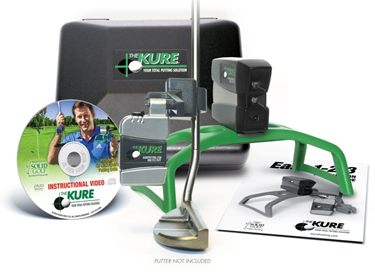
Well GURU nation a conspiracy has been under foot. It seems a certain golf instructor had passed along a gift wish of mine to Santa (a.k.a the wife) this year. I am now the proud owner of the KURE putting system and I must say they did a great job of keeping it a secret. I was certainly surprised. I know a lot of you out there have been curious about this device so I thought I would share my experiences as I work with the KURE over the next week. I will give you both the good, bad and the ugly so to speak.
Day 1.
Just unpacked the KURE inspected it and installed the batteries that were provided. The KURE comes packaged in a nice little plastic case that houses the KURE putting system and a short instructional video featuring Sir Nick Faldo and Mike Shannon from the Sea Pines resort. Mike gives the promotional side with Sir Nick covering the use and providing some drills to use. This video is NOT a putting lesson it just covers the basic use of the KURE and its benefits.
The KURE system itself consists of 3 components.
First is the “Target Module and Stand”. It is powered by 3 AA batteries (included). The stand is 4 legs and the module sits on top of the stand. When assembled it resembles a spider that sits over the hole or the target of your choice. Going forward I will refer to it as “The Spider”. Second is the “Aiming Module” this is a lightweight plastic part that attaches to your putter shaft. It is powered by one of the small coin batteries (included). The last component is a small “Laser module” It is powered by 2 AAA batteries (included) and clips to the Aiming Module after it is attached to your putter. The module outputs a laser so you can precisely align the aiming module square to your putter face.
Setup
Setup is straight forward and took about five minutes the first time. I can easily be done in about minute once you understand the basics. The only issue I had initially was the laser module did not turn on. A set of fresh batteries were installed and that took care of the issue.
The KURE in action.
Before we get to far into the actual performance of the product. Let me clarify the basic use and feedback of the KURE. The aiming module (after attachment/alignment to your putter shaft) has a small green light built into the top of it. This green light provides feed back on your head/eye position. If your eye is directly over the target line the light will show bright green, as you move your head off the line the light will actually appear to blink then grow dim the further you eyes get from the intended line. The Target Module or “Spider” has light two lights in the front of it. A yellow light and a green light. When your putter face is correctly aligned the yellow light will turn on to let you know you are correctly aligned. The green light comes on after you stroke the putt if the putter face was square to the target at impact. So the sequence goes something like this. Step into your address position and line up the face so the yellow light will come on (it will stay on as long as your putter face stays in alignment). Double check the green light on the aiming module to verify eye position. Make your stroke. If the Green light on the spider comes on you know that your stroke resulted in a square putter face at impact.
OK here we go with a real try at using the KURE. First let me say that currently my misses with the putter are almost always to the left. “Crap I pulled another one” is usually heard a lot during my rounds of golf. Anyway I set up a small target in the living room, placed the spider over it, dropped 1/2 dozen balls on the carpet 7-8 feet away, got into my address position, aimed the putter at the target and…….I did not get the yellow conformation light. Heck I say… The hole is only a couple of steps away so I back up, reset, and move back into the ball, aim the putter and……still no yellow light. This time around I rotate the putter until I got a yellow light and guess what. I was originally aimed ~3 inches to the left of my target. I repeated this a couple more times to confirm and sure enough I was consistently aiming left of my target. So now I move my body around until the yellow confirmation light came on and WOW I felt like I am aimed way to the right of the target. Now I am in denial, as I honestly did not believe I could be that far off on a putt of that length. So what do you think I did next?….Still in denial I re-checked the alignment and placement of the aiming device on the putter shaft because THAT had to be wrong. It was not. Still in denial I went back and re-tried addressing and aiming the putter….with the same results as before I was still aiming left of the target. Still in denial I enlisted the aid of a lovely assistant (my wife). I had her aim the putter face until she got a yellow light and I laid down on the floor behind the putter to confirm that it was aiming at the target and guess what???? It was aimed directly at the target::: 🙂
I am not in denial anymore…..I can say it now…..I have not been aiming the putter where I thought I was. I have run out of time for today’s session but I will be back tomorrow and pick up where we left off today. Just a final thought ,maybe, just maybe those putts that I was “pulling” were not getting pulled after all…..
Best,
Alan White
See you on the lesson tee,
Jason
Thanks for joining me on day 3 of 20 days with the Guru. Today I have hooked up a small segment of one of my lessons that includes a live look at how “The Claw Drill” will help improve your impact position. Here is your 3 step release program that will help you with that scoop or flip
1) 25 left arm only swings with an 8 iron off of a low tee
2) 25 Claw drills with an 8 iron off of a low tee
3) 25 3/4 punch shots until you can control the shaft of the club through the hitting area.
I hope you enjoy the video and a special thanks to Eric Ballard for allowing me show off his golf swing and my drill. Please leave a comment below, thanks and enjoy the claw.
Follow me on Twitter @ twitter.com/onplanegolf
See you on the lesson tee,
Guru
I feel like I am in a bit of a golfing rut. Writers block as they say. The problem isn’t the lack of ideas, it is too many ideas to choose from. So in an attempt to get some blogging 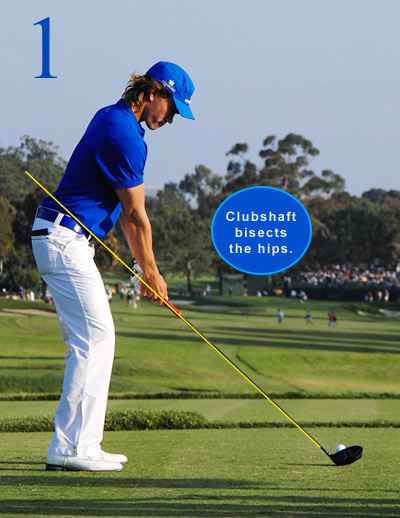 “FLOW”, I will be writing a tip, idea or whatever is on my mind for “20”, yes “20” straight days. The golf channel has 12 days at the academy…I have twenty days with the guru. I will attempt to educate you and entertain you as only my warped little golfing mind can do. So here is your idea for the day………………Understand the golfing instrument. “the club”
1. The club face, the club head and the club shaft all make up the tool that we use to propel the ball at the target. There are many methods, styles and ideas on how to create an efficient golf swing but it doesn’t matter as long as you adhere to the physicality of the way the club is built. (now it is up to you and your coach to figure out which one works for you). No matter what you are trying to do, there is no debating that there are two things the club must do to direct the ball in the manner that you wish.
1. Swing on a tilted “circle” on or parallel to the angle that the club rests on the playing surface “the ground”.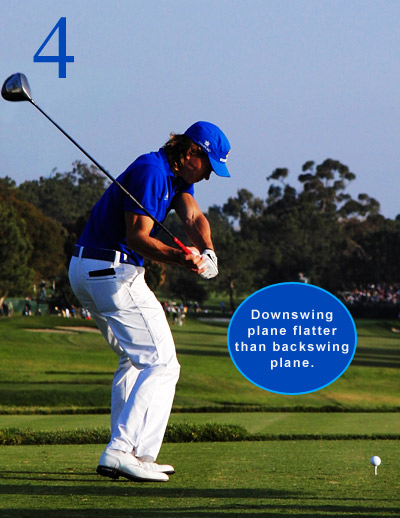
AN EASY WAY TO UNDERSTAND PLANE: The 5 Parallels
Assuming a stance that is square to the target, the club should be parallel to the target line at waist-high (1), parallel at the top of your swing when the club is perpendicular to the ground (2), parallel to the target line at waist-high on the downswing (3), parallel to the target line at waist-high on the front side (post impact)’(4) parallel to target line at three-quarters in the follow through.(5)2. Club face should be slightly open to the target line at impact and the ball should be struck on the inside quarter. The face of the club is only square a split second as the ball separates from the face.
3. The shaft of the club must lean towards the target in the impact zone as this is the key to compression and solid contact (also is the way the ball gets airborne).
For you expert golfers out there, you would be surprised at how many golfers don’t know these key physical basics of how to use the club, so bear with me as I never assume that my students or my audience knows anything……like a shanker that thinks he is hitting the ball off the toe of the club so they stand closer to the ball……what?
As we approach the winter season, get your golfing area in your house that will allow you to do some mirror work. I will expand on the importance of indoor practice as we move towards Christmas.
This is the best time to take a golf lesson because you aren’t playing as much so you are more likely to commit to a swing change. Stick with me and we will get an improvement plan in place.
Follow me on Twitter @ Twitter.com/onplanegolf
Until tomorrow,
Guru
 The Golf Guru Show