P.G.A. Merchandise Show Review ’11


As the 2011 PGA Show comes to a close, I wanted to reflect and give my experience from my week in Orlando. For those of you, pros or just avid golfers alike, you must go at least once to see just how massive this things is. I heard on the radio that if you walk all of it, you will have clocked around 10 miles. I walked every bit of it and some of it several times so I definitely got my exercise. I think that this was my best Show that I can remember and I am going to tell you why. As I have posted in some previous blogs, the main reason that I go is to get around people who I find interesting and that I can learn from. The gadgets and products are great and I will get into that but it’s the people you meet and spend time with that make the trip a success. I will break this down diary style since my laptop has currently died and didn’t make the trip or I would have been blogging as I go like my good friend John Graham http://www.johngrahamgolf.com).
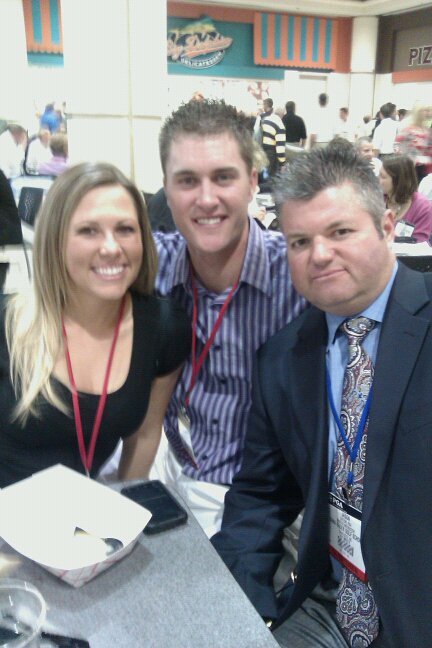
Sara Brown, Derek Radley and Me

Thursday (Day 1): Twitter has definitely made the world smaller and has allowed me to meet some great people along the way. The day started out by meeting up with Jason Helman (jasonhelmangolf.com) my friend and teaching pro from Canada. We walked the show for most of the morning to check out the new gadgets in the world of teaching. We met up with my good friend Derek Radley and his girlfriend Sara Brown (big break star and Rookie LPGA player), We had some lunch with her dad and the commisioner of the Futures tour. It was like walking around with a rock star as everyone recognizes Sara from TV.  After a great meeting with my Callaway rep, Tim Garrett,  to order my new clubs for the year, I ran into Rob LaRosa, Head Professional from Sterling Farms CC. We then made our way over to the Aimpoint booth to meet up with John Graham (@johngrahamgolf). We all walked over to the Swinkey training aid booth to
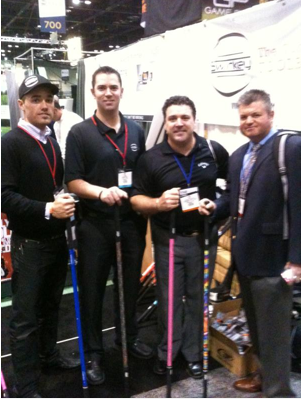
Swinkey Time

meet the boys http://swinkey.com and discuss the product and take a few pictures. So day one was just feeling out the location of the stuff we were interested in and meeting a few of the tweeps. After the show is when the good stuff happens if you are there. For those that follow me already know about the TWEETUP. This is a gathering of guys and girls that know each other on twitter. John Graham was nice enough to put it all together so about 30 of us met at Millers Ale house that night. Here is a list of some of the guys that I met:  David Wurzer, Jason Helman, Dan Carraher, Ricky Lee Potts, John Randle, Dennis Sales, Claude Harmon, Joe Hafera, Nick Clearwater, Sean Lalley, Rich Hunt, Todd Halpen, Bobby Siravo, Jamie Donaldson, Mark Sweeney, Bernie Najar, Ralph Perez, Andrew Lewis, Sara Dickson, Kirk Oguri, John Dochety, TJ Yeaton and Mario Bevilacqua. I wish I could have spent more time with everyone but I managed to get an idea of everyone’s teaching philosophies and backgrounds just by observing and listening to their conversations. I apologize for not taking more film as this one would have made a great reality show and surely would have went viral in an hour, but didn’t want to make anyone uncomfortable. I wish I would have taken pics. I was so busy talking that I forgot to eat.  No one got hurt although Doc (John Dochety) almost hit Ralph (gotham golf blog) with a front side chop as they battled over a #4 accumulator discussion. At the end, they hugged it out and we all made it home safe. I thank all of you for being willing to share all of your brilliant golf info so freely as this is what is going to help our industry grow and make us better coaches. It was great to finally put some of the names with the faces (and twitter handles) together. I also got to spend some time with two of my mentors and top 100 teachers, Chuck Evans and Charlie King which was great. I always learn something after spending time with them. I ran into new top 100 inductees, Charlie Sorrell and Mark Steinbauer and congratulated them on their accomplishment.
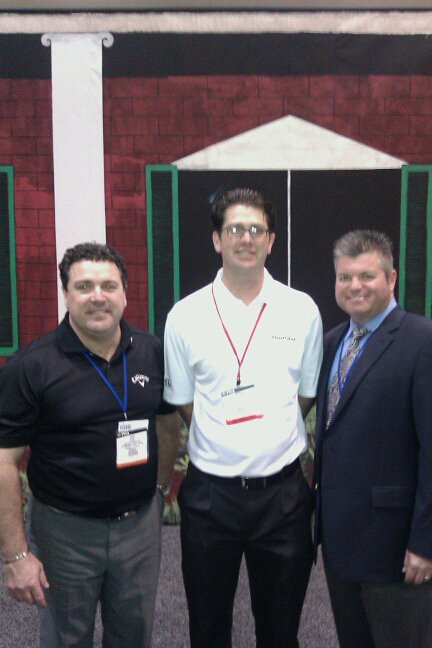
Jason Helman and John Graham at the show

Friday: The day started with checking out and getting more info on training aids. I know you all are waiting on my reviews so you can run out and buy or hopefully take a lesson from me. I will be doing video reviews as I get to use them in the coming months but here are my list of aids that I found interesting:

1. Swinkey (www.swinkey.com). One of the most versatile aids on the market for sure. I saw many swinkeys in the hands of people walking around the show so I think Todd and the boys did well. I highly recommend this product for any serious golfer who wants to improve. I would do a video review on it but unfortunately I don’t have an aid. I think I will check with Jim McLean and borrow his as I heard he got one for free, (just messing with you Todd). It was great to meet Disco Stu as well, he made his way around the show displaying the product with his cool World Cup jacket on. (great idea by @jasonhelmangolf) This company has a bright future for sure. Right On!

2. The Medicus Vision Stick: (www.medicuscatalogue.com) Endorsed by my good friend Chuck Evans and I look forward to using this one for path and low point training

3. Tour Striker: (www.tourstriker.com) Not a new product but I picked one up because I love the idea of helping players with impact and forward shaft lean. You have probably seen the infomercial on the golf channel.

4. Power Lag + Flat Wrist Pro (www.Powerlagpro.com): This is a devise that fits on your lead wrist and the back of your trail wrist to help feel the correct angle on your downswing. Developed by Sam Shah who invented the pivotpro. I will let you know how this works

5. The Perfect Release: (www.perfectrelease.com) An interesting aid that Martin Hall used on his first show on the Golf Channel. It is a bungee cord that connects your trail arm and the club shaft.

Possible candidates:

1. Drain-O Instant Pro Putting Fix -(http://www.drain-o.com/). A putting path aid made up of two tripods and a curved wire. I did shoot some video on this one. Might get one in the future.

2. Putter Master (www.puttermaster.com): A bar that is positioned across the wrists and helps keep your forearms square.

So the day ended with the an excellent putting seminar with my good friend Todd Sones and he was joined by Mike Shannon, the putting instructor from Sea Island. These two guys and who I learned how to teach putting and I always learn something new when spending some time with them.

Saturday: Last day at the show concluded a great week. I caught up with my new running mate from Ontario, Jason Helman and we caught a couple of short seminars on the main stage. I enjoyed the one with Suzy Whaley and her junior golf program with stations and fitness games that got the kids excited. Definitely the wave of the future of junior golf. Creating young athletes and then teaching them to play golf. I hit some of the new Callaway equipment on the trackman which was pretty cool. It got me excited to get back and play some golf when it warms up. Mr. Helman and I met John Graham and a friend for dinner to spend some more time before the week ended which was cool. I got back to the hotel and thought my night was done and then it happened. I get a call from TJ Yeaton, John Dochety and Mark Walder and we realized that we were staying in the same hotel so we met for drinks. For the rest of the night I was schooled in the world of Mac Ogrady’s MORAD system and some great stories about their experiences as only doc can describe it. You will be hearing from these guys as they are some of the brightest golf swing professors that I have ever met. There is so much more that I could tell you but you will have to get that from me on the lesson or a phone conversation. I want to thank Jason Helman for putting up with me all weekend and John Graham for allowing me to meet so many new friends. Let me know if I can do anything for any of you as I am in debt to you all.  What a great way to kick off the season.

Share this with someone and follow me on twitter @twitter.com/onplanegolf

To work with me at the Dana Rader Golf School call 704-542-7635 or visit our website @ danarader.com

See you on the lesson tee,

Guru

Playful Learning Part 2 – Teaching vs. Coaching


In the midst of another P.G.A. Merchandise show, I think for those who don’t participate just don’t know what they are missing. I enjoy seeing the new products and gadgets but that is not why I attend. I make the trip to Orlando to network with other professionals and friends in hopes to find a few nuggets or ideas that will help me guide my students when I get back. My students can’t wait for me to get back because I always have some great information and stories to tell that will enhance their golf games. Information is not just going to jump in your lap. It is not going to knock you down and crawl all over you. You must be a seeker and sometimes it takes courage to learn something new because we are all afraid of being wrong. For all you zen lovers, “You must be an empty cup”. I have attended the top 100 Golf Magazine party with my boss for the last 7 years and I always set a goal to meet a new teacher that I admire and be prepared to ask an intelligent question when you get that opportunity, because it could be a small window. This takes courage (and maybe a few glasses of wine,shh!). Your networking moment may happen when you least expect it. Here is a story: Last year an editor friend of mine asked if I would stop by the Cricket of Arms” pub for a pint because he wanted me to meet his good friend, Craig Shankland. For those of you who don’t know Craig, he is a legend in the teaching and playing game. Top 50 teacher and just a great guy.  In the first five minutes he could tell how passionate about coaching that I was and he was gracious enough to share valuable information about his teaching and great stories about his good friend, Moe Norman which was priceless. We talked for about 2 hours over a few pints of Guiness and it  was awesome. I shared with him my goals and this was the two pieces of advice that I received:

1) Keep writing as much as possible because that is what keeps your ideas fresh and your brain thinking and growing.

2)Pay attention: MAKE YOUR PLAYERS MULTI-DIMENTIONAL (He is very old school and teaches many LPGA players). He said that you have to be able to adjust to every lie and can’t fall in love with just one swing plane. He doesn’t use video very much and takes his students out on the course for the majority of the lessons to greater prepare for all of the different shots that make up a round of golf.  (The Ultimate In Coaching)

The time I spent with Mr. Shankland was the highlight of my trip for sure so keep your eyes open for opportunities for learning and growing. I will be forever greatful for the time that he spent with a nobody teacher like me. I hope that someday I can be that person sharing all that I have learned to a young, hungry professional.

To succeed as coaches we must be versitile and know when to teach and when to coach.

Here are some quotes from Tiger Woods. Maybe he needs to reread these to get back to the days when he was free to self-discover.

“My lie dictates the shot I will play”

“I always listen to my body”

“Some days when I warm up I am hitting the ball low, other days I am hitting the ball high. some days the ball is drawing, other days it is fading. i just play what i am doing that day”

“Today when I practice I like to play games-in fact I like to practice more than play on the course. I still try lots of different things, just like I did with my Pop”

“We always practiced together seeing who could make the most 5 foot putts”

“As a child the club and the ball became my playmate”

“Ultimately golf is a journey-full of learning and discovery”

“On normal shots, I swing 75% of my power, on longer shots I swing at 90%. If I go all out, I do not make solid contact-which is most important.”

“There are no shortcuts- golf requires patience and perseverance, with a yearning for learning. Accepting the fact that it is a game of ups and downs and learning every time you play”

“when I play-it is almost as if I get out-of-the-way and just let it happen. I let it happen, I do not make it happen.”

“I won 12 times in the year 2000, including 3 majors and I only remember hitting one shot I would call perfect. It was the 3 wood on #14 in the third round of the British Open at St. Andrews. AS with every shot I attempt, I visualize that ball flight and the shot turned ou exactly s I had planned. Moments like that stay fresh in my mind, providing a positive image for future reference.”

“I will always be respectful and gracious to opponents-but I want to win, to beat you by a lot, to beat you bad.

I look forward to hearing about your P.G.A. Show learning moments. What are you waiting for……GO FOR IT!

Follow me on twitter @twitter.com/onplanegolf or friend me up on facebook @facebook.com/jasonsuttongolf

See you on the lesson tee,

Jason

Are You Getting The Most Out of Your Workout? Get Out Of the Box!


As you know I work hard on my fitness. I am a big runner and recently completed my third marathon this past October (Chicago Marathon). I am not fortunate to have a very high metabolism, so i have to work hard to keep my weight down and to stay fit. I gain weight by just looking at a chocolate chip cookie. If you are one of those guys that can’t gain weight, I hate you, seriously.  One of my goals this year, to help improve my running and my golf is to get stronger in my core and upper body. My next race is the New York Marathon in November so I have time. If you are not getting the results from your workouts, you probably need to mix it up a bit, get out of the box. So I started doing my research and I think I found exactly what I have been looking for. This is my 2011 fitness routine as demonstrated by a PGA tour player.

Hahaha! Gotcha! It can’t be all serious, right. Who would have thought that
Ben Crane had a sense of humor.

Follow me on twitter @twitter.com/onplanegolf

I will be back soon with a serious post, but until then…….best of luck with your workouts and I hope you laughed today

See you on the lesson tee,

Jason

What Can I Do For You?


Welcome to your full service golf information blog. If this is your first day viewing my blog, welcome to Guru Nation. For those of you who follow me, thank you and let’s get busy on making this upcoming golf season the best ever. I have my goals in place and am very motivated to help as many golfers that I can with their games and also help coaches with information that will enhance their teaching. Some of my projects for the upcoming year include: authorship, improving my video/tv quality (Guru TV), writing for magazines, speaking appearances and blogging of course. I spend a lot of time trying to figure out what my audience needs and what they might want, but it is a guess at best. I frequently get the question,”Guru, how do you come up with all of your ideas that you blog about?” Most of my ideas are formed by my students that I work with on a day-to-day basis. My experience on the lesson tee is priceless. I learn something new every week that I spend talking to and helping people. So, In an attempt to achieve my 2 goals for this blog 1) to educate my readers and help your golf game and 2)grow my readership in order to reach more people so I can affect their golf games and their minds. SO I NEED YOUR HELP. Here is my charge to you, yes you.

1. TELL ME WHAT YOU WANT TO SEE IN THE WAY OF POSTS AND OR VIDEOS

2. TELL SOMEONE ABOUT MY BLOG. SHARE THIS BLOG WITH AT LEAST 3 OF YOUR GOLF FRIENDS THAT YOU THINK WOULD BENEFIT FROM THIS INFORMATION

Whether it is players or coaches, let’s get some dialogue going and help me bridge the gap between learning and getting RESULTS, which is the goal of every player or coach.

I look forward to hearing from you and I ask you again

WHAT CAN I DO FOR YOU?

Follow Me on twitter @twitter.com/onplanegolf or friend me up on facebook.com/onplanegolf (Jason Sutton)

See you on the lesson tee,

Jason Sutton

704.542.7635 or danarader.com

The Kure Putting Chronicles, Day 3: A Diary Of A Passionate Golfer by Alan White


Good afternoon Guru Nation
Here is day Three’s installment with the KURE.

Today’s session began as normal for me. Double checking the KURE. I have not removed any components since the initial setup and after today’s check-out the KURE is still spot on. I started the session where I left off yesterday, using the “rock in” to check out my initial aim as I set the putter behind the ball. The results were a little better than yesterday. I did 3 reps of 10 tries and went 6,7,7 of ten. Still not where I want to be, as they say “old habits die hard”. The thing that still shocks me is how hard it is to line up the putt correctly after doing it wrong for quite some time. To me this is quite different from making full swing changes. In a full swing change things FEEL a lot different. Using the KURE things LOOK a lot different. The eye/brain just does not want to co-operate.

Today’s “General Discoveries” will focus on how the KURE is different from other putting training aids that I have used. I have used many aids in the past. Chalk lines, stretched strings, the eye-line mirror, plane board, etc. so I have some experience with these aids. So how is the KURE different?
    
1.  The biggest difference I have seen so far is that the KURE uses no lines. Lets take the old standby, a chalk line. I have used a chalk line in the past with varied results. The problem I always had was if a line was present setting the putter down on the correct aim became easy. Heck that was a no-brainer, just follow the line right?. The same is true with the mirror board, strings and other. Regardless of how much I would try to “ignore” the reference line it was always there helping lead the way. Not so with the KURE. With the KURE you have to visualize the line then set the putter down with no “hints” as to what is correct. If you get the yellow light you are good to go. If not you can quickly check to see where you error was. This is some pretty solid feedback.

2. I listed this second but it is really a tie. The KURE gives you immediate feedback on the face alignment of the putter at impact. How cool is that? Short of video I do not know of another aid that gives you this information. If you get the yellow light, make your stroke, get the green light, the ball will be going to the target. Again pretty good stuff.

3. It allows you to experiment with some level of confidence. Ever wonder if using just your right hand to align the putter was better for you than using both hands? How about cross handed vs. conventional. I think that using the KURE would help in determining if the changes you are thinking about making or are actually trying to make are better. Think about it. If you can line up the putter correctly 10 out of 10 times using just your right hand and only 6 out of 10 times using both hands that would be good information to have.

4. The KURE uses batteries (3 types). My chalk line does not. Yes I know. In the age of laser range finders and GPS systems with fly-over mode batteries are almost as essential as a tee. But,,,,I still rue the day that drive to the practice range setup the KURE only to realize that a battery has expired.

In summary, the KURE is beginning to grow on me. Once you get familiar with it and think about the things you can do it’s pull becomes stronger. With the weather continuing to moderate the snow should melt by Tomorrow.  I hope to take it to the practice green and get some “real” experience with it.  

See you tomorrow.

Alan

Head Move (Or Not)-“So I Married A Teaching Professional” (Archive deux)


Something that I have been thinking a lot about lately as I have been giving hundreds of lessons is lOW POINT, HEAD MOVEMENT AND BODY PIVOT. As not to make this a full on debate amongst coaches (although that would be ok), I want to give the students a few ideas about how to improve the consistency of your contact. When we talk about the low point in the golf swing, we are referring to the bottom of the swing circle, just before it starts to elevate up and to the left. This point is typically even with your lead shoulder. This is why when you see a good player take a divot, it is usually 2 to 4 inches long on the target side of the golf
ball. If you are hitting the ball fat or thin, then your low point is not
as it should be so we have to look at a few areas that might give us
some insight into why this is happening. I am going to attempt to convey this in an understandable way for as I have alot of thoughts on this matter. Understanding is the easy part for most, it is application and what to apply that golfers struggle with. So question becomes: Should the head move in the golf swing? If so how much? How does the body pivot affect this idea? and Does head size make a difference? That was a joke.

HEAD MOVEMENT

                                                                                                                                                                           Early in my teaching career, I must have picked up a Jimmy Ballard book and read it (the 7 common denominators) because I allowed my students to shift there weight behind the ball, then turn, shift back to center and swing. As I have seen this method work for many players over the years. Rocco Mediate, Hal Sutton etc. It seems to require a lot of timing. So in the last 10 years, I have allowed no more than 1 half a head to the right as my guideline. To clarify what we mean by head movement: typically most teaching pros will draw a box or a circle around the head when looking at video. Any side to side or up and down motion will be easy to see when this is done. As I have been studying the teaching methods such and “stack and tilt” and “The Golfing Machine”, they like to see the head stay centered. The golfing machine calls it “the tripod”. I always struggled with this idea because I thought it changed the spine angle too much in a reversing manner to achieve an on plane downswing or to create power. After studying massive amounts of video on players that adhere to these methods I found that it these things were achievable. As long as lower center (naval area) is slightly ahead of upper center (sternum) you can find achieveable plane.  You just have to have the right components in place. In order to keep your head completely still or might I describe as “steady”, you must keep your shoulders rotating on top of your hips and a bit steeper than normal. The right hip absolutely cannot slide to the right at all or you will get a reverse spine angle. I more lateral move off of the ball might have a flatter shoulder plane.  So which is the right way? I think it depends on the students characteristics and athletic ability.

                                                                                                                                                                                                       I asked my friend and top 100 teacher, Chuck Evans about head movement and he said,”it must stay still, period. I then asked if it does move, does that change low point and the answer is absolutely. If you head is too far behind the ball, then your left wrist becomes low point. What percentage of golfers, your students, you, yeah you……….have a bowed left wrist at impact? Not as many as we want to admit, right. It can be more on top of the ball and still work.  So this makes the head steady idea make sense to me and has helped my students improve their contact even if impact isn’t perfect. When I move a player into a steeper shoulder plane with a steady head, the first reaction is it feels like a reverse pivot. When I show them on video that they still have a neutral or slightly tilted spine away from the target, they understand. The player with too much head movement to the right will feel this way because it is a big change. When they hit that first shot more solid, they buy into it pretty quick. I will hook up some video examples of my students to help make sense of all this.

MATCHING COMPONENTS

I have always been fond of a lower, flatter arm plane but have some students with high hands if they show the ability to successfully drop the club on plane. When you work with a more neutral pivot, to avoid getting too steep on the downswing, your arm plane should be a little flatter. If you tend to move off of the ball and tilt your spine more away from the target on the downswing, you can use a higher hand position. It is all about your ability to consistently find the plane line and low point that is important.

STEADY BUT NEVER IN FRONT

I think we would all agree that we don’t like to see the head forward of its original position at impact. This typically causes a loss of lag or club head throwaway. Another reason a steady head might be easier. If you shift too far off the ball, you must shift forward to recenter and could slide too far in front.

So in conclusion. Everyone wants more distance. If you load up on your backside and coil, you might give yourself a chance to hit it farther but you might sacrifice a consistent low point and your contact will suffer. I have found that for most players, SOLID CONTACT IS WAY MORE IMPORTANT. I have a saying,”Speed without contact is useless”. Think about it. So if you are struggling with solid contact, try a more neutral, head centered pivot and I think you will find that ever illusive LOW POINT and might even take make a target side divot. I will do a video on this in the near future that will help explain better. I hope this made sense.

P.S. remember these swing ideas are examples of A way to swing a golf club not THE WAY….Good teachers have a few tools, great teachers have MANY.

See you on the lesson tee,

Jason