In honor of his National award, Canadian Teacher of the Year, I thought I would re-air this Guru TV special. Now I can say that I knew him before he hit the big time. Congratulations my friend, you are the best. I can’t wait for the sequel. Also a rare appearance (on my lesson tee) from one of the most versitile training tools on the market, THE SWINKEY. Twitter building friendships at its best. If you are not on twitter, What are you waiting for?
On Wednesday April 13th, I will be teaming up with Golf Digest Top 50 Instructor and Golf Magazine Top 100 instructor, Todd Sones, for a full day scoring game school. The school will run from 9:00 until 3:00 and include lunch and impact golf school manual. You will learn all the shots from 30 yards and in including how putter fitting can help your stroke. This is a rare opportunity to work with one of the best short game instructors in the game today. The school will be held at The Dana Rader Golf School and the cost is $495.00 per person. Space is limited so call the school @ 704-542-7635 to sign up today. Here is a video of the types of shots that you will learn with Todd and Jason.
See you on the lesson tee. Only 7 spots available to call today 704-542-7635
In this video, I show one of the ways that I help to develop a better impact position with my students. Pay attention to the young man who does the demonstration as he is going to be a good one. His name is Aaron Walker. Please share some drills or ways that you help your students with this all important area of the golf swing?
Here is my latest Golf Illustrated Topic for my bi-monthly column and a short game Guru TV archive…..free of charge
Building an Expert Short Game
With the summer golf season approaching and golf course conditions beginning to firm up, a sound wedge and short game is paramount. The average golfer tends to struggle to pitch and chip when the fairways are tight or the ground is hard. If you tend to blade, scull or hit your short game shots fat, this is for you. Let’s look at some possible causes of poor shots around the green and then how we get you back on track. If you follow these guidelines you will be able to get the ball up and down from anywhere around the green.
Possible Roadblocks
1) The Wrong Philosophy – The number one error that golfers make is allowing the lead wrist to break down through impact. This typically starts with a flawed philosophy of how the ball gets into the air. If you allow the club head to outrace the handle, you will catch the ball on the upswing and blade it or hit behind it. Stop trying to help the ball into the air and let the club work the way it’s built.
2) Another misconception is that your body shouldn’t move during pitching swings. If the body doesn’t rotate, the club will outrace the rotation of the body and will arrive at impact improperly.
Keys to a Sound short Game
1) The RIGHT PHILOSOPHY – In order to hit solid short game shots, the club shaft must lean towards the target at impact. This is how the club is built. The lead wrist should be flat and the club head will be moving downward into the ball. This is how you put backspin on the ball which is a question that I am frequently asked.
2) Rotation of The Body Is Crucial – On the forward swing, the left hip, shoulders and chest must continue to rotate toward the target. This will allow you to maintain a flat lead wrist throughout as we discussed earlier.
Symmetry is the Key to Distance Control
Short game shots are nothing more than smaller versions of you full swing. Once you are able to hit your wedges more solid, now its time for distance control. Controlling distance is simply creating the proper length swing that matches the yardage that you want to carry. The backswing length and the forward swing follow through should match. For example: If your lead arm swing to parallel to the ground in the backswing, your trail arm should finish parallel to the ground in the follow through.
Strategy
Sometimes the hardest part about the short game is making the correct decision on what type of shot to play. My philosophy is to play the lowest shot allowable for the shot at hand. There are three types of shots (high, medium and low) the amount of green that you have to work with determines the height of the shot you will play. The more green, the lower the shot. The less green available, the higher the shot.
The 2 Variables
Once you have your shot planned, match your set-up to the picture that you have in your minds eye. The two variables that make up the set-up are 1) club selection and 2) ball placement. You can pitch with anything from a pitching wedge to a high lofted sand wedge. The ball position is critical to controlling the trajectory and roll of your shots. The closer to your rear foot that you place the ball (Subtracting Loft), the lower the shot will fly. The closer that you place the ball towards your front foot (Adding Loft), the higher your shots will fly.
Short Game Practice
1) Mechanical Practice – Working on your mechanics to improve your consistency of contact is the first goal. If you can’t create a solid strike then you can’t effectively work on distance control. When working on mechanics I suggest you set up a station which includes: sticks on the ground for alignment and a stick in the ground behind you for plane work.
2) The Median Drill For Measurement – Once your technique improves, this is how you can monitor your progress. Hit eleven shots to a flag. Remove the closest five balls. The “sixth” closest ball is your median or average distance to the flag. You can use this for any short game shot to measure your progress.
3) Practice for Play – Simulate the pressure that you encounter as you play on the course. Take 5 balls and hit your shots to the flag. Putt them in to see how many you can get “up and down”.
64% of all of your shots that you play during a round of golf are within 100 yards. Prioritize your practice accordingly. Improve you mechanics. Create consistent contact. Measure your progress. Follow this blueprint and you too can have a world class short game.
Follow me on Twiter @twitter.com/onplanegolf
To schedule a lesson with the Guru, call 704-542-7635 or visit our website @www.danarader.com
Refer to a previous post on body pivot and head movement. I don’t believe there is only one way to pivot your body. The neutral pivot tends to work best with shallow swingers with good flexibility and range of motion. Others that have steepening movements might do better with more spine tilt away from the target. It is up to the coach to decide which is the best for the student and what is easier for them to repeat and get the club swinging in the right direction and into the impact zone properly.
Leave a comment below and share with others if you think this is helpful.
See you on the lesson tee: 704-542-7635 to schedule a lesson
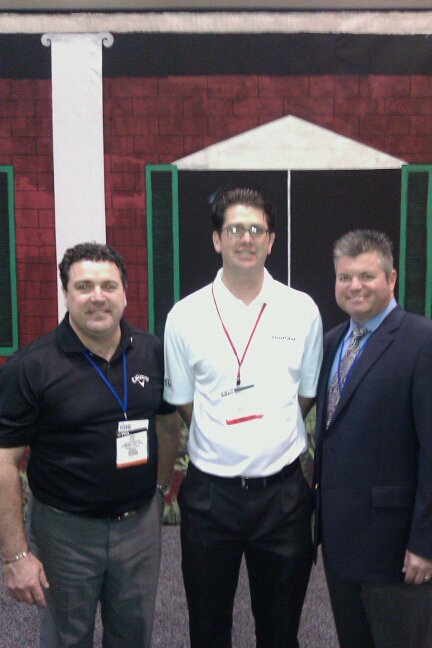
I wish I would have taken more video while at the show but was busy talking to people and gathering info. Here is a few clips to give you a glimpse of what to expect if you make it next year.
 The Golf Guru Show