Time To Get Your Groove On


With all the talk this weekend about” Groovegate” and some professional golfers getting called cheaters, I thought I would weigh in on this new groove situation. Do you understand the rule?What is this loophole that Ping is involved in? What does all this mean for the recreational golfer. I will attempt to answer all of these questions as I see it and help to simplify it for all of you players out there in Guru Nation. First off, The new grooves essentially cut down on the amount of spin that a player can create out of the rough. This will put a premium on straighter driving rather than the old “Bomb and Gouge.” The new condition of Competition concerning grooves applies to play on the professional tours and a small selection of other elite tournaments in 2010. For the vast majority of the golf played around the globe, the grooves in your current clubs are authorized by the ruling bodies until at least 2024. So unless you are reading this and are playing a professional tour, you can relax for a bit longer.

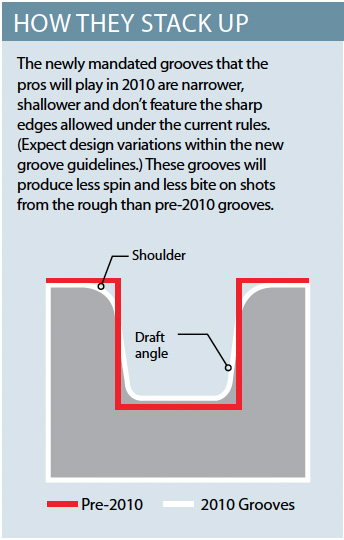
THE LOOP HOLE– As you probably already know, The Ping Eye 2 wedges before 1990, are considered legal because of the box groove law suit won be Karsten in 89′. This is what some of the pros have in their bags (namely Mickelson) because they are considered legal for the time being. I think that Mr. Karsten should just go ahead and write the letter allowing the USGA to make these illegal as well, just my opinion (and apparently Johnny Miller as well). Make it equal across the board and lets see who is the best. It was nice to see that Scott Macarron did apologize to Phil about calling him a cheater for using this wedge. He is not using it this week however. It will be interesting to see if and how this changes the game. One thing is for sure, we will see the pros working on there short  game and their driving. Here is a picture of the difference in the old and the new grooves to give you a better understanding of what we are dealing with. See you on the lesson tee and oh, don’t forget to breathe.

God Bless,

Guru
 

GURU TV – Lack of Trunk rotation: fitness episode 2


When evaluating your game and setting goals for the upcoming year, there are four components that are involved; 1)Long Game 2)Short Game/Putting 3)Mental Game and 4)Physical Fitness. Most people don’t put the time into their body and this can keep you from reaching your golfing potential. I hope you enjoy my second installment of Guru TV – fitness.

See you on the lesson tee,

Guru

Golf Illustrated Column and Matching Components


As we move into the first event on the P.G.A. Tour, I want to help you to become a more educated golf viewer. I want you to notice how many different ways there are to swing the club and play at a highest level. Top instructor Jim McLean always said, “If you take the top 5 players on the tour money list, you will see 5 different top of swing positions. He is right, try it sometime.  You must have the different components together in the swing that match up in order to create a playable ball flight. For example: an outside to in swing path coupled with a closed club face doesn’t work! You get nothing but low pulls and hooks along with deep divots. Now I am not going to go into every single combination out there but I just want you to understand how two main components work together in various ways to hit straighter shots: Club face angle and swing plane. The swing can be deceiving on television mainly because you don’t always get good camera angles. If  the camera is shooting from one side or the other, it skews the look of the swing plane and makes the club look like it is doing something different. So be careful.  In the February Issue of Golf Illustrated (hit newsstands today), I wrote a column entitled the 1-2-3 backswing. I have included the video (from my archives) that illustrates the message: There are many ways to get it done. Get a reputable teacher/coach to help you figure out which one works for you. This way you don’t go through your golfing career trying to swing like someone else. Be yourself and find your best swing.  Enjoy the video and Go get the magazine and let me know what you think. I look forward to your comments. Look for the next episode of Guru TV on The Importance of Mirror Work and Indoor Practice. Stay Tuned and thanks for checking out my blog

Guru

The Right Knee and my Upcoming Article


I have an article that comes out in the next couple of weeks in Golf Illustrated. The title of the article is “Post and Rotate.” The main focus of the article is the role of the lower body and the importance of clearing the hips and maintaining your spine angle. One of the most frequent errors that I see is called early extension. This occurs when the hips move towards the ball in your downswing and creates a change in spine angle through impact (see past episode of guru tv on fitness). I work on this move frequently with my students when they have too much hip and leg slide in their downswing which tends to crowd the arms into impact. We often call this getting trapped.  Recently, I was working with a student (we will call him Allen) on this very move and I noticed that his rear leg was straightening in his backswing. I have seen this before in golfers and this error can cause a number of swing errors like reverse pivoting, or can cause you to top the ball or hit it thin. Often I will try to create a swing error with my own body to help me to feel what the student is feeling which allows me to explain why a particular problem is occurring.  As I made a backswing and straightened my right leg, as my student did, I noticed that I had no way of pushing off my back side to move my hips through. Allen had no way of rotating his left hip backwards because he couldn’t push-off his right side. I hope you are in your living room or den recreating the top of swing with a straight right leg and you clearly understand what I mean. As soon as I got the student to maintain the flex in the right leg, he made a huge change in the amount of hip turn that we were able to create in his downswing. This improved his impact position dramatically. The shaft of the club leaned forward about 15 degrees more than when we started.  I need to do a video on this subject but I wanted to go ahead and share this with you while it was fresh. Here are the two things that I did to help Allen to feel this change. One is a  feel and the other a drill.

1. Remember when making a change that you need to feel as if you do the opposite. When you make your backswing, feel as if you flex or squat a little in order to keep your knee bent to the top of your swing.

2. Baseball Pitcher Drill – Take the club to the top of your swing. As you finish your backswing, lift your front leg off the ground as a baseball pitcher would and swing your leg across your back leg and balance your weight entirely on your back leg (this makes you keep your leg flexed). As you move forward, plant your left leg and then swing your arms down and through to your finish. This drill will also help you with your timing and transition. If you swing your arms down before you plant your left foot, your timing will suffer. 

To reiterate. Keeping the right leg stable and flexed at the top of your backswing, gives you the power to push and drive your right knee and hip toward the target which in turn will clear the left hip as you will see in my article. So go out and get the upcoming edition of “Golf Illustrated Jan/Feb.”

I look forward to your comments as you work on your right knee at the top of your golf swing.

Guru

A Time to Reflect and a Time to Look Ahead


As we come to the end of another year, I think it is beneficial to do two things. 1)reflect on the past year (what you did well and what mistakes can we learn from) 2. Set goals and look ahead to 2010 (what do you want to accomplish and more importantly do different and improve on). I enjoy looking at my goals that I had set to see which ones I accomplished and which ones that I didn’t and may want to carry over to next year. I encourage you all to do these things as well. Break them down into different categories (golf, spiritual, career, fitness etc.). I am not going to bore you with all my goals and aspirations but I will share with you a few things that I think might spark some interest in your growth as a golfer and as a person. One of the traits that we live by at the Dana Rader Golf School is being a continuous learner in all aspects of life. I work with a group of go getters that will not let you rest on your success and that keeps me on my toes when it comes to growth as a teacher/coach and as an individual which I like. We all enjoy sharing our knowledge gained from the books we read in our book club sessions or on our own and our best practice trips from other golf schools or facilities. I am a veracious reader and always have 3 to 4 books going at one time. If someone recommends a book I usually find a way to get it and read it. I often get the question from students or people that I meet. “What are you reading?” or “what are your favorite golf books”.  I would guess that I have read hundreds of golf books and you might be surprised that I do read about other things that I find interesting and might help me in life or my career.  So I made a list of the books that I read in 2009 (the ones that I could remember) and also a short list of my favorite golf books that I would recommend having in your library. Although I do think it is difficult to learn everything about golf from a book, it is a great place to start.  One of my idols, Mr. Jim Rohn said,”There is no coincidence why there is always a library in houses of $250,000 or more.” So here is some food for thought or bread for the head. I encourage you all to take some time to write down your goals for the upcoming year and reflect (good or bad) on the past year.  I hope you enjoy my list and would love to hear about some books that inspired you in your life.

Guru’s 2009 Book List :

1.The Power of Nice by Kaplan, Koval

2.Your 15th Club The Inner Secret to Golf by Rotella

3. The Slight Edge by Jeff Olson

4. The Power of Who by Bob Beudine

5. Take your performance to the next level, 50/50, secrets I learned from running 50 marathons in 50 days  by Dean Karnazes

6.Going  The Extra Mile by Pam Reed

7. Mind Over Golf by Dick Coop

8. Instinct Putting by Alpenfels

9. The Seven Principles of Golf  by Darrin Gee

10. The Last Lecture by Randy Pausch

11. Influencer- the power to change anything by Patterson

12. The impact Zone by Bobby Clampett

13. 25 ways to win with people by John Maxwell

14. Breaking the Slump by Jimmy Roberts

15. What happy people know by Dan Baker

Some of my favorite golf books:

1. Rock Solid Golf by Dana Rader

2. Swing Secrets and Lies by Mike Hebron

3. Perfectly Balanced Golf by Chuck Cook

4. Ben Hogan’s 5 lessons

5. the 30 second golf swing by T.J. Tomassi

6. Golf My Way by Jack Nicklaus

7 Flick on Golf by Jim Flick

8. On learning Golf by Percy Boomer

9. The Golfing Machine by Homer Kelly

10.Golfs Sacred Journey- seven days at  the links of utopia by David L. Cook


What I am currently reading:

Homer Kelleys Golfing Machine, the curious quest that solved golf by Scott Gummer

Sole Purpose- shoes of hope from the feet of a samariatan by Manny Ohonme.

Let me know of  some of your goals and I hope it includes the help from the GURU and the Dana Rader Golf School.

Happy New Year  and God Bless,

Guru

What We Can Learn From Ricky’s Swing


Periodically I will post a tour players swing that i think will allow us to learn something that will help my viewers and also give you a better idea of how I break down and look at a golf swing.  I have commented several times at how I am impressed with Ricky Fowlers overall game and his swing is a classic example of a player that knows his swing and is comfortable with it. It hs a few unusual things that many would call swing flaws but I call them individual trademarks that all great players have.  Examples would be: Trevinos open stance, shut club face and figure eight move through the ball, Furyks dramatic vertical left arm at the top and reroute to find the slot and Nicklaus’ flying right elbow and leg drive. I could go on and on but let’s get to the analysis of Ricky’s driver swing.

The first thing that you notice is that Ricky is not a very big guy, he weighs a mere 135 pounds which dispels the myth that you have to be big to hit the ball long. 

First things first: His setup and posture match beautifully to his very flat arm plane. Tip #1 – If you are a one planer (low arms swinger, you better be bent over at address to ensure a consistent trough to your swing circle. If not you will hit thin shots.) Ricky’s spine angle is approximately 90 degrees to the angle of the golf shaft at address.

Takeaway: His clubhead stay outside his hands as his arms swing across his body. Notice how his left arm is slightly lower than his shoulder plane at the top. (Very much like Mr. Hogan)

Swing flaw #1 : At the top of his swing, the club is pointing to the left of the target (often called laid off). Many teachers would change this but I wouldn’t and this is why.  The golf swing is a balancing act.  You have steep moves and shallow moves. The laid off position is a steep move that counterbalance his flat arm plane which is a shallow move. I hope this makes sense. If the club was on-line at the top or across the line, it would cause his swing to get too shallow or swing too much to the right.

His downswing: This is where he gets his power. Ricky gets incredible separation between his hips and shoulders which is a great power move. Stop the video half way down and notice how open his hips are as his shoulders are perfectly square to the target line. The laid off position that I talked about allows the club to stay in front of him on the way down and square the face at the bottom. Huge key: Notice how his spine angle is exactly the same at impact as it started at address. This allows the impact position to be very consistent. Copy this move if possible

Copy this finish: His finish is free and is result of the incredible sequencing that makes it look so easy. He is a great driver of the ball because he has the ability and confidence to let go. There is no hang on in this swing almost as he was “hitting balls into the OCEAN” – a great driving image.

So I think this swing is very functional and will stand the test of time. Coupled with his brilliant short game and putting stroke and I think you will see young Mr. Fowler have a great rookie season on the P.G.A Tour. Only time will tell.

Let me know if this is helpful and I will do more of this in the future including videos of me demonstrating the moves that I have discussed.

Until next time,

Guru

Q School wins and Losses


As a young man, I mean younger man….I always dreamed of playing the PGA Tour. Playing golf on television and against the best in the world. I often get the question from students that don’t know me, “Did you ever play the tour”. Even though I was an accomplished junior and college player and have currently 4 major victories on my resume  which include (Wva. chapter assistants championship, The Kannapolis Pro-Lady, The North Augusta Pro-Am), I was not even close to being good enough to play with these guys. Most people don’t realize how good these guys really are. So I have found my niche, teaching the game. The innate ability to communicate the game to the masses, students of all levels and even guys that play at the highest level, rely on my for advice and that feels pretty good.  On a previous post I called Q School the hardest golf tournament in the world and this year didn’t disappoint. There were new faces like Troy Merit (the winner) and wiley vets like JP Hayes  and Jay Williamson, and Jeff Maggert that made it through. The interesting part is always the ones that are on the bubble coming down the stretch. The magic number this year was 9 under for 6 rounds. For the good players out there, this doesn’t seem so daunting. You could probalby do this on a weekly basis but the pressure is unlike any golf tournament you will ever play in.  So here is my highlights that were of interest, the good and the bad.

1. The biggest last hole disappointments: James Hahn is on the number playing the 18th only needing a par.  He hits it 60 feet and 4 putts for double bogey. He was actually talking to himself out loud walking up to the green, this tells you how hard it is to control your emotions in this enviroment.

2.  Tour veteran and recent champions tour winner, Tom Pernice Jr. drives it in the water on the last to make double and miss by 1.

3.  Best reaction goes to Brad Delahoussaye. During his interview he tears up saying” I have been trying for so long”, talking to his fiance on the phone. He had to change his honeymoon plans to Hawaii, I think she will get over it.

4. Some notables that didn’t make it were: David Duval, Tim Herron, Jesper Parnevik, Paul Stankowski and Ken Duke.

5. Best Charlotte player, via Zimbabwe, is Brendon De Jonge which finished a solid 4th place and should get into plenty of west coast tournaments.

6.  Lastly, the best after round interview goes to Joe Ogilvie. Ogilvie talked about how Shakespeare would never write this book and how he couldn’t understand why more people wouldn’t watch this tournament because it is the greatest in the world. He made an apprentice reference that was very funny…..if anyone can find this video please post as I feel he has a very good future in tv. This guy is very funny and obviously a great player.

Young phenom, Ricky Fowler who is slowly becoming one of my favorite players to watch, made it look easy and made it through. It helps when you have plenty of sponsors exemptions waiting for you if you don’t make it. I just can’t get used to the dutch boy painter hat and the long hair but I know the kids are digging it. His short game and putting is just ridiculous and is world-class. Check out his putting setup and stroke as its exactly like what I teach.

Next weeks Guru TV will be on putting: The arc stroke vs. Straight line putting………..so stay tuned

Don’t forget to breathe when you are nervous and I will see you on the lesson tee

Guru