20 Days With the Guru, Day 16:The Forgotten Pre-Swing Fundamental

You have heard the saying,”It is hard to make a putt with hour hands around your neck,” we have all been in situations where we get nervous or uptight on the golf course. It usually involves a first tee or a shot that applies pressure because it has a special meaning to us. It could be a final putt or a drive in which we have a chance to break a career low barrier or win a big tournament. Our mind and our thoughts become our worst enemy. We can sabotage a great opportunity to succeed by tightening up our muscles, owe mouth gets dry and we can’t swallow or what?………….Breathe dawg, breathe! That was my caddy bringing me out of my coma on the last hole. We have all heard how important a sound pre shot routine is to transferring a skill that is easily executed on the practice range by ourselves, yet being able to pull it off under pressure become quite difficult.
Several years ago, I attended a teaching summit where I saw a popular sports psychologist, Dr. Dick Coop speak on this very subject. Dr. Coop coached the likes of Payne Stewart and Corey Pavin. He went through all the physical fundamentals of a good routine such as starting from behind the ball, picking an intermediate target etc. The thing that I found interesting was where he said to breathe. Yes, you heard me. Breathe! It seems simple but so important. It is amazin how we forget sometimes                              Here is what Dr. Coop said:
THE 3 PLACES TO BREATHE
1.Standing behind the ball as you visualize – this is where the tension starts and the fear creeps in. Take a cleansing breath as you picture your shot. It will help you think clearly and keep your rhythm.
2. As you walk into the ball- The pace that you walk into the ball will dictate the tempo of your swing. (sing your favorite slow song in your head).
3.As you waggle and get ready to pull the trigger- This is where most players choke. A deep cleansing breath will help alleviate the tension and ward off any negative thoughts that might creep in. Also, if you focus on breathing you won’t have room for these sabotaging thoughts.

The Importance Of Breathing and the Lympathic System 

In order to help my students with there breathing and to learn more about the importance of it, I found a cd program from Tony Robbins, one of my favorite success coaches,  that I found most helpful in explaining how and why to breathe. I share this will all of my students as I do a playing lesson or work on pre-shot routine. Here is a exerpt from Tony Robbins program, Enegise for Life :

There are many benefits that arise from making deep breathing a part of your daily routine, most of which are due to the fact that deep, cleansing breaths give your lymph system a helping hand in clearing out the toxins from your body.

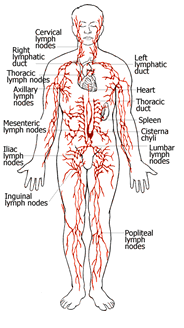
What is the Lymphatic System?

The lymph system is commonly referred to as the body’s sewerage system. It works by acting in harmony with the blood, surrounding every cell in the body and protecting each one by removing dead cells, blood proteins and any other toxins and excreting them from the body. The toxins are then removed from the body through our waste products, mucus, or our skin.

The body is hugely dependent upon the lymph system, to the point whereby if the lymph system was shut down for 24hrs you would die as a result of the trapped toxins and proteins surrounding our cells.

In addition to deep breathing, rebounding can be a further way to stimulate your lymphatic system.

The lymph that is collected around the body drains through two ducts into the blood, which are located at the base of the neck (around the thoracic duct). By breathing we stimulate the flow of the lymph, and through deep breath we can encourage the flow to be both cleansing and powerful. Once we breathe, the duct sends the lymph into our blood flow, then onto the liver where it metabolises and then onto the kidneys where the toxins are filtered.

 
Deep breathing is so important because, unlike our blood flow, the lymph system does not have a ‘pump’ to push the lymph fluids around our bodies. Rather, the lymph system requires the muscular movement which is created by breathing.

As well as acting as a filter, the lymph system is also able to destroy bacteria, viruses and abnormal cells, such as cancer cells. So enough of the anatomy lesson, lets talk abou how we should breathe. Here is an excersice that I want you to try.

Breathe In the Following Ratio

Breath in for 1 count

Hold for 4 counts

Breath out for 2 counts

for example – if you were to breath in fo 4 seconds,then you hold your breath for sixteen seconds and then breath out for eight. If you are able to do this ten times, three times a day (morning, evening, and before bed), you will see a huge difference to your energy, clarity and your ability to ward off illness.

This is why runners, yoga enthusiasts don’t get sick that often.

So pratice your breathing, work it into your pre-shot routine. Go have fun and I can promise you that you will be cool under pressure and finish off that career round.

Feel free to share this blog if you find it helpful by hitting one of the social site buttons below. Leave a comment as well

See you on the lesson tee and don’t forget to, well you know,

Jason

20 Days With the Guru, Day 15: Head Movement and Body Pivot Part 2


Stuart Mackenzie: Look at the size of that boy’s heed.
Tony Giardino: Shhh!
Stuart Mackenzie: I’m not kidding, it’s like an orange on a toothpick.
Tony Giardino: Shhh, you’re going to give the boy a complex.
Stuart Mackenzie: Well, that’s a huge noggin. That’s a virtual planetoid.
Tony Giardino: Shh!
Stuart Mackenzie: Has it’s own weather system.
Tony Giardino: Sh, sh, shh.
Stuart Mackenzie: HEAD! MOVE!


Stuart Mackenzie: I’m not kidding, that boy’s head is like Sputnik; spherical but quite pointy at parts! Now that was offside, wasn’t it? He’ll be crying himself to sleep tonight, on his huge pillow.

I know, I know,  I’m a freak…….(crickets) but I had to post that for those of you who didn’t get the original title, laughing now? The average adult head weighs about 15-21 pounds, so you better be careful as to where it goes during your golf swing.  

Yesterday I posted a blog on different style body pivots and head movement. Thank you for all the comments that I received from coaches and friends. This is a great discussion topic that could go on for a while. What are the pros and cons of each style (a 2 pivot point move) or (a neutral, centered approach). Once again the genius in expert teaching is for the coach to design a pivot and a style that  works for the student and not fit the student to the style or method. A lot of golfers cannot fit into a centered pivot due to physical limitations and immobility in their hips and lack of rotating ability. So we have to allow them to move off of the ball a bit in order to gain sufficient power. This puts a huge importance on training the hands and arms to create speed and an impact position that can allow them to hit the ball first and reach low point. There are many more factors that we could discuss that could affect these things (ball placement, set-up, posture, swing shape etc.) that we can save for a later time. In the meantime, since I didn’t have time to do a Guru TV episode this soon, I got permission from my friend and mentor, Chuck Evans to use a few segments from a webinar that he did that demonstrates this topic perfectly. Leave your comments below and thanks for all your feedback as I am learning so much from all of you. I am evolving as we speak. Enjoy the video.

http://video.medicus.com/video.php?id=485 – video describing the two different pivots

http://video.medicus.com/video.php?id=491 – video describing the pivot that promotes less back pain.

Remember: Everything we teach is borrowed or stolen from our teaching ancestors, communicate it clearly and watch the language that we use. Be careful of what you ask the student to do, they might just do it – Manuel DelTorre

follow me on twitter @twitter.com/onplanegolf or friend me up on facebook.com/onplane golf

See you on the lesson tee,

Jason

Head Move (Or Not)-“So I Married A Teaching Professional” (Archive deux)


Something that I have been thinking a lot about lately as I have been giving hundreds of lessons is lOW POINT, HEAD MOVEMENT AND BODY PIVOT. As not to make this a full on debate amongst coaches (although that would be ok), I want to give the students a few ideas about how to improve the consistency of your contact. When we talk about the low point in the golf swing, we are referring to the bottom of the swing circle, just before it starts to elevate up and to the left. This point is typically even with your lead shoulder. This is why when you see a good player take a divot, it is usually 2 to 4 inches long on the target side of the golf
ball. If you are hitting the ball fat or thin, then your low point is not
as it should be so we have to look at a few areas that might give us
some insight into why this is happening. I am going to attempt to convey this in an understandable way for as I have alot of thoughts on this matter. Understanding is the easy part for most, it is application and what to apply that golfers struggle with. So question becomes: Should the head move in the golf swing? If so how much? How does the body pivot affect this idea? and Does head size make a difference? That was a joke.

HEAD MOVEMENT

                                                                                                                                                                           Early in my teaching career, I must have picked up a Jimmy Ballard book and read it (the 7 common denominators) because I allowed my students to shift there weight behind the ball, then turn, shift back to center and swing. As I have seen this method work for many players over the years. Rocco Mediate, Hal Sutton etc. It seems to require a lot of timing. So in the last 10 years, I have allowed no more than 1 half a head to the right as my guideline. To clarify what we mean by head movement: typically most teaching pros will draw a box or a circle around the head when looking at video. Any side to side or up and down motion will be easy to see when this is done. As I have been studying the teaching methods such and “stack and tilt” and “The Golfing Machine”, they like to see the head stay centered. The golfing machine calls it “the tripod”. I always struggled with this idea because I thought it changed the spine angle too much in a reversing manner to achieve an on plane downswing or to create power. After studying massive amounts of video on players that adhere to these methods I found that it these things were achievable. As long as lower center (naval area) is slightly ahead of upper center (sternum) you can find achieveable plane.  You just have to have the right components in place. In order to keep your head completely still or might I describe as “steady”, you must keep your shoulders rotating on top of your hips and a bit steeper than normal. The right hip absolutely cannot slide to the right at all or you will get a reverse spine angle. I more lateral move off of the ball might have a flatter shoulder plane.  So which is the right way? I think it depends on the students characteristics and athletic ability.

                                                                                                                                                                                                       I asked my friend and top 100 teacher, Chuck Evans about head movement and he said,”it must stay still, period. I then asked if it does move, does that change low point and the answer is absolutely. If you head is too far behind the ball, then your left wrist becomes low point. What percentage of golfers, your students, you, yeah you……….have a bowed left wrist at impact? Not as many as we want to admit, right. It can be more on top of the ball and still work.  So this makes the head steady idea make sense to me and has helped my students improve their contact even if impact isn’t perfect. When I move a player into a steeper shoulder plane with a steady head, the first reaction is it feels like a reverse pivot. When I show them on video that they still have a neutral or slightly tilted spine away from the target, they understand. The player with too much head movement to the right will feel this way because it is a big change. When they hit that first shot more solid, they buy into it pretty quick. I will hook up some video examples of my students to help make sense of all this.

MATCHING COMPONENTS

I have always been fond of a lower, flatter arm plane but have some students with high hands if they show the ability to successfully drop the club on plane. When you work with a more neutral pivot, to avoid getting too steep on the downswing, your arm plane should be a little flatter. If you tend to move off of the ball and tilt your spine more away from the target on the downswing, you can use a higher hand position. It is all about your ability to consistently find the plane line and low point that is important.

STEADY BUT NEVER IN FRONT

I think we would all agree that we don’t like to see the head forward of its original position at impact. This typically causes a loss of lag or club head throwaway. Another reason a steady head might be easier. If you shift too far off the ball, you must shift forward to recenter and could slide too far in front.

So in conclusion. Everyone wants more distance. If you load up on your backside and coil, you might give yourself a chance to hit it farther but you might sacrifice a consistent low point and your contact will suffer. I have found that for most players, SOLID CONTACT IS WAY MORE IMPORTANT. I have a saying,”Speed without contact is useless”. Think about it. So if you are struggling with solid contact, try a more neutral, head centered pivot and I think you will find that ever illusive LOW POINT and might even take make a target side divot. I will do a video on this in the near future that will help explain better. I hope this made sense.

P.S. remember these swing ideas are examples of A way to swing a golf club not THE WAY….Good teachers have a few tools, great teachers have MANY.

See you on the lesson tee,

Jason

20 Days With the Guru, Day 13: Feel vs. Real and Pattern Development


Video in instruction can be a valuable tool if used correctly. There have been documented cases of video abuse by golf instructors or students that just love to look at themselves. I use video mostly to help my students bridge the gap between FEEL AND REAL. In my opinion, this is a big part of what separates expert golfers from the average ones. Amateurs have much bigger bridges than Professionals. A Pro has a better feel (good or bad) of what is going on with their golf swing than the amateur. For example: If you have been following my blog lately, I posted a list that I wanted for Christmas which included 10 passionate golfers to work with. Well, I found one under the tree today in the likes of JM (he knows who he is). JM had a lot of thoughts about what he was trying to do with his golf swing and (because he follows my blog, hint, hint) most of them were excellent golfing ideas. But until we put his swing on video were we able to 1)see what was actually happening and 2)focus in on a couple of root causes of all the gobbledygook that were effects of these causes. JM was a 95 to 100 shooter with a lot more ability than that (if he is reading this, as I am sure he is ……we already discussed his potential). I feel I can get him shooting into the 80’s fairly quickly. Lets look at feel vs. reality: 1)feel (he thought grip was strong: real: it was neutral at best and too much in the palm. 2)feel (he thought his takeaway was on plane and that he wasn’t flexible enough to turn: real(he was overturning his hips and shoulders which moved the club way to the inside and rolled the club face open. All of these events caused JM to lift his arms up to the top of his backswing and swing outside  to in on the downswing. As a result, a weak face with poor contact occurred. As soon as he saw his swing on video, these errors were very clear as he was even rehearsing a pretty good takeaway. So it was my job to get him to focus on the two ro three things that we would work on (Grip, initial takeaway and backswing shape)and explain how this progression will help his overall shape and contact. Then I gave him a drill to help him solidify the correct feel. Here is the drill that I gave him to practice

PROGRESSION AND PATTERN DEVELOPMENT

My friend John Graham (johngrahamgolf.com) came up with the word pattern development, (which I love) so I am using it for this description. Every golf swing is like a fingerprint. It is very difficult to completely change the pattern…..But……If you change the correct pieces or the cause of the problem, other things start to behave differently. As soon as we got the club head on the other side of JM’s hands (on plane) and a shorter turn with a flatter left arm at the top of his downswing, his downswing flattened out about 40 degrees to the positive side (toward the plane line). The ball flight went from a weak fade to a straight or slightly pulled draw that went 20 yards farther. Needless to say he was very pleased and was excited about the direction we were going. Why? 1)Because he saw positive change in his skills to strike the ball and 2)We now had a plan for improvement that was visibly measured through the use of video. He now understands what his swing should look like and the ball flight that matches in order to improve. The two images that will allow him to practice in the mirror at home are 1) the club shaft should remain in between the forearms and 2)the left arm needs to match his now steeper shoulder plane which shortens the swing a bit.

FOR THE COACHES

Guide the student in their learning by helping them focus on what you want them to see and not pointing out every little thing that they do wrong. Start with the positives and then focus on the areas that you want to work on. If you over do it you will do more harm than good. Trust me, I am a recovering “overuse video addict.” Hi my name is Jason…….you get the point.

Thanks JM for allowing me to post this lesson and thank you for spending an hour of your valuable time on a cold snowy day. I look forward to seeing your improvement.

See you on the lesson tee,

Jason

20 Days With the Guru, Day 10: How Important Is The Caddy To a Player and How to Be Your Own Luper


Sara Brown

Caddy programs at golf courses are not the norm any longer but if you ever get the chance to play a round of golf with a caddy, I highly recommend it. Professional golfers are used to having someone carry their bag during a round but a good caddy can mean so much more to the performance of the player. Recently, Sara Brown (big break star) made it through q school to earn

The Golfers Brain

her LPGA Tour card. For those who don’t know this, her boyfriend, Derek Radley is one of my good friends as he used to work with me at the golf school. Derek has been by Sara’s side through the grind of playing the futures tour and ultimately making the big jump to the tour by caddying for her. Here is an article that I found that highlights an instance where Derek had to make a tough call as a caddy (and a nervous boyfriend) coming down the stretch. click here to read the article. Congratulations to Sara and best of luck on the tour in 2011.

So how important is a caddy? Does the decisions they make, what they say or how they say it make a difference to the performance of their player? Absolutely. This is where it is important that they know the players tendencies, moods, mannerisms so that they know when to say something and also when to say nothing. This is why the best players tend to have caddys that have been with them for a long time. The most notable are Phil Mickelson and “Bones Mckay” and Tiger and “Steve Williams”. Here is a great article about Bones that I found. click here

A good caddy has the ability to help his or her player focus on the shot at hand with a simple phrase like “pick a good target” or “smooth swing big guy”. The caddy can also be a sounding board for venting frustration after a bad shot. So caddying is more than just getting a correct yardage, handing the player a club or raking a bunker. We have seen many instances where the caddy plays a big role in a young players first win by keeping them focused coming down the stretch. So what can the average player do on the weekend when they don’t have a caddy to talk to them or calm them down after a bad shot. WE MUST BE OUR OWN CADDY AND PLAYER COMBINED! SO HOW DO WE DO IT? HERE ARE SOME KEYS TO BEING YOU OWN CADDY:

THE CADDY PRE-SHOT ROUTINE AND SELF-TALK

A pre-shot routine should last around 40 seconds. The first half of that is what I call the caddy stage. This would include: 1)planning the type of shot you want to play, 2) getting a yardage, 3)choosing a club, 4)assessing the conditions…lie of ball, wind, up hill or down hill etc. The POST ROUTINE is also very important. I teach my players
ANCHORING techniques. How you react to a shot is critical in the success of the next shot, good or bad. example: When a Sorenstam shot 59, in order to keep her emotions even keel, her coach Pia Nilson told her to giggle to herself after every shot (good or bad). Obviously anchoring is easier after a good shot so let’s focus on the bad ones. I give my players 6 seconds to get upset before they have to let it go or when ever they put the club back in the bag (whichever comes first). Self Talk is also important (the caddy in you). How many times have you beat yourself up, called yourself a bad name (big dummy or worse)…. How did that work out for your next shot. Let it Go, brother. How many times have you stood over an importance shot and a thought popped into your mind like, “just DON’T HIT IT IN THE WATER!” where did it go…….The water. The subconscious mind can not differentiate between positive and negative commands. So you just hit the ball where your brain told your body to hit it. Next time how about asking the question,”Where’s My Target?”

Not to get into a whole mental discussion but you must be your own best friend, like Bones or Stevie. Be kind to your self and use self talk to pump your self up or motivate not to annihilate.

The play our best golf when we allow our subconscious (the garden) mind take over. The conscious mind (the gardner) seems to always get in the way. Thats enough for today so I will leave you with some food for thought, some bread for the head. Before every shot, we plant something…..seed of hope or doubta …………we can choose to plant flowers or we can plant weeds……….Champion Golfers plant beautiful flowers

Let’s connect: to follow me on twitter @twitter.com/onplanegolf

See you on the lesson tee,

Jason

20 Days With the Guru, Day 7: That Which Can Be Measured Can Be Improved….But How Do You Know


How do you know what to practice? Most golfers tend to practice what they are good at because it is fun. You hit your favorite club so you can look good on the range because you are self-conscious about what you look like and how you are perceived. This is normal human behavior as no one wants to be embarrassed or look bad especially when it comes to golf. The serious and intelligent golfers practice their weaknesses instead of their strengths, you just have to be courageous and be able to take a good hard look at your entire game. So let’s say that you have bought into what I just said, the key is to first KNOW your WEAKNESSES. Only then can we get the most out of our practice sessions and really start to see improvement. I use a great piece of technology that will allow you to track your progress, target your weaknesses and be able to put together an intelligent practice program every time you go to the
practice ground. It is called SHOTBYSHOT.  This is the best software to track your progress that I have ever seen. What I really like about it is that it compares your stats in each area of your game to your goal handicap. (example:if you are a 5 handicap and want to be a scratch, you will see what your stats should be in each area to reach your goal. It then highlights your weakest area so you know what to focus on in your practice). It also gives you precise stats on your putting from specified distances that you record after each round). I use this to Taylor practice sessions for my tour players and elite juniors. It makes it easy for the player and the coach to create a plan for improvement.
Once you start to record some scores into shotbyshot.com, here are some general recommendations for practice structure and a few drills that can give you measurement in each area of your game.  Here is a link to Peter Sanders Blog (owner of shotbyshot.com)
Disclaimer******YOU MUST OWN YOUR GOLF GAME! AND YOUR PRACTICE! Your coach should not have to force you to practice, if so, you don’t deserve to get better. Remember,”YOU CANT FOOL GOLF,”
DRILLS FOR MEASUREMENT
The Median Drill (short game)
also called the eleven ball drill. You can use this on any short game shot……pitch, chip, bunkers etc. Pick a shot. You can use multiple targets if you have more than 1 pin on your practice green. Hit eleven shots to your targets. Take away the closest 5 balls. Measure how close to the hole your 6th ball is. This is your distance.your goal is to decrease this distance. Clear measurement.

14 Ball Drill (driving accuracy)
Pick out an imaginary fairway on your practice range. Maybe two flags as wide as wide as your average fairway as a reference. Going through your golf course routine, hit 14 drivers as you would in a round of golf. Count how many that you hit into your imaginary fairway. MEASUREMENT! Set your goals accordingly.

30 foot drill (putting)
Measure off a 30 foot putt. It is approximately 10 steps. Lay a club or dowel rod 3 feet behind the hole. Hit ten putts in attempt to make the putt or leave the ball in between the hole and the stick. Count how many you get in the zone. Measurement. This will help with your distance control.
Whatever your practice plan is, always include some form of putting practice.

So I hope this helps organize your practice in the upcoming season always remember,”In order to get to where you are going, you must know where you are. Only then can you figure out how to get there”

See you on the lesson tee,

Jason

20 Days With the Guru: Day 5….My Christmas List: What Do You Want Under Your Golfing Tree?


As the P.G.A. Tour schedule wind down and we have time to catch our breath, we should all find a quiet place to help us think. So what should we think about. What should we dream about. Should we look back on the past season of golf? Should we dare look ahead to the next year and want we want. The answer is YES, YES AND DID I MENTION YES. I don’t know where I find you in your golfing career. Some of you may be contemplating whether to play for a living. Some of you might be finishing up a college career (like the young Englishman that I gave a lesson to today), A few of you are looking to break new scoring barriers such as 90 or 80 and some might be just getting started with this great game. Regardless of where you are in golf, as long as you in it. That is what is important. As the stats reveal every year, there are just as many golfers leave the game as there are taking it up…..I am here to try to inspire you to embrace golf as you would your favorite blanket and let’s dream big for 2011. So what do you want Santa Guru to bring you for Christmas this year? Let me share my list of the 12 things I want under my tree:

12 new students with a passion for the game

11 junior golfers that want to play college golf

10 rounds of golf (compared to the 7 that I played this year)

9 new ideas about teaching and coaching that will help my students

8 flat lead wrists at impact

7 birdies on 9 holes with 6 putts

6 phone calls for people asking me to speak at their seminar or function

5 great book ideas for the winter that will help me grow

4 different major champions under 30 years old (including Ricky Fowler, please)

3 trips to top a top ten golf course (hopefully Augusta National if anyone is wondering)

2 P.G.A. Tour players to coach

1 Golf Magazine Top 100 List with my Name on it (It is spelled Jason E. Sutton)…..a guy can dream right

What can I do to help you reach your golfing dreams this upcoming year? I encourage all of you to evaluate your goals that you set this year, reflect, set goals for next year and develop a plan to get there. I would love to be a part of it.

If you can dream it, then you can achieve it. You will get all you want in life if you help enough other people get what they want.
Zig Ziglar

Follow me on twitter @twitter.com/onplanegolf

 
See you on the lesson tee,
 
Jason