20 Days With the Guru, Day 13: Feel vs. Real and Pattern Development


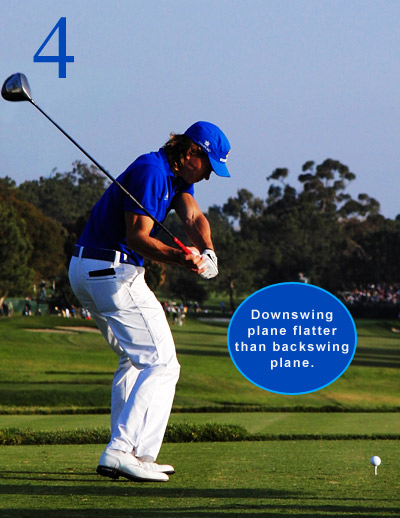
Video in instruction can be a valuable tool if used correctly. There have been documented cases of video abuse by golf instructors or students that just love to look at themselves. I use video mostly to help my students bridge the gap between FEEL AND REAL. In my opinion, this is a big part of what separates expert golfers from the average ones. Amateurs have much bigger bridges than Professionals. A Pro has a better feel (good or bad) of what is going on with their golf swing than the amateur. For example: If you have been following my blog lately, I posted a list that I wanted for Christmas which included 10 passionate golfers to work with. Well, I found one under the tree today in the likes of JM (he knows who he is). JM had a lot of thoughts about what he was trying to do with his golf swing and (because he follows my blog, hint, hint) most of them were excellent golfing ideas. But until we put his swing on video were we able to 1)see what was actually happening and 2)focus in on a couple of root causes of all the gobbledygook that were effects of these causes. JM was a 95 to 100 shooter with a lot more ability than that (if he is reading this, as I am sure he is ……we already discussed his potential). I feel I can get him shooting into the 80’s fairly quickly. Lets look at feel vs. reality: 1)feel (he thought grip was strong: real: it was neutral at best and too much in the palm. 2)feel (he thought his takeaway was on plane and that he wasn’t flexible enough to turn: real(he was overturning his hips and shoulders which moved the club way to the inside and rolled the club face open. All of these events caused JM to lift his arms up to the top of his backswing and swing outside  to in on the downswing. As a result, a weak face with poor contact occurred. As soon as he saw his swing on video, these errors were very clear as he was even rehearsing a pretty good takeaway. So it was my job to get him to focus on the two ro three things that we would work on (Grip, initial takeaway and backswing shape)and explain how this progression will help his overall shape and contact. Then I gave him a drill to help him solidify the correct feel. Here is the drill that I gave him to practice

PROGRESSION AND PATTERN DEVELOPMENT

My friend John Graham (johngrahamgolf.com) came up with the word pattern development, (which I love) so I am using it for this description. Every golf swing is like a fingerprint. It is very difficult to completely change the pattern…..But……If you change the correct pieces or the cause of the problem, other things start to behave differently. As soon as we got the club head on the other side of JM’s hands (on plane) and a shorter turn with a flatter left arm at the top of his downswing, his downswing flattened out about 40 degrees to the positive side (toward the plane line). The ball flight went from a weak fade to a straight or slightly pulled draw that went 20 yards farther. Needless to say he was very pleased and was excited about the direction we were going. Why? 1)Because he saw positive change in his skills to strike the ball and 2)We now had a plan for improvement that was visibly measured through the use of video. He now understands what his swing should look like and the ball flight that matches in order to improve. The two images that will allow him to practice in the mirror at home are 1) the club shaft should remain in between the forearms and 2)the left arm needs to match his now steeper shoulder plane which shortens the swing a bit.

FOR THE COACHES

Guide the student in their learning by helping them focus on what you want them to see and not pointing out every little thing that they do wrong. Start with the positives and then focus on the areas that you want to work on. If you over do it you will do more harm than good. Trust me, I am a recovering “overuse video addict.” Hi my name is Jason…….you get the point.

Thanks JM for allowing me to post this lesson and thank you for spending an hour of your valuable time on a cold snowy day. I look forward to seeing your improvement.

See you on the lesson tee,

Jason
20 Days with the Guru: Day 1 “Physical Basics Of the Instrument”


I feel like I am in a bit of a golfing rut. Writers block as they say. The problem isn’t the lack of ideas, it is too many ideas to choose from. So in an attempt to get some blogging “FLOW”, I will be writing a tip, idea or whatever is on my mind for “20”, yes “20” straight days. The golf channel has 12 days at the academy…I have twenty days with the guru. I will attempt to educate you and entertain you as only my warped little golfing mind can do. So here is your idea for the day………………Understand the golfing instrument. “the club”
1. The club face, the club head and the club shaft all make up the tool that we use to propel the ball at the target. There are many methods, styles and ideas on how to create an efficient golf swing but it doesn’t matter as long as you adhere to the physicality of the way the club is built. (now it is up to you and your coach to figure out which one works for you). No matter what you are trying to do, there is no debating that there are two things the club must do to direct the ball in the manner that you wish.
1. Swing on a tilted “circle” on or parallel to the angle that the club rests on the playing surface “the ground”.
AN EASY WAY TO UNDERSTAND PLANE: The 5 Parallels
Assuming a stance that is square to the target, the club should be parallel to the target line at waist-high (1), parallel at the top of your swing when the club is perpendicular to the ground (2), parallel to the target line at waist-high on the downswing (3), parallel to the target line at waist-high on the front side (post impact)’(4) parallel to target line at three-quarters in the follow through.(5)2. Club face should be slightly open to the target line at impact and the ball should be struck on the inside quarter. The face of the club is only square a split second as the ball separates from the face.
3. The shaft of the club must lean towards the target in the impact zone as this is the key to compression and solid contact (also is the way the ball gets airborne).
For you expert golfers out there, you would be surprised at how many golfers don’t know these key physical basics of how to use the club, so bear with me as I never assume that my students or my audience knows anything……like a shanker that thinks he is hitting the ball off the toe of the club so they stand closer to the ball……what?
As we approach the winter season, get your golfing area in your house that will allow you to do some mirror work. I will expand on the importance of indoor practice as we move towards Christmas.
This is the best time to take a golf lesson because you aren’t playing as much so you are more likely to commit to a swing change. Stick with me and we will get an improvement plan in place.
Follow me on Twitter @ Twitter.com/onplanegolf

Until tomorrow,

Guru

The Key to Staying on Track With Your Golf Game: A Journal


As I reflect on my year and look ahead into the future, a key tool that I use is a writing journal. I have a journal for each area of my life: Spiritual, Family, Personal Development and Teaching. Before I can move forward, I must make certain that I am heading in the right direction. If you are serious about improving your golf game, I encourage you to start writing. No, you don’t have to write a book. Heck, you don’t even have to use proper grammar. As long as it makes sense to you, that is all that matters. I encourage all of my tournament players, elite juniors and serious golfer fanatics to participate in this practice of journaling. I have read hundreds of golf books over the years, some good and some not so good. No matter what I try to take something out of every one of them that will make me a better teacher or player. Nick Price wrote a book in 1997 called,”The Swing: mastering the Principles of the Game.” Although the instruction portion was average at best, the last chapter was interesting because Mr. Price published his swing journal that he kept while working with David Ledbetter. (The before and after pictures of his swing was quite interesting as well). Here is what he wrote which I think does a nice job of summing up the importance of keeping a journal from a major champion. He writes, ” During the course of my career I have kept a journal of my thoughts, primarily about my swing as I was working on it. I did not do this on a regular basis, but simply jotted notes down as they occurred to me, to reinforce ideas in my mind. Often after working with David Ledbetter I wanted to think about what we had discussed and to work things out in my own mind. Writing thoughts down helps me focus on what I want to do, and why.” When I look back through the journal now, I am struck by how I was obviously struggling toward the clear understanding of the swing that I sought. It is a never-ending journey that I enjoy-most of the time and keeping these notes helped me clarify matters.

Keeping a journal is a great way to keep thoughts that work (or don’t work) to remind yourself of what you are working on the last time you were on the lesson or the practice tee.  Here is an example of one of Nick Prices’ journal entries:

Supination : This is created when the left hand remains bowed through impact. The forearm rotates after impact, releasing the clubhead down the line of the target, still in the plane of the swing. This is undoubtedly the secret to consistent ball-striking, especially with the irons. When the left wrist is bowed incorrectly through impact, errant shots will result, the most frequent type being a hook. To insure against this happening, the thumb of the left hand must remain on top of the shaft, with the clubhead coming in low and after impact released. The normal result when this is done correctly is a very piercing flight of the ball, essential for extremely accurate iron play! The things to remember while trying or using this move are:

1. Make sure the club is taken away low from the ball

2. Make sure the backswing is completed

3. make sure the weight is transferred

4. make sure a  full turn is achieved

Wow! I don’t know about you but that is alot of stuff to work on in one session. This was only a portion of the post, believe it or not. I think this is the point of my career that I started giving my students less and less to work on in a lesson, right teachers. First understand that he is a tour player and it was his job to practice and secondly, he was a very analytical learner. The point is to jot down ideas that will keep you focused, you don’t have to write a book.

A Mental Excercise

For you “negative nellies” out there that only focus on the bad shots that you hit, try this in your journal. The next time you play, I challenge you to write down all the good shots that you hit (what club it was, yardage, how it looked, how it felt). This will start to project some positivity in your attitude and you will be amazed at how it will help your visualization skills.

So that is enough for now. Please share some of you goals for this past year and goals for 2011. I will post on how to help you set your goals if you are struggling soon. Leave a comment below.

Follow me on twitter @ twitter.com/onplanegolf or friend me up at facebook.com/onplanegolf

See you on the lesson tee (704-542-7635 to schedule a lesson)

Guru…….p.s. HAVE YOU PURCHASED YOUR DANA RADER GIFT CARD YET FOR CHRISTMAS?

GURU TV – Federico Celano: The Tour Player Chronicles


Welcome to another addition of “So you want to be a tour player” This week I am highlighting one of my new students that is playing the “e-golf tour“. Federico Celano is a very talented young player from Italy that is destined to be a great player. As we started working together and evaluating his stats, it was apparent that his putting was his weakness. He was averaging around 13 to 14 greens in regulation and about 33 putts per/round. In order to compete at the highest level we must get his putting average to about 28 to 29 with the occasional 24–25 putt round if he is going to contend. I won’t go into what we are working on is the putting as I will hook up some video of his stroke at a later date. Today, I want you to enjoy a very sound golf swing and pay attention to some of the things that we are working on together as they may be similar to what you are working on in your game. You can follow Federico’s progress on the e-golf tour by clicking on the link provided above. Enjoy the show and any comments would be appreciated.

See you on the lesson tee,

Guru

www.danarader.com

704-542-7635 To work with the Guru

GURU TV – How To Release The Club Part 2 (HD Remastered)


What’s Up Guru Nation. I don’t think we can talk enough about impact how to achieve it. Producing a solid impact position which should include a flat lead wrist, a forward leaning shaft and a square clubface with an efficient body pivot is the most important position in the golf swing but also the hardest to achieve. As long as golfers try to lift or scoop the ball off of the ground, I WILL ALWAYS HAVE A JOB. At the golf school, we call this job security. SO STOP SCOOPING! I understand that there is more to creating impact than what the hands and arms are doing but educating the hands, wrists and arms with small swings is where it starts. Then you can add the body pivot and tie it all together. Good Luck with your impacts and schedule a lesson so we can get to work on these key elements of the golf swing.

To work with the Guru, please call 704-542-7635 or visit our website @www.danarader.com

See you on the lesson tee,

Guru

GURU TV – “The Jeff Passage Project”:Episode 3


Here is the latest episode of “the Jeff Passage Projet”. Our New goal is to break 90. Jeff shot 99 in his first attempt to break 100 with 39 putts and he didn’t use his driver, so I think we have a chance here. Stay tuned for upcoming video on putting and the short game to help Jeff reach his goal. Be sure to keep watching until the end of the video as I give a sneak peak of some key ideas that I teach in putting which I will go into more detail as we go forward. Thanks for the view and I will see you on the lesson tee,

Guru
danarader.com
704-542-7635