As most of you know, I started a new junior golf program for elite juniors called (J.E.T.S.) that includes 2 coaching sessions per month as well as 2 private lessons per month as well. I wanted to do something different from the normal junior golf program so I partnered with my T.P.I. level 3 trainer, Mark Kane (kanetraining.com) to help develop the kids physically as well as help them improve their golfing skills. I just finished my second month and I am very excited to say that is going very well. We have five kids currently signed up and I am so proud of how hard they have all worked. They are required to keep a journal of what they do when they practice and keep track of their stats using shotbyshot.com. My goal was to create athletes through the fitness and the drills and then teach them golf. The kids did a nice job of setting goals and writing them down and a few of them have been able to mark off a few which is pretty cool. Here are some wins to report so far:
Luke Thalman shot a career low tournament round of 65
Henry Shimp won a NJGC event by shooting 69-71 and is now ranked number one on that tour.
Aaron Walker shot 79-72 to win his first NJGC event
All of the kids have worked so hard and they have pushed each other which was one of my goals of this program. I try to promote a competitive team atmosphere to help motivate each of these fine young men. Here is a couple of videos that will give you an idea of how my coaching sessions are set up. Enjoy.
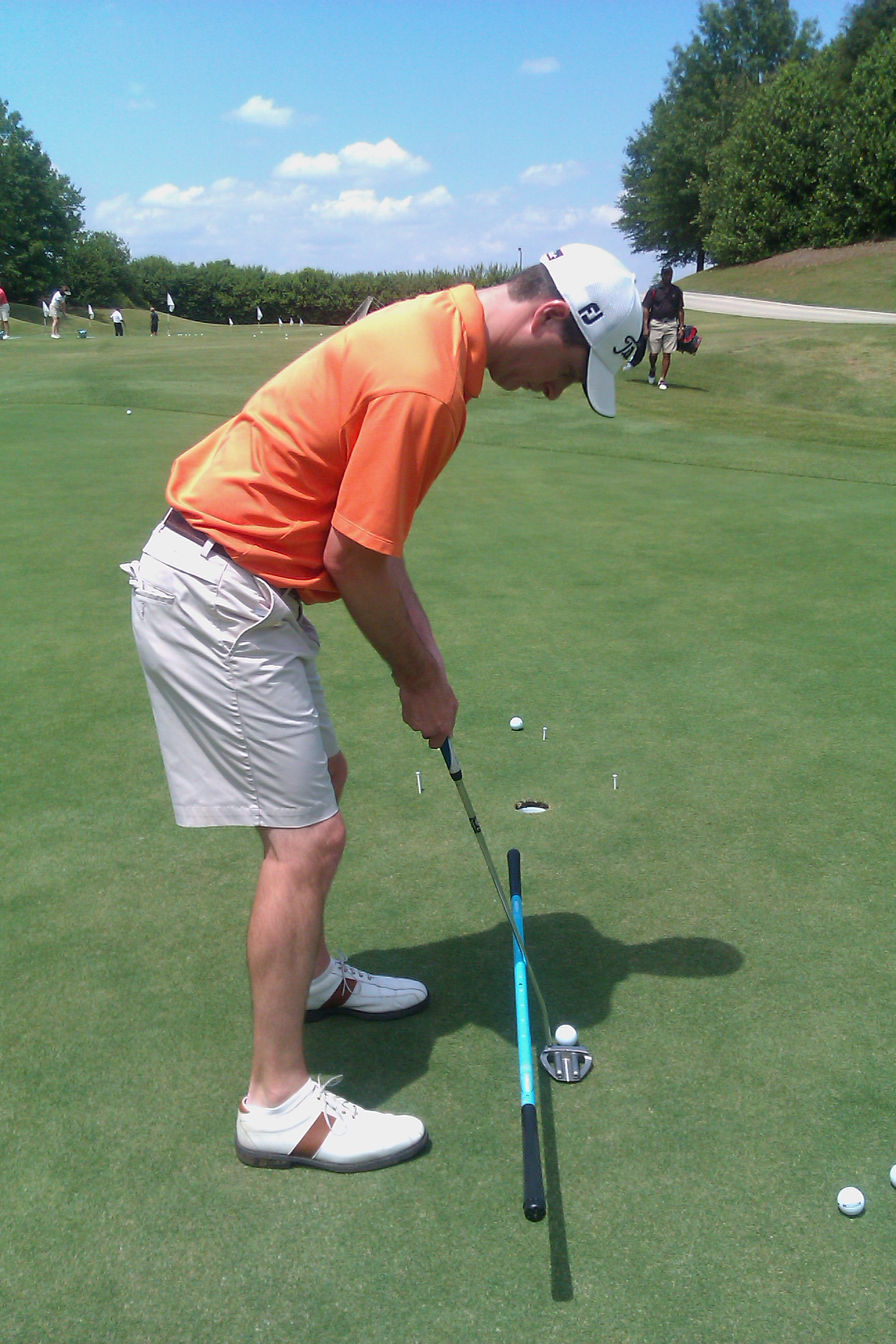
My student Mike Smith using the swinkey as a putting aid
My boss came by the other day to watch me teach for a bit and noticed this Carolina Blue pole in my bag and was curious. “What is that?” she asked. “It’s my Swinkey I said” I proceeded to show her all of the uses that were possible as I unscrew the top of my training aid. “You are becoming quite the gadget guy,” she said. I never thought of myself as much of a training aid teacher as I try to utilize my hands to manipulate the student into feeling the changes that I want them to make and I still do. For those who know me are aware of how picky I am in what I use as aids for my teaching so it has to be good and it has to be simple for the student to use. I like training aids that are basically hard to screw up and I have found the one that you can use for the rest of your career. “The Swinkey”. The golfers toolbox or the Swiss Army Knife of training aids is many aids in one which makes it convenient and versitile. I was introduced to it by my good friend, National Canadian Teacher of the Year, Jason Helman (jasonhelmangolf.com) when he appeared on my Guru TV show last year passing through Charlotte. I met Todd Halpen, one of the owners of this fine training tool on twitter (swinkeytodd) and later met the rest of the guys at the PGA show and they are all great guys. They are all accomplished players and have an excellent idea of what golfers need to get better. I posted a question on the golf pro facebook group the other day to see what training aids were being used by some of the best instructors in the game and the Swinkey was on many of their lists which says alot.
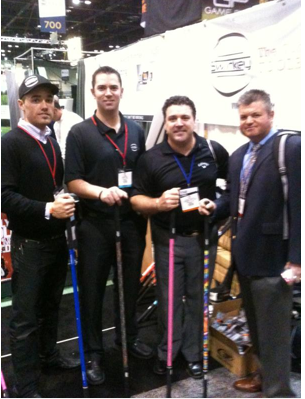
The Swinkey Boys, Jason Helman and Me at the PGA show
The Swinkey is a solid metal tube that holds two alignment rods and two metal stakes that can transform into so many different forms to help you get more out of your practice. I currently use it for :1) warmup swing trainer 2)alignment 3) ball position 4)swing plane 5)putting aid )putting string aim line 7) holding my impact bag in place. I am sure there are many others that I will find as I use it more. I would highly recommend that you order
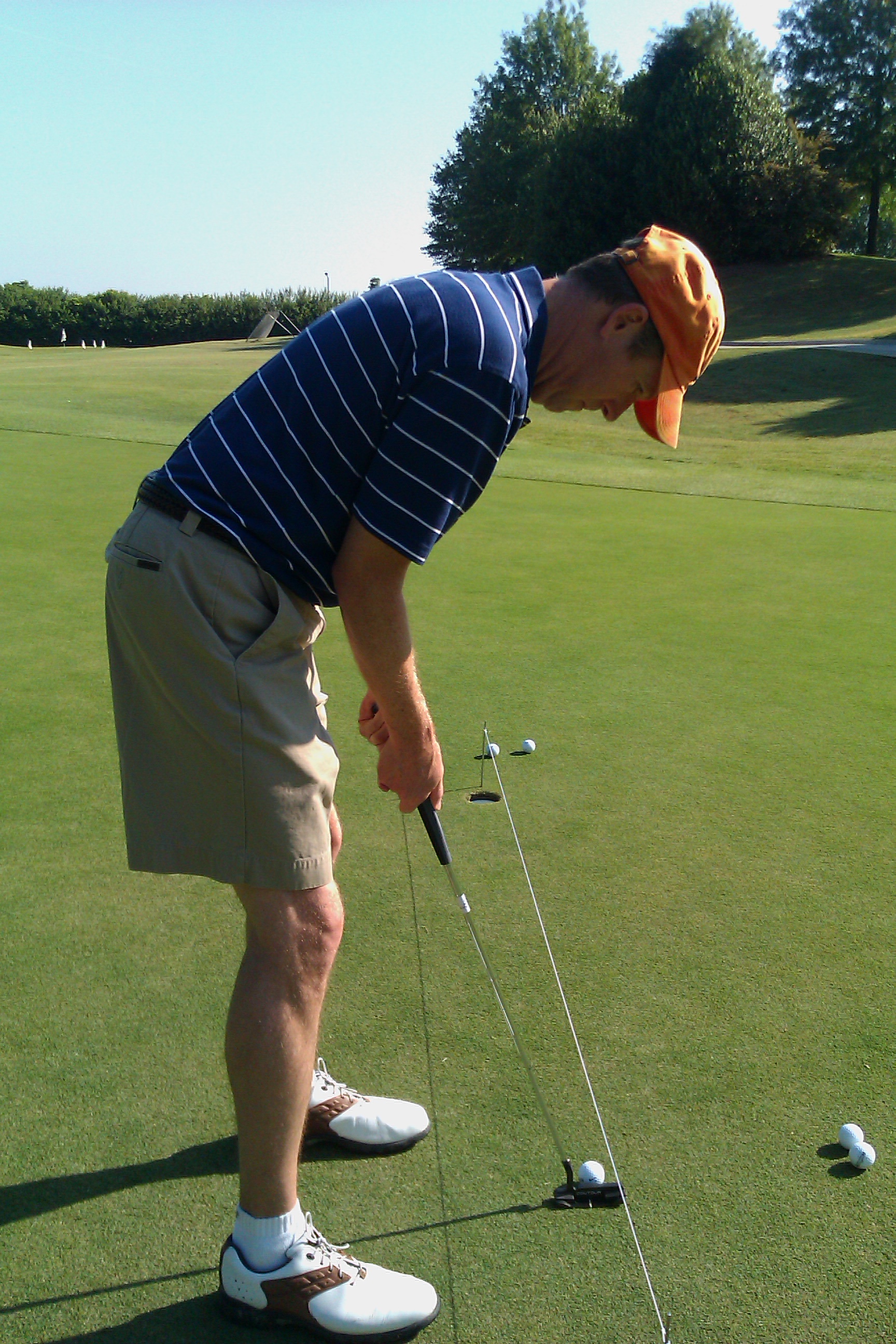
my student Brian McAlpine using the Swinkey string for alignment
your today and start to get more out of your practice.
visit http://www.swinkey.comto order yours today and use PRO CODE:( Swinkey_26) to get a 10% discount. Just tell them The Guru Sent You and they will say Who is that? Anyway. I suggest you go get one now!
Please visit our website at www.danarader.com or call 704-542-7635 to schedule a lesson with the Guru and see the swinkey in action
This is a video that I did for the Golf Channel. Special thanks to my good friend, Tim Morrisey for filming it and editing it as well. I hope it helps refresh your thoughts on fixing the dreaded out to in swing path.
To schedule a lesson with the Guru, please call 704-542-7635 and be sure to check out our website @www.danarader.com for more info on the Dana Rader Golf School
Special thanks to everyone who has supported Guru TV the last two years. As a tribute to my most popular video, I wanted to repost it for those who haven’t seen it. This is called “How To Drive a Golf Ball Straight”. Guru TV will be back shortly. I am putting together some new ideas and am looking forward to sharing my ideas that will hopefully make you a better golfer. Always feel free to leave a comment or an idea that you would like to see on the show in the future.
For more information check out our website @www.danarader.com or call 704-542-7635 to schedule a lesson with the guru.
Distance from the ball can mean many things when it comes to golf. For instance, After I hit my driver…I am still standing too close to the ball. (wink,wink). Chi Chi Rodriguez used to joke that in order to hit your driver farther…..you must hit your ball and then turn and run backwards, haha. All kidding aside, there are a few things that I have been thinking about lately when it comes to driver setup that I want to share with you all. Feel free to jump in at any time and call me crazy but I tend to learn things from observing, testing, tweeking and then bouncing ideas off of people that are smarter than me…..you guys! Are you struggling with your driver. Maybe you are not getting the ball flight that you want although you feel you are creating the pattern that your coach is prescribing. You have the perfect driver for your swing. You have all the components in your swing that you are looking for. So what is missing? Have you checked your contact point on the clubface and most importantly have you checked your DISTANCE FROM THE BALL- I know that sounds basic but hear me out.
I attended a trackman seminar a couple of years ago and they were talking about gear effect. For those of you who don’t understand gear effect here is an excerpt from about.com that explains it nicely: “Gear effect” is the term used to describe the action of the clubhead, during impact with the ball, that causes a shot hit off the toe to curve in a draw or hooking motion, and a shot hit off the heel to curve in a fade or slicing motion.
These actions of sidespin and shot curvature happen because the clubhead rotates around its vertical center-of-gravity axis whenever the ball is hit off the toe or heel.
When the head rotates in response to a toe-hit, the ball slides, then rolls, sideways across the face from the toe toward the center of the face. This causes the ball to leave the face with a hooking or draw sidespin. Conversely, when the head rotates the other direction in response a shot hit off the heel, the ball slides, then rolls, sideways across the face from the heel toward the center of the face, which causes the ball to leave the face with a slicing or fade sidespin.
The reason all woodheads are designed with a horizontal curvature across the face (called “bulge”) is because of the gear effect. If shots hit off the toe generate a hook or draw curvature, the face needs to be radiused (curved) horizontally so the toe shot will leave the face angled to the fade side of the target. Thus the bulge radius causes the ball to start off more to the right (for a right-handed golfer; or to the left one a toe shot by a left-handed golfer), after which the hook spin generated by the gear effect takes over to bring the shot back toward the center of the fairway.
For shots off the heel, the bulge radius across the face of the wood causes the ball to take off to the left (for a right-handed golfer; or to the right from a heel shot for a left-hander), after which the fade spin generated by the gear effect takes over to bring the shot back toward the center of the fairway.
The presenter was telling a story about a player who was swinging 4 degrees from the outside with a 6 degree shut club face and was hitting a PULL FADE! Doesnt make sense, right. Until you check the contact point. The player was hitting the ball extremely on the heel of the driver which made the ball curve to the right. (Gear Effect). I don’t give a driver lesson now without a piece of face tape so I can see where the ball is contacting the face. After studying some of the best drivers of the golf ball, I have noticed a couple of observations.
1. Many PGA Tour pros address their driver closer to the TOE of the club. A few notables include: Zach Johnson, Dustin Johnson, Kenny Perry, Trevor Immelman, Jason Sutton (hacking teaching pro, sorry) and many others. Now I know there are many that don’t but bear with me.
2. Set-up distance from the ball (hands to body distance) is larger. The hands tend to hang out from the body and under the eye-line. Where iron set-ups, the hands tend to hang below the shoulder sockets. Here is my theory on this……..
Guru’s Theory (inconclusive): since the physics of the driver swing is flatter by nature, the arms will tend to swing out and away from the body as they get back out in front of the body which throws the club a little farther away from the player than it started. I know in most golf swings, the hands rise up through impact as well. This leads us back to our distance from the ball.
The Punch Line: If the golfer is standing too close to the ball and assuming that they are swinging on a shallow plane/path (in to out)……They will hit the ball in the heel. Even if you are swinging out to the right, the ball will still fade which drives alot of golfers crazy. This is why it is important to check your contact point as well as your swing mechanics and adjust your distance from the ball accordingly. I gave a lesson to a guy the other day that had a very nice pattern, could hit his irons with a beautiful draw but struggled with his driver. I merely moved him 2 inches farther away from the ball and his fade turned into a draw……coincidence ( I don’t know). Just some food for thoughtbut these are the things that keep me up at night. I am just looking for the truth and I appreciate you for reading.
If you feel this was helpful please use one of the share buttons at the bottom. Check out our website at @www.danarader.com and follow me on twitter @twitter.com/golfgurutv
Here is my latest column for Golf Illustrated that will come out in the Summer issue in June. I will also have a feature article titled “Hands and Arms University” so go get it when it comes out. I think that it is important that we understand the golf swing but as coaches we must create a feel for the student that is often very different than what is actually happening to make a long-lasting pattern change. For those who follow my writing and my videos, you know how important that I feel exaggerated rehearsal swings are to creating the proper feel for the student. For you students…..being able to rehearse your swing changes in slow motion is so valuable to your long-term change. Enjoy the article.
How Do you Start Your Downswing, It Depends On Your Pattern
One of the most difficult moves in the golf swing is “the transition” or what is best described as when the club changes direction from the backswing to the forward swing. What moves first? What should you feel? These are the questions that I am asked by my students on a daily basis. The problem is that every golfers swing patterns are different so we have to figure out what you need for your particular swing plane error. Most coaches would agree that the downswing plane needs to be near or parallel to the original shaft plane established by the club your are using. So that being the ultimate goal, you have to know where your club shaft is on the way down as it approaches the ball. If you are hitting it poorly, you will fall into one of two camps. You are above the plane too much (too steep) or you are underneath the plane too much (too shallow). Most of you will fall into the first camp but I will address both to be fair to those who might fall into the too shallow category. So let’s look at each area and talk about how to start your downswing to get you back on plane.
ABOVE PLANE (TOO STEEP)
If you are swinging the club too much from the outside or above the plane line on the downswing, you are starting the downswing with too much upper body rotation. The average golfer will often say, “I got quick.” This means that the upper body started before the lower body and throws the club outside and across the ball. I call these types of players “SPINNERS”. Typical ball flight for this pattern will be pulls and slices.
THE FIX (WHAT YOU SHOULD FEEL)
To start your downswing, you should feel a small shift to the lead foot with your hips. It is very difficult for most players to separate there lower body and their upper body so if you try to rotate your hips too soon, your shoulders will be pulled out towards the ball and cause you to come over the top. The key feel here is to keep the hips and shoulders closed to the target as you shift your weight. This will give you time to pull or drop your hands and club down to the inside and into the slot. There will be plenty of time to rotate your body through the shot as your now have the opportunity to hit the inside of the golf ball. Just think SHIFT – DROP AND SWING OUT. No Spinning!
BELOW PLANE (TOO SHALLOW)
If you are dropping the club below the plane line in the downswing, your body is rotating too slowly and your spine is tilting away from the target too much. This pattern can cause you to hit the ball thin, fat and create pushes and hooks. You are the opposite of the spinners and are staying closed to the target too long which allow your hands and club to drop too much to the inside.
THE FIX (WHAT YOU SHOULD FEEL)
To start your downswing, you should feel as if you are rotating your upper body faster and more level to the ground. Good players often call this feel,” covering the ball with your back shoulder”. This will keep your spine angle more vertical and not allow the club to drop too much from the inside. When done properly it will feel as if you are swing more to the left (for a right handed player). A great image is to try to get your hands to swing close to your lead leg and exit low in the follow through.
The first thing to figure out is which camp that you fall in. Are you too steep or too shallow? You need to see your coach and get your swing analyzed so you know which feel to implement. Once you find your pattern, the key to making changes is to exaggerate the opposite feel. The more you try to overdo it the closer you will be to an on plane golf swing. I hope this helps and remember,” The only place to get off of the plane, is at the airport.” Good luck with your golf.
To work with the Guru or get more information about the Dana Rader Golf School….check out our website @danarader.com or call 704-542-7635
In an attempt to revamp our junior golf program this season, I took the reins on our elite junior program. I was already coaching several very good junior players so I came up with a system that I thought would bring them together and help take their games to another level. I was already doing many of these things with my kids so I just gathered all of the information and created this program to enhance some teamwork amongst the kids. My program includes 2 hours of private lessons per/month which allows me spend one on one time to work on mechanics and then bringing them together for two group coaching sessions twice a month where I can create a supervised practice atmosphere (similar to a football practice) and I have partnered with the best TPI trainer in Charlotte, Mark Kane to get the kids working on agility, mobility and power. My vision is to bring these kids together to promote some teamwork and also a competitive atmosphere that will drive the kids to become better. It is amazing how much more they tend to focus when their peers are watching and participating. I am also instilling in them the work that is required to become proficient players that might have the ability to play at the collegiate level. I give them homework every session that will include:
journaling about their practice sessions, lessons and results of their required drills
entering scores in their shotbyshot.com accounts to track results and give us direction on the area of the game that we need to work on in our private sessions
the word of the day. So far we have discussed Accountability and Trust
I also created a Facebook group page to allow me to communicate and they can send me results of tournaments, questions that they may have and I can post pictures, articles and videos that I think would be helpful for the group.
Our first month was a huge success as Mark Kane worked the kids out last night and did an amazing job connecting and motivating the kids to push themselves through the “Cyclone” stations. Check out the video and meet our new stars or the future.
If you need more information about this program or have questions, feel free to email me at jasonsuttn@aol.com or check out the Dana Rader Golf School website @http://www.danarader.com or call 704-542-7635 to schedule a lesson
Please share if you feel this information is helpful and thanks for checking out my blog.
 The Golf Guru Show