Here is my latest Golf Illustrated Topic for my bi-monthly column and a short game Guru TV archive…..free of charge
Building an Expert Short Game
With the summer golf season approaching and golf course conditions beginning to firm up, a sound wedge and short game is paramount. The average golfer tends to struggle to pitch and chip when the fairways are tight or the ground is hard. If you tend to blade, scull or hit your short game shots fat, this is for you. Let’s look at some possible causes of poor shots around the green and then how we get you back on track. If you follow these guidelines you will be able to get the ball up and down from anywhere around the green.
Possible Roadblocks
1) The Wrong Philosophy – The number one error that golfers make is allowing the lead wrist to break down through impact. This typically starts with a flawed philosophy of how the ball gets into the air. If you allow the club head to outrace the handle, you will catch the ball on the upswing and blade it or hit behind it. Stop trying to help the ball into the air and let the club work the way it’s built.
2) Another misconception is that your body shouldn’t move during pitching swings. If the body doesn’t rotate, the club will outrace the rotation of the body and will arrive at impact improperly.
Keys to a Sound short Game
1) The RIGHT PHILOSOPHY – In order to hit solid short game shots, the club shaft must lean towards the target at impact. This is how the club is built. The lead wrist should be flat and the club head will be moving downward into the ball. This is how you put backspin on the ball which is a question that I am frequently asked.
2) Rotation of The Body Is Crucial – On the forward swing, the left hip, shoulders and chest must continue to rotate toward the target. This will allow you to maintain a flat lead wrist throughout as we discussed earlier.
Symmetry is the Key to Distance Control
Short game shots are nothing more than smaller versions of you full swing. Once you are able to hit your wedges more solid, now its time for distance control. Controlling distance is simply creating the proper length swing that matches the yardage that you want to carry. The backswing length and the forward swing follow through should match. For example: If your lead arm swing to parallel to the ground in the backswing, your trail arm should finish parallel to the ground in the follow through.
Strategy
Sometimes the hardest part about the short game is making the correct decision on what type of shot to play. My philosophy is to play the lowest shot allowable for the shot at hand. There are three types of shots (high, medium and low) the amount of green that you have to work with determines the height of the shot you will play. The more green, the lower the shot. The less green available, the higher the shot.
The 2 Variables
Once you have your shot planned, match your set-up to the picture that you have in your minds eye. The two variables that make up the set-up are 1) club selection and 2) ball placement. You can pitch with anything from a pitching wedge to a high lofted sand wedge. The ball position is critical to controlling the trajectory and roll of your shots. The closer to your rear foot that you place the ball (Subtracting Loft), the lower the shot will fly. The closer that you place the ball towards your front foot (Adding Loft), the higher your shots will fly.
Short Game Practice
1) Mechanical Practice – Working on your mechanics to improve your consistency of contact is the first goal. If you can’t create a solid strike then you can’t effectively work on distance control. When working on mechanics I suggest you set up a station which includes: sticks on the ground for alignment and a stick in the ground behind you for plane work.
2) The Median Drill For Measurement – Once your technique improves, this is how you can monitor your progress. Hit eleven shots to a flag. Remove the closest five balls. The “sixth” closest ball is your median or average distance to the flag. You can use this for any short game shot to measure your progress.
3) Practice for Play – Simulate the pressure that you encounter as you play on the course. Take 5 balls and hit your shots to the flag. Putt them in to see how many you can get “up and down”.
64% of all of your shots that you play during a round of golf are within 100 yards. Prioritize your practice accordingly. Improve you mechanics. Create consistent contact. Measure your progress. Follow this blueprint and you too can have a world class short game.
Follow me on Twiter @twitter.com/onplanegolf
To schedule a lesson with the Guru, call 704-542-7635 or visit our website @www.danarader.com
Refer to a previous post on body pivot and head movement. I don’t believe there is only one way to pivot your body. The neutral pivot tends to work best with shallow swingers with good flexibility and range of motion. Others that have steepening movements might do better with more spine tilt away from the target. It is up to the coach to decide which is the best for the student and what is easier for them to repeat and get the club swinging in the right direction and into the impact zone properly.
Leave a comment below and share with others if you think this is helpful.
See you on the lesson tee: 704-542-7635 to schedule a lesson
This is an example of a portion of a typical putting lesson. I would watch the student hit some putts on the putting green and then bring them in and put them on video. Then I would finish up on the putting green again for drills and green reading.
As the 2011 PGA Show comes to a close, I wanted to reflect and give my experience from my week in Orlando. For those of you, pros or just avid golfers alike, you must go at least once to see just how massive this things is. I heard on the radio that if you walk all of it, you will have clocked around 10 miles. I walked every bit of it and some of it several times so I definitely got my exercise. I think that this was my best Show that I can remember and I am going to tell you why. As I have posted in some previous blogs, the main reason that I go is to get around people who I find interesting and that I can learn from. The gadgets and products are great and I will get into that but it’s the people you meet and spend time with that make the trip a success. I will break this down diary style since my laptop has currently died and didn’t make the trip or I would have been blogging as I go like my good friend John Graham http://www.johngrahamgolf.com).
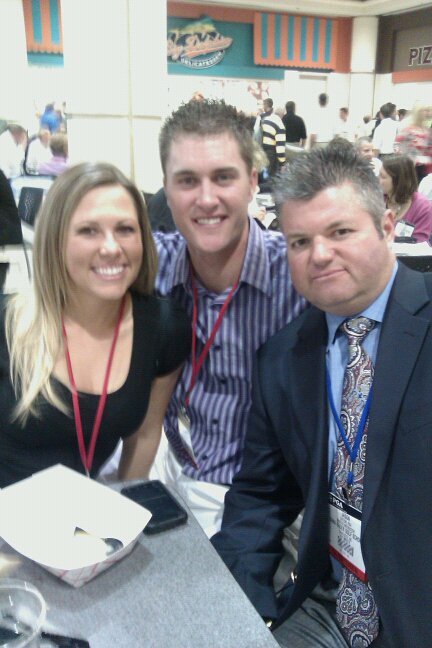
Sara Brown, Derek Radley and Me
Thursday (Day 1): Twitter has definitely made the world smaller and has allowed me to meet some great people along the way. The day started out by meeting up with Jason Helman (jasonhelmangolf.com) my friend and teaching pro from Canada. We walked the show for most of the morning to check out the new gadgets in the world of teaching. We met up with my good friend Derek Radley and his girlfriend Sara Brown (big break star and Rookie LPGA player), We had some lunch with her dad and the commisioner of the Futures tour. It was like walking around with a rock star as everyone recognizes Sara from TV. After a great meeting with my Callaway rep, Tim Garrett, to order my new clubs for the year, I ran into Rob LaRosa, Head Professional from Sterling Farms CC. We then made our way over to the Aimpoint booth to meet up with John Graham (@johngrahamgolf). We all walked over to the Swinkey training aid booth to
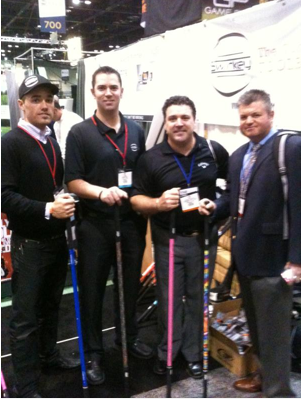
Swinkey Time
meet the boys http://swinkey.com and discuss the product and take a few pictures. So day one was just feeling out the location of the stuff we were interested in and meeting a few of the tweeps. After the show is when the good stuff happens if you are there. For those that follow me already know about the TWEETUP. This is a gathering of guys and girls that know each other on twitter. John Graham was nice enough to put it all together so about 30 of us met at Millers Ale house that night. Here is a list of some of the guys that I met: David Wurzer, Jason Helman, Dan Carraher, Ricky Lee Potts, John Randle, Dennis Sales, Claude Harmon, Joe Hafera, Nick Clearwater, Sean Lalley, Rich Hunt, Todd Halpen, Bobby Siravo, Jamie Donaldson, Mark Sweeney, Bernie Najar, Ralph Perez, Andrew Lewis, Sara Dickson, Kirk Oguri, John Dochety, TJ Yeaton and Mario Bevilacqua. I wish I could have spent more time with everyone but I managed to get an idea of everyone’s teaching philosophies and backgrounds just by observing and listening to their conversations. I apologize for not taking more film as this one would have made a great reality show and surely would have went viral in an hour, but didn’t want to make anyone uncomfortable. I wish I would have taken pics. I was so busy talking that I forgot to eat. No one got hurt although Doc (John Dochety) almost hit Ralph (gotham golf blog) with a front side chop as they battled over a #4 accumulator discussion. At the end, they hugged it out and we all made it home safe. I thank all of you for being willing to share all of your brilliant golf info so freely as this is what is going to help our industry grow and make us better coaches. It was great to finally put some of the names with the faces (and twitter handles) together. I also got to spend some time with two of my mentors and top 100 teachers, Chuck Evans and Charlie King which was great. I always learn something after spending time with them. I ran into new top 100 inductees, Charlie Sorrell and Mark Steinbauer and congratulated them on their accomplishment.
Jason Helman and John Graham at the show
Friday: The day started with checking out and getting more info on training aids. I know you all are waiting on my reviews so you can run out and buy or hopefully take a lesson from me. I will be doing video reviews as I get to use them in the coming months but here are my list of aids that I found interesting:
1. Swinkey(www.swinkey.com). One of the most versatile aids on the market for sure. I saw many swinkeys in the hands of people walking around the show so I think Todd and the boys did well. I highly recommend this product for any serious golfer who wants to improve. I would do a video review on it but unfortunately I don’t have an aid. I think I will check with Jim McLean and borrow his as I heard he got one for free, (just messing with you Todd). It was great to meet Disco Stu as well, he made his way around the show displaying the product with his cool World Cup jacket on. (great idea by @jasonhelmangolf) This company has a bright future for sure. Right On!
2. The Medicus Vision Stick: (www.medicuscatalogue.com) Endorsed by my good friend Chuck Evans and I look forward to using this one for path and low point training
3. Tour Striker:(www.tourstriker.com) Not a new product but I picked one up because I love the idea of helping players with impact and forward shaft lean. You have probably seen the infomercial on the golf channel.
4. Power Lag + Flat Wrist Pro(www.Powerlagpro.com): This is a devise that fits on your lead wrist and the back of your trail wrist to help feel the correct angle on your downswing. Developed by Sam Shah who invented the pivotpro. I will let you know how this works
5. The Perfect Release: (www.perfectrelease.com) An interesting aid that Martin Hall used on his first show on the Golf Channel. It is a bungee cord that connects your trail arm and the club shaft.
Possible candidates:
1. Drain-O Instant Pro Putting Fix -(http://www.drain-o.com/). A putting path aid made up of two tripods and a curved wire. I did shoot some video on this one. Might get one in the future.
2. Putter Master(www.puttermaster.com): A bar that is positioned across the wrists and helps keep your forearms square.
So the day ended with the an excellent putting seminar with my good friend Todd Sones and he was joined by Mike Shannon, the putting instructor from Sea Island. These two guys and who I learned how to teach putting and I always learn something new when spending some time with them.
Saturday: Last day at the show concluded a great week. I caught up with my new running mate from Ontario, Jason Helman and we caught a couple of short seminars on the main stage. I enjoyed the one with Suzy Whaley and her junior golf program with stations and fitness games that got the kids excited. Definitely the wave of the future of junior golf. Creating young athletes and then teaching them to play golf. I hit some of the new Callaway equipment on the trackman which was pretty cool. It got me excited to get back and play some golf when it warms up. Mr. Helman and I met John Graham and a friend for dinner to spend some more time before the week ended which was cool. I got back to the hotel and thought my night was done and then it happened. I get a call from TJ Yeaton, John Dochety and Mark Walder and we realized that we were staying in the same hotel so we met for drinks. For the rest of the night I was schooled in the world of Mac Ogrady’s MORAD system and some great stories about their experiences as only doc can describe it. You will be hearing from these guys as they are some of the brightest golf swing professors that I have ever met. There is so much more that I could tell you but you will have to get that from me on the lesson or a phone conversation. I want to thank Jason Helman for putting up with me all weekend and John Graham for allowing me to meet so many new friends. Let me know if I can do anything for any of you as I am in debt to you all. What a great way to kick off the season.
As we all get cabin fever this winter, I am constantly getting questions of how you can work on your golf game indoors. There are several ways to be effective inside but few are as valuable as “mirror work”. Of course you can putt in the house (hopefully with the Kure) and chip balls into the sofa, just don’t skull it please……..but standing in front of a mirror and going through the positions that you are trying to change can be helpful. Slow motion swings require patience but can change you faster than banging balls at full tilt when it is difficult to actually feel everything that is going on. So before you start your mirror work here are a few rules:
1) Understand what you are working on and where the club and your body should be. Hopefully your instructor has made it clear to where the club should be or body positions etc. ( If not you could be doing more harm than good)
2) try a weighted club, a swing fan or an Orange whip trainer to your session for a bit of a fitness workout.
I will be shooting a few videos on this subject when I get the time but until then, enjoy a video archive on changing the club face in the mirror.
.
Follow me on twitter @ twitter.com/onplanegolf.com or friend me up on facebook @ facebook.com/jasonsuttongolf.com…….to work with me at the Dana Rader Golf School call 704-542-7635 to schedule some time.
In the midst of another P.G.A. Merchandise show, I think for those who don’t participate just don’t know what they are missing. I enjoy seeing the new products and gadgets but that is not why I attend. I make the trip to Orlando to network with other professionals and friends in hopes to find a few nuggets or ideas that will help me guide my students when I get back. My students can’t wait for me to get back because I always have some great information and stories to tell that will enhance their golf games. Information is not just going to jump in your lap. It is not going to knock you down and crawl all over you. You must be a seeker and sometimes it takes courage to learn something new because we are all afraid of being wrong. For all you zen lovers, “You must be an empty cup”. I have attended the top 100 Golf Magazine party with my boss for the last 7 years and I always set a goal to meet a new teacher that I admire and be prepared to ask an intelligent question when you get that opportunity, because it could be a small window. This takes courage (and maybe a few glasses of wine,shh!). Your networking moment may happen when you least expect it. Here is a story: Last year an editor friend of mine asked if I would stop by the Cricket of Arms” pub for a pint because he wanted me to meet his good friend, Craig Shankland. For those of you who don’t know Craig, he is a legend in the teaching and playing game. Top 50 teacher and just a great guy. In the first five minutes he could tell how passionate about coaching that I was and he was gracious enough to share valuable information about his teaching and great stories about his good friend, Moe Norman which was priceless. We talked for about 2 hours over a few pints of Guiness and it was awesome. I shared with him my goals and this was the two pieces of advice that I received:
1) Keep writing as much as possible because that is what keeps your ideas fresh and your brain thinking and growing.
2)Pay attention: MAKE YOUR PLAYERS MULTI-DIMENTIONAL (He is very old school and teaches many LPGA players). He said that you have to be able to adjust to every lie and can’t fall in love with just one swing plane. He doesn’t use video very much and takes his students out on the course for the majority of the lessons to greater prepare for all of the different shots that make up a round of golf. (The Ultimate In Coaching)
The time I spent with Mr. Shankland was the highlight of my trip for sure so keep your eyes open for opportunities for learning and growing. I will be forever greatful for the time that he spent with a nobody teacher like me. I hope that someday I can be that person sharing all that I have learned to a young, hungry professional.
To succeed as coaches we must be versitile and know when to teach and when to coach.
Here are some quotes from Tiger Woods. Maybe he needs to reread these to get back to the days when he was free to self-discover.
“My lie dictates the shot I will play”
“I always listen to my body”
“Some days when I warm up I am hitting the ball low, other days I am hitting the ball high. some days the ball is drawing, other days it is fading. i just play what i am doing that day”
“Today when I practice I like to play games-in fact I like to practice more than play on the course. I still try lots of different things, just like I did with my Pop”
“We always practiced together seeing who could make the most 5 foot putts”
“As a child the club and the ball became my playmate”
“Ultimately golf is a journey-full of learning and discovery”
“On normal shots, I swing 75% of my power, on longer shots I swing at 90%. If I go all out, I do not make solid contact-which is most important.”
“There are no shortcuts- golf requires patience and perseverance, with a yearning for learning. Accepting the fact that it is a game of ups and downs and learning every time you play”
“when I play-it is almost as if I get out-of-the-way and just let it happen. I let it happen, I do not make it happen.”
“I won 12 times in the year 2000, including 3 majors and I only remember hitting one shot I would call perfect. It was the 3 wood on #14 in the third round of the British Open at St. Andrews. AS with every shot I attempt, I visualize that ball flight and the shot turned ou exactly s I had planned. Moments like that stay fresh in my mind, providing a positive image for future reference.”
“I will always be respectful and gracious to opponents-but I want to win, to beat you by a lot, to beat you bad.
I look forward to hearing about your P.G.A. Show learning moments. What are you waiting for……GO FOR IT!
What is your teaching philosophy? What do you consider a successful golf lesson? How do you know if the student gets it? These are all questions that should keep coaches up at night, I know it does me at times. How do we improve our teaching process in order to help the student learn more efficiently. One of my mentors, Martin Hall, told me once,”If the student gets better, good teacher, if they get worse, bad teacher,”. I believe this is true as there are many ways to reach a goal. I am sure if we put all the top coaches in a room together and gave them the same student, we would surely get a myriad of answers, fixes and directions in which we would take them. We all have our opinions that we stand behind (methods/non-methods) but how do we really know. On my continued quest to become the best coach that I can be, I am going to do a series of posts that hopefully will be thought-provoking and cause you to consider your philosophy (RIGHT OR WRONG) and how to improve it. The key to learning is to have an open mind and be ready for new information. So here we go! In the age of technology with (trackman, k-vest, video analysis and 3 d simulators) and updated information about ball flight laws (the d-plane, cp release vs. cf release, angular momentum and hsp vs. vsp, stack and tilt, morad, one plane, two plane etc ) and new equipment and training aids, we have more information as coaches that can help the student through the learning process than ever before. The ability to apply the information that you have learned or memorized is the key. Because without positive results, what good is the information. It just makes us feel smart or educated. The key is not to leave out the most important factor, “The Student”. I teaching has always been built around a student centered approach, whatever you teach this is the most important. I am reading an interesting book written by Michael Hebron, whom I greatly admire, called “Play Golf To Learn Golf”. There is so much information that he has researched that it would be impossible to share all of it so I want to give you a few nuggets that will describe his philosophy on what he calls “Playful Learning.”
Whatever I know, or what I am given credit for knowing is not very much when compared to what could be known (I am going to put this on my bulletin board for sure). To keep investigating, looking for “the yet uncovered,” to help people grasp unfamiliar concepts so they can make progress, is my philosophy.
Mr. Hebron states:
Whenever you try to help a golf swing you can win or lose-but when you help a golfer you always win. Help golfers become less dependent on their coach.
The student and their needs are always more important than what the instructor wants. The aim of effective instruction is to be a practical guide. (sound familiar)
Any approach to instruction must take the “nurture of learning” into consideration, if it is going to be effective.
Mankind is born playful, and when we play to learn, we don’t learn to play (hmmmm.?)
Workable instruction does not try to change poor habits, it changes poor insights, and develops patterns or access to knowledge
Many golfers see their poor habits as “riddles” that can’t be solved and often look to someone else for answers that only they themselves can answer and solve. Progress in golf is founded on the problem on the problem solving skills of the student (see options)
Teaching is really the art of assisting discovery
A “breakthrough” in learning is a breakout, or breakaway from a past point of view, opening new learning paths.
Most golf advice and swing models are based on someone’s description of body parts in motion, overlooking the alignment and application of force with the club through impact. The ball flight laws should be exchanged for the golf club laws.
Are the wheels turning yet, let’s see if this helps. Here are some random thoughts on “Playful Learning”
Trying to teach is different form helping someone to learn
Learning is influenced by change and unfortunately many individuals believe making changes requires trying to “get something right”, or trying to fix something. Studies show that fixing has never been learning, and trying to “get it right” creates the kind of stress that fragments progress. (my next topic of video pro models “helpful or not”)
Efficient approaches to learning ask students what they would like to improve.
Efficient approaches to learning improve a students capacity to learn.
Students want to learn. Judge them and students will not make the kind of progress they are capable of.
Pointing out mistakes is a poor motivator
One last one: “It is the student who often reveal the best way to help them experience the kind of learning that lasts.
The main thing that Mr. Hebron is trying to convey is:
Ask the right questions, Listen to the student and always keep the student involved in the learning process and we can all say that we gave it our best effort as coaches. Be careful of the language that we use, the pictures that we create and the expectations that we put on our students. I have plenty more to discuss but I will let you all digest this and talk amonst yourselves. Remember, they don’t care how much you know until they know how much you care. Keep caring and we will all figure this thing out together.
Feel free to leave a comment below and use the share buttons appropriately if you think this is helpful




 The Golf Guru Show