Golfers….Stop Majoring In the Minors!! Keys To Being A Better Student


I haven’t posted anything new in a while and received an excellent topic from one of my twitter friends, Blaze Grinn (click to follow him on twitter), which is “How to keep your students on task?” I know I post a lot about how we can get better as coaches and teachers but this is about the students and ” How To Be A Better Student.” If you are out there trying to get better at this crazy game, how do you do it? This is an important question that you need to ask as we get ready to start a new year and golfing season. We all set goals and expectations but I can tell you that you must assemble a quality team to have any chance to achieve them. The first person you need to hire is your golf teacher. One that you trust, has the knowledge and expertise to answer your questions but more importantly is willing to be a part of your plan to achieve your goals. So here are some important ideas that have to be considered before you take a lesson.

A Commitment Level  That Matches Your Goalsreach_for_the_stars_poster-rdcd2d3071ab84c329c371c2a675982e6_ayhe_152

1. Expectations Must Match Commitment – One of the first questions that I ask every student after establishing a specific goal is “How much time do you have to practice and play?” For example: If you are a 16 handicap and want to be an 8 handicap by years end and you are able to practice once a week and play once on the weekend then you are not being realistic. It’s like myself starting to work for your sales force and wanting to break all of your records but only wanting to work the standard 40 hours a week. It isn’t going to work, so be realistic and share BE HONEST with your coach so you can set goals that you can achieve.

2. Trust Your Coach No Matter What – Your coach has your best interest at heart and I would encourage him to lay out the plan for your improvement and be specific. If might look like, (takeaway, pivot, path) = push draw that doesn’t cross target line (goal). Or it may be a short game or putting specific plan. Whatever it is, you must stick to the plan. If it is not on the list, don’t waste time worrying about it because YOU think it is the right thing. (you are not the expert)

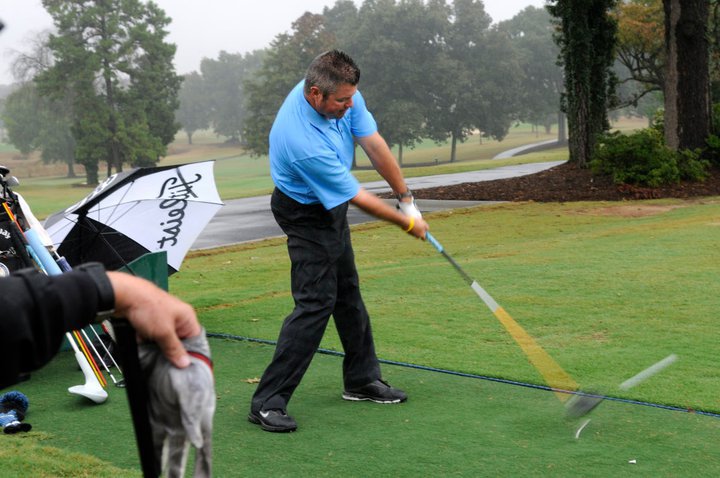
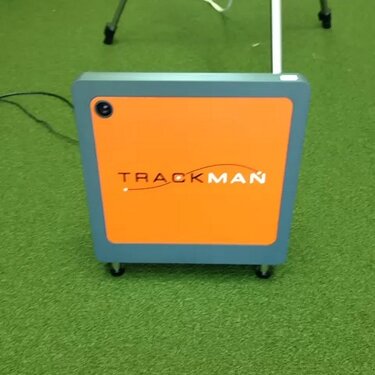
3. Looks can be dangerous – One of the things that I have learned from teaching with TrackmanTrackman is that impact alignments are always more important than the look of a swing. I understand that there are position changes that often need to be made in order to change ball flight but it is about a repeatable impact condition that is important. It is up to the coach to discern whether you can achieve the goal with your individual move and if it is worth changing. Don’t change for a picture but rather a result that will hep you play better.  Most of the time students fall into the trap of trying to look like someone they saw on TV or in a magazine or better yet one of their playing partners. Clarification by the coach is important is this respect and is necessary to make sure you are working on what is important instead of what is perceived to LOOK good. Example: If some coach would have tried to change Jim Furyks’ position at the top, we may have never heard of him. It is a good thing that his father figured out that he was repeating where it is important and didn’t change it.
4. Stay Focused On The Majors – When taking a lesson it is important to not try to get ahead of the teacher of out think the process. Stay focused on the couple of things that the learning picinstructor has you working on and that’s it. Typically lessons fail because the student has a hard time letting go of what they thought they should be working on instead of focusing on what the teacher is trying to get you to focus on. STAY ON TASK! This is why video can be dangerous for some students because they try to pick apart what they had in their mind as the perfect swing. Your coach must guide you to look at ONLY what is important (Major). If they don’t mention it, let it go!

Give Constant Feedback

As much as your instructor is trained in reading your body language, your verbal feedback dufneris crucial to the success of the team. (you and your instructor). It starts with sharing your injuries, past surgeries and aches and pains. I love it when I ask this question at the beginning of the lesson and I get nothing, only to find that the student had surgery on their left knee. No wonder they were having trouble getting their weight forward at impact. Even though you think it is not affecting your motion, let your coach decide as he evaluates your move. Most of the time it matters and you don’t realize it.

5. Share Feels and Observations – There is nothing worse than a quiet student in a golf lesson. Whether the shot is good or bad, giving constant feedback on how you liked the shot or what it felt like is valuable information for the coach. Otherwise we are only assuming and trying to read body language. The words that you use to describe each shot and how it felt gives your coach a clear indication on your learning style and what drills, type of language or external cues to use for your progression.

6. Keep a Golf Journal – With all the technology that we have to help us play and learn journalbetter, I still see value in the “old school” act of journaling. I encourage my students to get a notebook and write down everything from: What they took from each lesson (confirm with your coach), what drills they did in practice and how did they feel, to what didn’t work in their practice session. Failures can teach us some very important lessons that will help us improve. I believe that writing can help organize your mind and help you to stay on task which will help you……….wait for it…….

Major In The Majors! 

Stick to what is important and stop worrying about what isn’t part of the plan. Lets have a great 2014 and I hope you all reach your golfing goals.goal chart

Please leave you comments below with your thoughts and don’t be afraid to share and follow me on twitter @golfgurutv

Merry Christmas,

Guru

A Guest Post From “The Golf Geek”: How Rat Poison Can Get You Target Focused


Here is a guest post from my good friend Allan from the U.K. He has a passion for the game and some great insight. I always enjoy a view from a passionate golfer and I hope you enjoy this insightful and creative post. Please leave a comment below.

About the Author

Dr Geek is a golf-obsessed physician who uses his medical knowledge to suggest how you can��improve at golf. If you sign up for his newsletter, you’ll get a copy of his eBook (worth $9.95) absolutely free. He’d love to welcome you to DrGolfGeek.com, so please swing by his site.

If I were to tell you my knowledge of pesticides helped lower my scores, you’d think I was mad, wouldn’t you?

“Poor old boy” you’d say, “the strain of producing thought-provoking content just proved too much for him.”

You’d bring me cups of�chamomile tea and speak in a soothing voice until the doctors in sandals and socks could take me off to their hospital with lockable wards.

And yet that’s exactly what’s happened.

(Rat poison lowering my scores, that is. Not the enforced move to the wrong side of a locked ward)

I can see this might take some explaining.

Pull up a chair, and I’ll be as entertaining and as swift as I can.

When it comes to long putts, there are 2 schools of thought.

The first suggests that the hole shouldn’t be the target, as it puts too much pressure on the golfer, and the chances of holing out from 30 feet are slim. Aiming for a three foot �dustbin lid� area around the hole is instead suggested.

Advocates of this school argue this leaves more margin for error and increases the possibility of holing out in no more than 2 strokes. This seems to be the prevailing view of the traditional paradigm of golf instruction.

However, other coaches argue we should choose a very small and precise target, as this suits the way our brains work and means the ball is more likely to finish nearer the hole.

This means the hole is always the target for long putts. For short putts the hole is too large a target, and a smaller target, e.g. an individual blade of grass or a speck of dirt inside the cup, should be your goal. These coaches advocate choosing �the smallest target you can see without squinting� for any given shot.

Golf is too civilised for this disagreement to turn nasty, but these views appear to be as firmly held as they are divergent.

I don’t just know the answer…I can prove it .

And I’m going to tell you too.

A big claim, I know. And you could be forgiven for wondering if I’ve duped you into reading this with a juicy headline that bears no resemblance to the ensuing post.

After all, there’s no way rat poison could hold the key to this. No chance at all.

But you’d be wrong.

Incredible as it may seem, my experience of the use of rat poison in a very specific setting really has told me all I need to know about target focus.

This will need a little background information to make sense; please bear with me and all will be revealed…

Warfarin is an anticoagulant � a medicine given to prevent blood forming clots. It was originally developed as a pesticide; it was discovered after cattle started bleeding to death after eating mouldy silage made from sweet clover.

It was initially marketed as rodent poison � rats would eat it as it was both colourless and odourless. It�s still used for this purpose today, although most people use newer poisons.

From the mid-1950s it�s been used (in much smaller doses) in humans for the wide variety of medical conditions caused by, or complicated by, blood clots. It’s now the drug most widely prescribed for this purpose in the UK and USA.

Although it’s very effective, there are a number of difficulties with its use. Response to it varies from individual to individual and a great number of other medications can interact with it.

Careful monitoring is therefore essential as there’s risk to the patient if the level goes too high or if it drops below the effective level (known as the INR). A blood sample is taken, and there’s a range of acceptable levels (in most cases this is 2-3, in some cases it can be 3-4).

When I first started work we aimed for levels within these ranges, knowing the drug would be effective.

This is similar to aiming for the three foot �dustbin lid� around the hole.


Difficulties arouse, however, with scores that were just outwith the recommended range. There’s no evidence warfarin with a level any lower than 2, and yet it was quite common to see patients with an INR of 1.9 without any change proposed to their usual dose. The same happened at the upper end, for example 3.2 being seen as acceptable, despite no evidence of greater benefit to offset the (albeit slightly) higher risk of bleeding.

I’m pleased to say this isn’t the case any longer.


So what changed?

 Our target focus.


Instead of aiming for a wide range, we now aim for a precise target in the middle of the range (2.5 or 3.5). This has led to more scores falling within the target area, and far fewer falling outside it.

If you go for a broad target you increase the �scatter� of shots around your target. This is because your margin for error is happening at both ends of the range, rather than around one point in the centre.

When your target is in the centre of your acceptable range, more shots fall within that range. When your target is less well-defined, so too are your results.

This isn’t just for putting; it applies to all clubs – from putter to driver and everything in between.

Decrease the scatter and improve your accuracy.

Aim for the precise target, then accept results which fall within the range.


And let rat poison guide you to lower scores.


Thanks for your outstanding blog post, Dr. Geek. It proves the point that your commitment to the target has a great effect on your overall accuracy. I am in this camp that you mention for sure. This is a great prelude to an upcoming post that I am going to do on “The Talent Code”.

If you find this post helpful, please feel free to use one of the share buttons to spread it around.
follow me on twitter @twitter.com/onplanegolf and follow the geek @twitter.com/the_golf_geek

See you on the lesson tee,

Jason (call 704-542-7635 to schedule a lesson with The Guru

What Can I Do For You?


Welcome to your full service golf information blog. If this is your first day viewing my blog, welcome to Guru Nation. For those of you who follow me, thank you and let’s get busy on making this upcoming golf season the best ever. I have my goals in place and am very motivated to help as many golfers that I can with their games and also help coaches with information that will enhance their teaching. Some of my projects for the upcoming year include: authorship, improving my video/tv quality (Guru TV), writing for magazines, speaking appearances and blogging of course. I spend a lot of time trying to figure out what my audience needs and what they might want, but it is a guess at best. I frequently get the question,”Guru, how do you come up with all of your ideas that you blog about?” Most of my ideas are formed by my students that I work with on a day-to-day basis. My experience on the lesson tee is priceless. I learn something new every week that I spend talking to and helping people. So, In an attempt to achieve my 2 goals for this blog 1) to educate my readers and help your golf game and 2)grow my readership in order to reach more people so I can affect their golf games and their minds. SO I NEED YOUR HELP. Here is my charge to you, yes you.

1. TELL ME WHAT YOU WANT TO SEE IN THE WAY OF POSTS AND OR VIDEOS

2. TELL SOMEONE ABOUT MY BLOG. SHARE THIS BLOG WITH AT LEAST 3 OF YOUR GOLF FRIENDS THAT YOU THINK WOULD BENEFIT FROM THIS INFORMATION

Whether it is players or coaches, let’s get some dialogue going and help me bridge the gap between learning and getting RESULTS, which is the goal of every player or coach.

I look forward to hearing from you and I ask you again

WHAT CAN I DO FOR YOU?

Follow Me on twitter @twitter.com/onplanegolf or friend me up on facebook.com/onplanegolf (Jason Sutton)

See you on the lesson tee,

Jason Sutton

704.542.7635 or danarader.com

20 Days With the Guru, Day 19: How To Choose A Golf Coach


As you set your goals for 2011, your golfing success could hinge on getting the right

which one are you?

coaching for you and your game. Golf is a game that is difficult to learn without another set of eyes and some guidance through the learning process. This is why the best players in the world on the P.G.A. and L.P.G.A. tours have coaches that keep an eye on their technique. A great coach is not only a swing changer but can be a valuable sounding board for a golfer in all areas including the mental side and course strategy. Sometimes an individual to listen to a post round synopsis or an encouraging pep talk before a round can be the difference between success and failure. I believe in coaching in all areas such as business, spiritual and physical fitness as it pertains to your needs in golf and in life. The question becomes,”How do I find the best coach for ME (you)?” Here are some ideas that may help push you in the right direction:

1. First, decide on what type of lessons that you want. Private or in a group setting. I think groups are a wonderful way to learn the game with friends and family. Small groups (4:1 ratio or less) is a great way to meet other golfers of like ability. Private instruction is for the golfer that needs more attention. You decide.

2. Do your research: Just like making any major purchase, I would suggest doing some homework. Here are a few keys to get you started. 1)ask your friends that take lessons (if they are getting better) who they see. 2)Ask the better players at your club who has the best reputation, they will tell you.

3. Interview the coach before hand. 1)ask them their teaching philosophy (if they can’t give an educated answer or say something like “I just keep it simple”, might not be worth your time. 2)Are they busy? Great teachers teach alot because their students come back. Ask them how many lessons they give a year. Easy sign of a successful coach.

4. Check out their website, blog or videos. This will give you an idea of their personality, teaching ideas and presence before you contact them.

5. Is the coach easily accessible for follow-up questions – I have no problem giving my students my email address and social site handles so they can contact me whenever they want. The last thing I want to do is leave them out there without there questions being answered. If I don’t, someone else will.

6. Does the coach ask you for your golfing goals? Do they listen to your feedback? There are too many coaches that are self-centered and have their own agenda. They might have lots of knowledge but it is useless unless applied to help the student improve.

7.  Ask what kind of training they have had and how did they learn to teach and coach. Will give you some insight into what you might get during a lesson.

8. Finally, you can tell if the coach enjoys what they do and is passionate about teaching golf by their body language and personality. Do they dress an act like a professional? Find a personality that will help you improve. Some need nurturing ann some need tough love. An expert coach knows when to do both.

Books are great to learn new ideas and to see pictures on different skills. Videos are great for the visual and auditory learners to help clarify and educate golfers. These things will only take you so far…………NOTHING CAN REPLACE spending time with a great golf coach. The only way I can allow you to feel what I am teaching you is to use my two favorite training aids: MY TWO BARE HANDS. I am a master of manipulating my students during the lesson and creating the correct feel for the change. The other venues simply wet your appetite, you must join me on the lesson tee to get the FULL COURSE MEAL. Just like any business or occupation, there are good teachers and then there are not so good teachers. Choose wisely and you will be able to enjoy this great game for many years to come. I don’t care what your buddy might say after he shot 130, It is always more fun to play better. Heres to your greatest golfing year ever, 2011

See you on the lesson tee,

Jason

King Louis Dominates The Open: His Classic Swing and The Red Dot


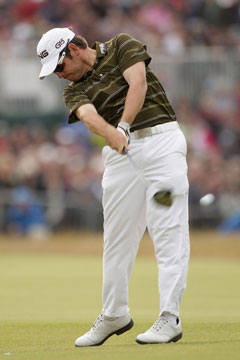
Louis Oosthuizen, the young South African, dominates the 2010 British Open with some steady driving and unbelievable ball striking. How about the live pro tracer that they used on the 17th, now that was cool technology. I have had some questions about the red dot on Louis’ glove and what I thought he used it for and what he was thinking….I will get to that in a minute. Let’s see what we can learn from his very simple looking golf swing as I have cued up a slow motion video of Louis hitting a driver.in driving. 1) He has a very solid set-up with excellent posture and balance to start from. 2)Copy his one-piece takeaway with the arms, shoulders and chest move at the same speed into the waist-high position. Notice how the club head stays outside of his hands and in between his forearms. This creates plenty of width for his backswing. The club is right online at the top of his swing which makes it easy to transition into his forward swing. 3)He has a very smooth transition in which he separates his lower body and his upper body which allows the club to drop into the slot and stay right on plane. 4. He delivers the club from the inside which allows a free release of the forearms, hands and clubhead. He made great swing after swing the entire tournament which is why he led the field

Full Release

What Was The Deal With The Red Dot Guru?

It’s no secret that the greatest players have a pre-shot routine that doesn’t vary too much from shot to shot. The initial part of every routine is what is called a “trigger” or “a call to action”. Some players use the hitching of their pants like Palmer, Couples, Furyk. Some use a club raised over head like Mediate or the velcro on their glove like Els. A raise of the left shirt sleeve like Tiger Woods. You can’t expect to focus for the entire round and you shouldn’t try. You must be able to turn it on and off when it is your time to play, maybe 30 seconds at a time. Louis used a red dot on his glove that he and his mental coach, Karl Morris came up with to bring him back to the present when his mind wandered. It helped him enter “the zone” when it was time to play each shot. I have often used a word or a phrase for my players like “no fear” or “focus” but anything will work if you will stick to it. Try something like this the next time you play that will allow you to get into every shot as it was the only one that you will hit, afterwards……Accept and let your mind wander until the next shot. This was how King Louis kept so calm and was able to not picture himself holding the trophy too early as many of us do when we are having a career round. Here is a short article that I found that explains it further…..The Red Dot.

I hope this explains the red dot and thanks for your question Steve. Feel free to comment on the Open championship as I have heard mixed views on how the fans liked. I think it was great and we just may have seen a star born.

See you on the lesson tee,

Guru

Guru’s Keys To Breaking 80:”How To Join This Elite Club”


The Bullet Proof Vest For Golf

Every golfer has goals. Mostly of breaking one of three scoring barriers: breaking 100, breaking 90 or breaking 80. The lower you get the more difficult this achievement becomes. According to NGT Research, there are over 60 million golfers in the world today and less than half of them will never break 100.  33% will break 90.  However, only 5% will ever break 80.  That’s 3 million people out of 60 million golfers. So this makes breaking 80 an elite club for sure. If you have done it once in your life, congratulations. For those of you who follow the guru’s blog already know my formula for breaking 100 and breaking 90. Recently, one of my twitter friends posed the question,”What are your keys to breaking 80?” So after some thought and a bit of research, Here are my keys to success. Building from my list of breaking 90…………..

1. Drive the ball in play and average 230 yards. I am assuming that you are shooting in the low 80’s from the back tees at this point.

2. Most Important: You must average 8 greens in regulation. Assuming you make at least 2 of 8 birdie putts and don’t three putt. This leaves 10 greens that you have to chip, pitch and hit bunker shots.

3. Get it up and down an average of 40 percent of the time. This leaves us a few shots to play with

4. Limit three putts and average 32 putts per round. 2nd most important stat.

Get in the habit of keeping your vital statistics of your rounds of golf. FIR, GIR, Putts/round and up and down pct. If you are looking for a website to keep stats and track your progress, I suggest ShotbyShot.com.  This will give you starting point and show you how close you are to reaching this barrier that most golfers can’t cross. Of course, this is just my opinion and there are many factors that go into a golf game that help make up the level of player but this is a great place to start. Here are a couple of ideas that just might get you over the hump if you are trying to turn 81 into 79.

1. Use the 80/20 rule. If you do find trouble, don’t be Phil Mickelson and try to hit the career shot. If you can’t pull it off at least 80 percent of the time, play it safe. Punch it out and make your bogey.

2. Aim for the middle of the green. Refer to my past post of the stop light theory. There are very few green lights out there, proceed with caution and hit more greens.

3. Work on your mental side. Focus on pre-shot routine and TARGET and quit playing golf swing. Ask yourself 2 questions before every shot……”Where’s my target?” and “How do I want to play this shot”…..Sure beats standing over it saying, “Just don’t hit it in the water”

Best of Luck with your golf and enjoy the journey. I will see you on the lesson tee.

Are you tweeting? Friend me up @twitter.com/onplanegolf and get use the @sign to join the conversation.

Guru……….. call 704.542.7635 to schedule a lesson or check out our website at danarader.com

Predicting Ball Flight is The Key To Great Golf:Whatever the Ball Flight


Jack and Tiger
Jack and Tiger

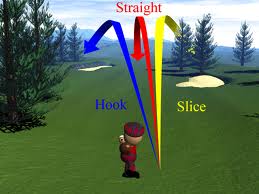
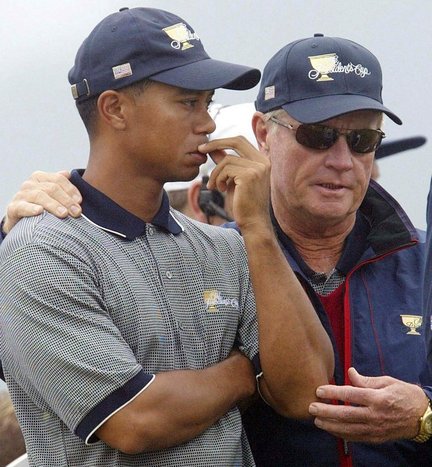
Great golf is about predicting the shot you are about to hit, simple as that. I get aggravated with students that I work with that think that they must hit a draw. There was a guy named Nicklaus (whom I named my very son after) that won a few tournaments while playing a fade. Ben Hogan talked about hating to hit a hook. Now, if you hit a 30 yard draw or hook and can repeat it then you will do pretty well. The main thing in my opinion is taking one side of the course out of play if possible. This gives you a one-sided miss which again is predictable. Something that I still teach in course management classes and playing lessons is not crossing your line (this is something that Jack Nicklaus often talked about especially at Augusta). What this means is this: Imagine that you are playing number 13 at Augusta and are hitting your second shot into a back right pin. According to Nicklaus, the shot calls for a fade that starts left of the pin. The key is to not let the ball flight cross over the target line and finish right of the flag. the same goes for a draw shot into a back left pin. This is a great way to manage your round. This means that you can’t shoot at every pin but should take advantage of shots that fit your typical ball flight but not over do it to miss on the short side. DON’T CROSS YOUR LINE AND YOU WILL PLAY GREAT GOLF AND WHO KNOWS, MIGHT GET YOU A GREEN JACKET. predictability and consistency in your misses are the key to great golf. Thanks for letting me vent and I will see you on the lesson tee.

Guru

danarader.com 704-542-7635

Are You Shooting at Every Flag?


I haven’t posted much on the mental side but this is something that I teach in my playing lessons every time. Most amateurs have no business even looking at a flag that isn’t in the center of the green. If there were no flags in the greens, what would you shoot? Most of you would play better. Here are my three factors that will help you decide on how to pick smarter targets.

1. How are you swinging? Do you have you A, B or C swing? Always have a pulse on your momentum. This will help you stick to your game plan. If you are playing well or playing poorly, stick to the plan.

2.  What club are you hitting? I suggest you rate your clubs. 1=favorite 2=medium 3=I loath this one

3.  Where is the flag located? I use the stop light system. Red Light: A tucked pin that you should never shoot at unless you are playing a captains choice. Yellow Light: An exposed pin that is close to the front or back of the green. You must be careful with your club selection because you could leave it short or knock it over the green. Green Light: A pin that is in the middle of the green and you can fire at all day

When making decisions on your approach shots, the ideal situation is when you have your A swing, A #1 club and A green light pin. This is what we call The Go Zone. If you are struggling with your swing, hitting 2 and 3 rated clubs and getting red and yellow pins………..Play it Safe. Hit more greens and shoot lower scores. Stay tuned for the next installment of The Jeff Passage Project….coming soon

See you on the lesson tee,

Guru