Golf Vacation Tips (Guest Post by Beth Myers)


As the season starts to wind down and have some time to reflect on the year, I promise that I will be doing some writing and shooting some videos to help play and teach the game a little better. Until then, I am always entertaining articles from guest writers. Here is another one from Beth Myers from East Coast Golf Sales. Thank you Beth for your submission.


Get Your Vacation on Track by Picking the Right Tracks

There are few things better than a golf vacation. First of all, vacations are great to begin with. Add in sunshine and golf courses you have never played and it is hard to go wrong. One challenge can be selecting which courses you are going to play. If you are heading to a

Briars Creek

golf hotspot, there are likely dozens of choices to pick from, with a variety of designs and greens fees. In addition, some courses are friendlier to women players than others. Following are a few points to keep in mind when selecting your vacation golf stops.

–          Keep it Easy. Even if you are a good player, nobody likes to get beat up on vacation. Choose courses that have relatively low slope ratings, and therefore are easier on your scorecard. Save the challenging tracks for a regular old Saturday – you are on vacation and should get to post a good score to go with your good mood.

–          Research Pace of Play. One way not to spend your vacation is waiting for the

Bandon Dunes #1 on my list

group in front of you to get off the green. Check web forums and review sites for insight into pace of play issues on courses you are considering. If a particular course seems to have a slow play problem, skip it in favor of quicker options.

–          Don’t Break the Bank. Vacations are not cheap, especially in the days of $4.00 per gallon gasoline. You do not need to stretch the budget even farther by playing super-expensive courses. You are going to have fun playing golf regardless of how much the greens fees are, so take it easy on the pocketbook. A good rule of thumb is to play one high end course on the trip, and play the rest of the rounds on less expensive tracks.

–          Picture Perfect. You will want to have some photographic memories of your trip, so pick courses that have great natural scenery. A course near a mountain or lake will provide an awe inspiring day of golf, regardless of how well you play. Be sure to remember the digital camera and take a quick moment to get some great shots for the scrapbook once you get back home.

The Ocean Course at Kiawah

–          Play With Others. If you are traveling with less than four golfers, always try to get paired up with another group at the course. In touristy areas, you are very likely to meet people from a wide range of places. This can be a great experience and makes for a fun day on the course chatting with someone from a different place.

Some of my favorite memories are from golf vacations. Golfers love trying new courses anyway – trying new ones far from home is even better. One other tip I have is try to play earlier in the day if possible. Sometimes an afternoon tee time can eat up your entire day and leave no time of other vacation activities. By getting up and playing early, you will probably have a better pace of play and finish your round with plenty of day left to explore.

Beth Myers is a passionate golfer, mother & wife…not in that order J.  She writes for East Coast Golf Sales on all things women’s golf – you could say she is a little obsessed.  Be sure to follow her on twitter @GolfBeth

What are your top 5 golf destinations? Leave your ideas in the comment section and feel free to share this article. Thank you Beth 🙂

You can follow me on twitter @golfgurutv

Guru


7 Yoga Poses For Golf (A Guest Post by Cindy Prosser)


Since I am not writing as much as I used to, I am entertaining offers from guest posts. It must relate to golf preferably. So if you have an idea and need a venue, feel free to contact me @jsutton@carmelcountryclub.org and send it over for my approval. Please welcome Cindy Prosser as she shares some yoga poses that will help you with your golf game.

Improve Your Swing with these Top 6 Yoga Poses for Golfers:

Golf is a sport where every detail matters. You’re focused on the position of your body behind the ball, your swing, and even some things that are out of your control – like how hard the wind is blowing. Did you know that yoga can help you greatly improve your golf performance?

In fact, there are six key yoga poses that are known for helping you improve your golf game. They’ll help you increase flexibility, hone your mental concentration, and improve your range of motion. They can also help minimize (or eliminate!) the common complaints of golfers like strained shoulders, a sore back, and tight chest muscles. Here are our top 6 yoga poses recommended for golfers (and check out our favorite mens tshirts at bare necessities too!):

Lunge: Let’s start with one of the most basic yoga poses – a lunge. Start on your hands

Lunge Pose

and knees. Step your left foot forward so it rests between your hands, making sure your shin is perpendicular to the floor. Press the heel and toes of your back foot into the floor. Draw your hips forward and push the right thigh toward the floor. Hold for 30 seconds and switch sides, then repeat 10 times. Benefits: Helps with balance and stretches your hips.

Revolved Crescent Lunge: Start in mountain pose and lunge your right foot forward. Your right knee should be directly above your right ankle so your shin is perpendicular to the ground. Press your left leg straight and draw your hands together at your heart. Twist from the waist and rest your left tricep on the outside of your right thigh while rotating up to gaze past your right shoulder. Press your palms together through the entire pose and hold for 30 seconds. Then, repeat on the other side. Benefits: Gives your hips a deep stretch.

Bird Dog Pose: Start on your hands and knees. Spread your fingers apart to stabilize

Bird Dog Pose

your hands so you don’t sink into your wrists. Make sure your knees are placed directly below your hips. While keeping your back flat, extend your left arm straight in front of you while extending your right leg behind you. Hold for two breaths, and then return to your original position. Repeat on the opposite side for 10 repetitions. Benefits: Improves core strength, coordination, and balance.

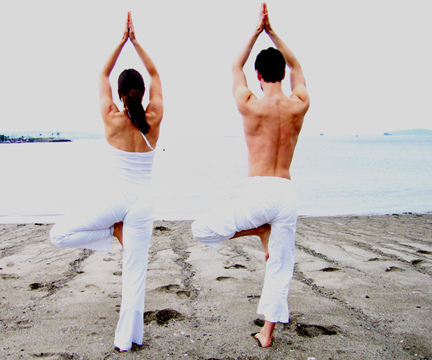
Tree Pose: Start standing up with your feet together. Shift your weight onto your left foot while bending your right knee. Place your right heel on the inside of your left knee and rotate your right leg out. Put your arms at heart’s center or over your head and hold for 30 seconds. Breathe deeply, then repeat with the other leg. Benefits: Improves breathing, balance, and mental focus.

Tree Pose

Locust Pose: Start on your stomach with your forehead on the ground. Your legs should be together, toes pointed, and arms resting alongside your torso with your palms facing up. Exhale and lift your chest, head, arms, and legs off the floor while keeping your shoulder blades back and down. Hold (and breathe) for 10 seconds, and then lower your body and rest for 20 seconds. Repeat 3 times. Benefits: Strengthens back and lengthens your spine.


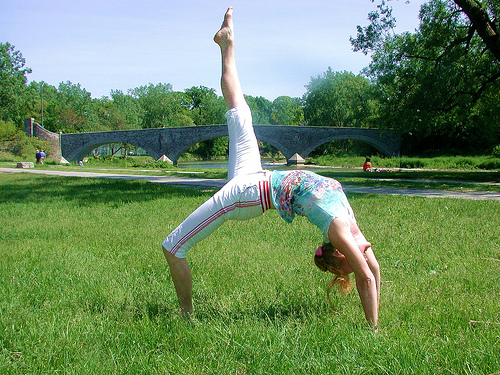
Bridge Pose: Start on your back with your knees bent and feet resting hip-distance apart. Put your arms by your sides with your palms facing down. When you inhale, tuck in your tailbone and press down through your hands while lifting your hips into the air. Your knees, hips, and chest should fall in the same straight line. Breathe for 20 seconds, rest, and repeat 3 times. Benefits: Strengthens hips, hamstrings, and lower back.


And there you have it, folks. Try out these six yoga poses and you’ll see an improvement in your golf game in no time flat!

About the Author:

Cindy Prosser approaches her golf game the same way she does shopping: by getting a leg up on her competition.  Cindy finds behind-the-scene ways to improve her golf stroke just as she finds behind-the-scene deals while shopping for mens tshirts at barenecessities for her husband. It’s a stroke of genius, really.

A Guest Post From “The Golf Geek”: How Rat Poison Can Get You Target Focused


Here is a guest post from my good friend Allan from the U.K. He has a passion for the game and some great insight. I always enjoy a view from a passionate golfer and I hope you enjoy this insightful and creative post. Please leave a comment below.

About the Author

Dr Geek is a golf-obsessed physician who uses his medical knowledge to suggest how you can��improve at golf. If you sign up for his newsletter, you’ll get a copy of his eBook (worth $9.95) absolutely free. He’d love to welcome you to DrGolfGeek.com, so please swing by his site.

If I were to tell you my knowledge of pesticides helped lower my scores, you’d think I was mad, wouldn’t you?

“Poor old boy” you’d say, “the strain of producing thought-provoking content just proved too much for him.”

You’d bring me cups of�chamomile tea and speak in a soothing voice until the doctors in sandals and socks could take me off to their hospital with lockable wards.

And yet that’s exactly what’s happened.

(Rat poison lowering my scores, that is. Not the enforced move to the wrong side of a locked ward)

I can see this might take some explaining.

Pull up a chair, and I’ll be as entertaining and as swift as I can.

When it comes to long putts, there are 2 schools of thought.

The first suggests that the hole shouldn’t be the target, as it puts too much pressure on the golfer, and the chances of holing out from 30 feet are slim. Aiming for a three foot �dustbin lid� area around the hole is instead suggested.

Advocates of this school argue this leaves more margin for error and increases the possibility of holing out in no more than 2 strokes. This seems to be the prevailing view of the traditional paradigm of golf instruction.

However, other coaches argue we should choose a very small and precise target, as this suits the way our brains work and means the ball is more likely to finish nearer the hole.

This means the hole is always the target for long putts. For short putts the hole is too large a target, and a smaller target, e.g. an individual blade of grass or a speck of dirt inside the cup, should be your goal. These coaches advocate choosing �the smallest target you can see without squinting� for any given shot.

Golf is too civilised for this disagreement to turn nasty, but these views appear to be as firmly held as they are divergent.

I don’t just know the answer…I can prove it .

And I’m going to tell you too.

A big claim, I know. And you could be forgiven for wondering if I’ve duped you into reading this with a juicy headline that bears no resemblance to the ensuing post.

After all, there’s no way rat poison could hold the key to this. No chance at all.

But you’d be wrong.

Incredible as it may seem, my experience of the use of rat poison in a very specific setting really has told me all I need to know about target focus.

This will need a little background information to make sense; please bear with me and all will be revealed…

Warfarin is an anticoagulant � a medicine given to prevent blood forming clots. It was originally developed as a pesticide; it was discovered after cattle started bleeding to death after eating mouldy silage made from sweet clover.

It was initially marketed as rodent poison � rats would eat it as it was both colourless and odourless. It�s still used for this purpose today, although most people use newer poisons.

From the mid-1950s it�s been used (in much smaller doses) in humans for the wide variety of medical conditions caused by, or complicated by, blood clots. It’s now the drug most widely prescribed for this purpose in the UK and USA.

Although it’s very effective, there are a number of difficulties with its use. Response to it varies from individual to individual and a great number of other medications can interact with it.

Careful monitoring is therefore essential as there’s risk to the patient if the level goes too high or if it drops below the effective level (known as the INR). A blood sample is taken, and there’s a range of acceptable levels (in most cases this is 2-3, in some cases it can be 3-4).

When I first started work we aimed for levels within these ranges, knowing the drug would be effective.

This is similar to aiming for the three foot �dustbin lid� around the hole.


Difficulties arouse, however, with scores that were just outwith the recommended range. There’s no evidence warfarin with a level any lower than 2, and yet it was quite common to see patients with an INR of 1.9 without any change proposed to their usual dose. The same happened at the upper end, for example 3.2 being seen as acceptable, despite no evidence of greater benefit to offset the (albeit slightly) higher risk of bleeding.

I’m pleased to say this isn’t the case any longer.


So what changed?

 Our target focus.


Instead of aiming for a wide range, we now aim for a precise target in the middle of the range (2.5 or 3.5). This has led to more scores falling within the target area, and far fewer falling outside it.

If you go for a broad target you increase the �scatter� of shots around your target. This is because your margin for error is happening at both ends of the range, rather than around one point in the centre.

When your target is in the centre of your acceptable range, more shots fall within that range. When your target is less well-defined, so too are your results.

This isn’t just for putting; it applies to all clubs – from putter to driver and everything in between.

Decrease the scatter and improve your accuracy.

Aim for the precise target, then accept results which fall within the range.


And let rat poison guide you to lower scores.


Thanks for your outstanding blog post, Dr. Geek. It proves the point that your commitment to the target has a great effect on your overall accuracy. I am in this camp that you mention for sure. This is a great prelude to an upcoming post that I am going to do on “The Talent Code”.

If you find this post helpful, please feel free to use one of the share buttons to spread it around.
follow me on twitter @twitter.com/onplanegolf and follow the geek @twitter.com/the_golf_geek

See you on the lesson tee,

Jason (call 704-542-7635 to schedule a lesson with The Guru

A Great Blog Post From James Donnelly: Body Language


I think we can apply this to our golf games and our jobs, whatever you may do. Thanks for the gret post and for the kind shout-out. I know I will be thinking of these swing thoughts as I prepare for some upcoming speeches. Thanks JD.

swing thought”

You’ve probably heard that body language is important when communicating. 

How important?  UCLA Professor Emeritus of Psychology Albert Mehrabian believes that non-verbal communication accounts for more than 50% of the success of getting your message across.  (To be exact, Mehrabian believes that words account for 7%, tone of voice 38%, and body language accounts for 55% of a listener’s ability to warm up to you or your message.)

There are nearly twenty non-verbal cues that make the difference between bad and great body language for communicators.  However, when I conduct communications training/coaching sessions, I typically don’t share that list at the beginning of a session.

Why?  I’m a golfer. 

What if a golf coach told you:  “Feet still…shoulders start the swing back…hands over your back foot…hinge at your waist…swivel your back to the target…pause at the top…start the downswing with the hips…drop the arms to the inside…strike the ball with a descending blow…rotate the forearms…finish high with all of your weight on the front foot.”  How well do you think you’d swing?

Instead, a good golf coach would give you a swing-thought – a simple key that would enable all the other things to happen.  It might be:  “Swing around your sternum and drop your arms inside.”  (I’m currently working on this one now with the terrific Jason Sutton of the Dana Rader Golf School.)

So, here’s my one body-language swing-thought for anyone addressing a large group of people or conducting a media interview:

“Be a more confident version of yourself, even if you have to fake it.”

With this one tip, I typically find that people begin to naturally address most of the items on the body language checklist.  This list includes:

  • Adopting a more athletic and engaging posture
  • Speaking more deliberately and impactfully
  • Taking time to breathe and think
  • Using your hands to punctuate and illustrate key points
  • Making better eye-contact with the reporter/audience
  • Moderating your vocal speed and volume

 The tip isn’t a magic bullet, but I’d say it has a success rate of about 4 out of 5.  When it doesn’t work, then I’ll begin to address a few of the finer points, or I’ll try to introduce a new swing thought, customized to address a person’s body-language faults.

I hope this tip helps you…almost as much as I hope to begin hitting a consistent draw.

You will JD, I promise…….if it kills me first.

Please share this is you find it useful. Follow me on twitter.com/onplanegolf and twitter.com/jamesjdonnelly

To schedule a lesson please call 704-542-7635 and I will see you on the lesson tee,

Jason

2010 U.S. Amateur at Chambers Bay: Perspective from an avid golfer. A Guest Post from Tom Chambers


As the U.S. Am finishes up today at Chambers Bay, I received an excellent email that I wanted to share from one of my students that recently played there. Here is Tom Chambers take on his experience at one of Americas hidden gems. Thanks for the post Tom. I am officially jealous and will put Chambers Bay on my bucket list of places to play. Here is the website: chambersbaygolf.com

Jason,
 
Thought you may enjoy a few stories and maybe a topic for the blog.
 
Last month I had a chance to play at Chambers Bay in the state of Washington. Oh and it also is hosting the 2010 US Amateur currently going on and play host to the US Open in 2015.
 
Since this is the first time I have played a course which is now on TV, I can appreciate what these guys are doing and how tough the course is going to play. Also amazed these guys are that good. I’ve muttered a few times, “He doesn’t stand a chance of making the 20 footer breaking 8 feet going down hill, he’ll be lucky to 3 putt”……….of course, they either cozy it up there tight or make the putt.
 
A little about the course. True links style golf. All the grass is fine fescue (fairways and greens). Sometimes it’s hard to tell where the fairway ends and the greens begin. From what I hear, similar to St Andrews. The course is built entirely on a bed of sand ranging from 10-50 feet deep. So it plays hard and fast. No winter rules and all the rain they get up there, it all drains really fast. The site was an old gravel and sand processing yard so some of the greyish looking sand is from the site. Bunkers all over the place although many are designated as waste areas but it can be hard to tell where the waste area ends and the hazard begins (Learn from Dustin Johnson and play them all as a bunker)
 
A player is not going to spin and zip the ball back. You have to play for a release and in some cases, some 10-15, even 20 yards of release with the longer irons. Pull out the British Open pointers, you will need them. Plenty of 3/4, lower flight  and bump and run type shots.
 
There isn’t a true level lie on the course. Just about every shot will have some sort of undulation. Ball a little above/below the feet or a slight uphill/downhill lie. It’s hard to remember to choke down a little or put a little more bend in the knees. Really, just enough to make it annoying. This is also true on the tee boxes, especially the par 3’s.
 
First, the greens. Watching a little on the golf channel tonight, I can attest, that 11.5 on the stimp meter may sound slow, but they play a lot faster. If you are not on the correct tier, these guys will be lucky to two putt if it is going down hill. Number 1, 12 (Drivable par 4 if the pin is in the front) and 17 in my opinion can ruin your round if you are not careful. Then add to the fact the greens are made of sand, a little grain of sand can just jump up and knock the ball of line. That may actually be the toughest part, knowing you put a good stroke on the ball and watch it jump left or right just a little and you are left saying what the ???????
 
On the first hole, if the player has a draw in his normal ball flight, he has to stay as far left as possible. Anything left and 99% of the time, the player will be left with a nasty 50 yard blind uphill shot. Twelve is a wicked 4 tier green and if you get lazy, one can easily putt back onto the fairway. For seventeen, if the flag is on the upper right tier, short can be dead as well as long and right. If it is on the lower left tier, nothing really to worry about.
 
Most of the lower holes have some sort of slight elevation change, ranging from a half to a full club up or down the bag. There are some other holes with hug  elevation changes like number 9. A par 3 with about 50-75 feet downhill elevation change. But I can say I hit a 9 iron some 175 yards!!! (normally a 6 iron)
 
Also there are plenty of tee box locations. I’m sure the USGA is going to play with them a lot this week. Somehow they stretched the course another 300-500 yards. Not sure how, I was looking for the tournament tees and couldn’t find them on some holes. They also took away a stroke on 18, which normally plays as a par 5. Today it was playing 511 yards but they can push the tees back and it can reach 550. Can you imagine a 550 yard par 4 finishing hole?!?
 
Very cool course and a must play if one gets to the Seattle area but you better be in shape, walking only.
 
And if you are wondering, I’ve played the course twice 86-90. Killed myself the first 12 holes this time around by playing east coast American golf (Fly it to a realativley soft green). My putting really saved me on the way to the house with six straight one putts.
 
Played another muni the next day. Jefferson Golf Course. Yes the same course that Fred Couples played when he was growing up. Actually saw him before my round when I was on the practice putting green. He was there with the Golf Channel doing a walk down memory lane before the Senior US Open. And shot an 81……….
 
I’ll be in for a tune up soon.
 
Stay well,
 
Tom Chambers