20 Days With the Guru, Day 18: A Full Swing Lesson on Pivot, Plane and Low Point
December 23, 2010
Follow me on twitter @twitter.com/onplanegolf or friend me up on facebook @ facebook.com/onplanegolf
See you on the lesson tee,
Jason
Follow me on twitter @twitter.com/onplanegolf or friend me up on facebook @ facebook.com/onplanegolf
See you on the lesson tee,
Jason
Stuart Mackenzie: Look at the size of that boy’s heed.
Tony Giardino: Shhh!
Stuart Mackenzie: I’m not kidding, it’s like an orange on a toothpick.
Tony Giardino: Shhh, you’re going to give the boy a complex.
Stuart Mackenzie: Well, that’s a huge noggin. That’s a virtual planetoid.
Tony Giardino: Shh!
Stuart Mackenzie: Has it’s own weather system.
Tony Giardino: Sh, sh, shh.
Stuart Mackenzie: HEAD! MOVE!
I know, I know, I’m a freak…….(crickets) but I had to post that for those of you who didn’t get the original title, laughing now? The average adult head weighs about 15-21 pounds, so you better be careful as to where it goes during your golf swing.
Yesterday I posted a blog on different style body pivots and head movement. Thank you for all the comments that I received from coaches and friends. This is a great discussion topic that could go on for a while. What are the pros and cons of each style (a 2 pivot point move) or (a neutral, centered approach). Once again the genius in expert teaching is for the coach to design a pivot and a style that works for the student and not fit the student to the style or method. A lot of golfers cannot fit into a centered pivot due to physical limitations and immobility in their hips and lack of rotating ability. So we have to allow them to move off of the ball a bit in order to gain sufficient power. This puts a huge importance on training the hands and arms to create speed and an impact position that can allow them to hit the ball first and reach low point. There are many more factors that we could discuss that could affect these things (ball placement, set-up, posture, swing shape etc.) that we can save for a later time. In the meantime, since I didn’t have time to do a Guru TV episode this soon, I got permission from my friend and mentor, Chuck Evans to use a few segments from a webinar that he did that demonstrates this topic perfectly. Leave your comments below and thanks for all your feedback as I am learning so much from all of you. I am evolving as we speak. Enjoy the video.
http://video.medicus.com/video.php?id=485 – video describing the two different pivots
http://video.medicus.com/video.php?id=491 – video describing the pivot that promotes less back pain.
Remember: Everything we teach is borrowed or stolen from our teaching ancestors, communicate it clearly and watch the language that we use. Be careful of what you ask the student to do, they might just do it – Manuel DelTorre
follow me on twitter @twitter.com/onplanegolf or friend me up on facebook.com/onplane golf
See you on the lesson tee,
Jason
Something that I have been thinking a lot about lately as I have been giving hundreds of lessons is lOW POINT, HEAD MOVEMENT AND BODY PIVOT. As not to make this a full on debate amongst coaches (although that would be ok), I want to give the students a few ideas about how to improve the consistency of your contact. When we talk about the low point in the golf swing, we are referring to the bottom of the swing circle, just before it starts to elevate up and to the left. This point is typically even with your lead shoulder. This is why when you see a good player take a divot, it is usually 2 to 4 inches long on the target side of the golf
ball. If you are hitting the ball fat or thin, then your low point is not
as it should be so we have to look at a few areas that might give us
some insight into why this is happening. I am going to attempt to convey this in an understandable way for as I have alot of thoughts on this matter. Understanding is the easy part for most, it is application and what to apply that golfers struggle with. So question becomes: Should the head move in the golf swing? If so how much? How does the body pivot affect this idea? and Does head size make a difference? That was a joke.
HEAD MOVEMENT
MATCHING COMPONENTS
I have always been fond of a lower, flatter arm plane but have some students with high hands if they show the ability to successfully drop the club on plane. When you work with a more neutral pivot, to avoid getting too steep on the downswing, your arm plane should be a little flatter. If you tend to move off of the ball and tilt your spine more away from the target on the downswing, you can use a higher hand position. It is all about your ability to consistently find the plane line and low point that is important.
STEADY BUT NEVER IN FRONT
I think we would all agree that we don’t like to see the head forward of its original position at impact. This typically causes a loss of lag or club head throwaway. Another reason a steady head might be easier. If you shift too far off the ball, you must shift forward to recenter and could slide too far in front.
So in conclusion. Everyone wants more distance. If you load up on your backside and coil, you might give yourself a chance to hit it farther but you might sacrifice a consistent low point and your contact will suffer. I have found that for most players, SOLID CONTACT IS WAY MORE IMPORTANT. I have a saying,”Speed without contact is useless”. Think about it. So if you are struggling with solid contact, try a more neutral, head centered pivot and I think you will find that ever illusive LOW POINT and might even take make a target side divot. I will do a video on this in the near future that will help explain better. I hope this made sense.
P.S. remember these swing ideas are examples of A way to swing a golf club not THE WAY….Good teachers have a few tools, great teachers have MANY.
See you on the lesson tee,
Jason
Video in instruction can be a valuable tool if used correctly. There have been documented cases of video abuse by golf instructors or students that just love to look at themselves. I use video mostly to help my students bridge the gap between FEEL AND REAL. In my opinion, this is a big part of what separates expert golfers from the average ones. Amateurs have much bigger bridges than Professionals. A Pro has a better feel (good or bad) of what is going on with their golf swing than the amateur. For example: If you have been following my blog lately, I posted a list that I wanted for Christmas which included 10 passionate golfers to work with. Well, I found one under the tree today in the likes of JM (he knows who he is). JM had a lot of thoughts about what he was trying to do with his golf swing and (because he follows my blog, hint, hint) most of them were excellent golfing ideas. But until we put his swing on video were we able to 1)see what was actually happening and 2)focus in on a couple of root causes of all the gobbledygook that were effects of these causes. JM was a 95 to 100 shooter with a lot more ability than that (if he is reading this, as I am sure he is ……we already discussed his potential). I feel I can get him shooting into the 80’s fairly quickly. Lets look at feel vs. reality: 1)feel (he thought grip was strong: real: it was neutral at best and too much in the palm. 2)feel (he thought his takeaway was on plane and that he wasn’t flexible enough to turn: real(he was overturning his hips and shoulders which moved the club way to the inside and rolled the club face open. All of these events caused JM to lift his arms up to the top of his backswing and swing outside to in on the downswing. As a result, a weak face with poor contact occurred. As soon as he saw his swing on video, these errors were very clear as he was even rehearsing a pretty good takeaway. So it was my job to get him to focus on the two ro three things that we would work on (Grip, initial takeaway and backswing shape)and explain how this progression will help his overall shape and contact. Then I gave him a drill to help him solidify the correct feel. Here is the drill that I gave him to practice
PROGRESSION AND PATTERN DEVELOPMENT
My friend John Graham (johngrahamgolf.com) came up with the word pattern development, (which I love) so I am using it for this description. Every golf swing is like a fingerprint. It is very difficult to completely change the pattern…..But……If you change the correct pieces or the cause of the problem, other things start to behave differently. As soon as we got the club head on the other side of JM’s hands (on plane) and a shorter turn with a flatter left arm at the top of his downswing, his downswing flattened out about 40 degrees to the positive side (toward the plane line). The ball flight went from a weak fade to a straight or slightly pulled draw that went 20 yards farther. Needless to say he was very pleased and was excited about the direction we were going. Why? 1)Because he saw positive change in his skills to strike the ball and 2)We now had a plan for improvement that was visibly measured through the use of video. He now understands what his swing should look like and the ball flight that matches in order to improve. The two images that will allow him to practice in the mirror at home are 1) the club shaft should remain in between the forearms and 2)the left arm needs to match his now steeper shoulder plane which shortens the swing a bit.
FOR THE COACHES
Guide the student in their learning by helping them focus on what you want them to see and not pointing out every little thing that they do wrong. Start with the positives and then focus on the areas that you want to work on. If you over do it you will do more harm than good. Trust me, I am a recovering “overuse video addict.” Hi my name is Jason…….you get the point.
Thanks JM for allowing me to post this lesson and thank you for spending an hour of your valuable time on a cold snowy day. I look forward to seeing your improvement.
See you on the lesson tee,
Jason
See you on the lesson tee,
Jason
Day 8 of my blogging bonanza and the last unedited raw footage of Guru TV as I just got my laptop out of the repair shop, so I will be back to full strength with my editing capabilities. Enjoy the show and please leave comments below.
Follow me on twitter @ twitter.com/onplanegolf
See you on the lesson tee,
Jason
See you on the lesson tee,
Jason
Thanks for joining me on day 3 of 20 days with the Guru. Today I have hooked up a small segment of one of my lessons that includes a live look at how “The Claw Drill” will help improve your impact position. Here is your 3 step release program that will help you with that scoop or flip
1) 25 left arm only swings with an 8 iron off of a low tee
2) 25 Claw drills with an 8 iron off of a low tee
3) 25 3/4 punch shots until you can control the shaft of the club through the hitting area.
I hope you enjoy the video and a special thanks to Eric Ballard for allowing me show off his golf swing and my drill. Please leave a comment below, thanks and enjoy the claw.
Follow me on Twitter @ twitter.com/onplanegolf
See you on the lesson tee,
Guru
I feel like I am in a bit of a golfing rut. Writers block as they say. The problem isn’t the lack of ideas, it is too many ideas to choose from. So in an attempt to get some blogging 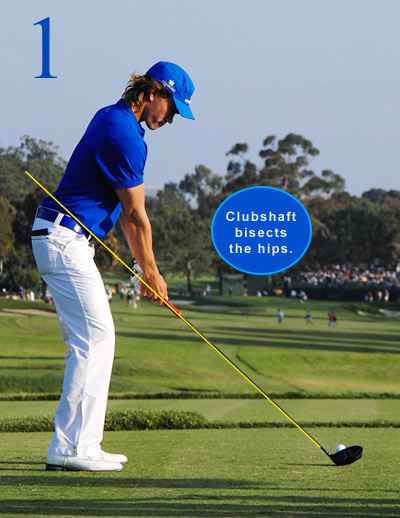 “FLOW”, I will be writing a tip, idea or whatever is on my mind for “20”, yes “20” straight days. The golf channel has 12 days at the academy…I have twenty days with the guru. I will attempt to educate you and entertain you as only my warped little golfing mind can do. So here is your idea for the day………………Understand the golfing instrument. “the club”
1. The club face, the club head and the club shaft all make up the tool that we use to propel the ball at the target. There are many methods, styles and ideas on how to create an efficient golf swing but it doesn’t matter as long as you adhere to the physicality of the way the club is built. (now it is up to you and your coach to figure out which one works for you). No matter what you are trying to do, there is no debating that there are two things the club must do to direct the ball in the manner that you wish.
1. Swing on a tilted “circle” on or parallel to the angle that the club rests on the playing surface “the ground”.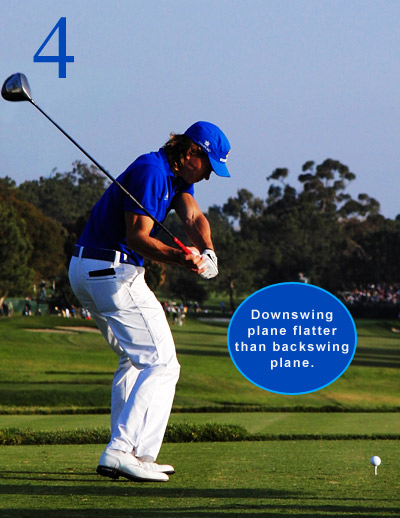
AN EASY WAY TO UNDERSTAND PLANE: The 5 Parallels
Assuming a stance that is square to the target, the club should be parallel to the target line at waist-high (1), parallel at the top of your swing when the club is perpendicular to the ground (2), parallel to the target line at waist-high on the downswing (3), parallel to the target line at waist-high on the front side (post impact)’(4) parallel to target line at three-quarters in the follow through.(5)2. Club face should be slightly open to the target line at impact and the ball should be struck on the inside quarter. The face of the club is only square a split second as the ball separates from the face.
3. The shaft of the club must lean towards the target in the impact zone as this is the key to compression and solid contact (also is the way the ball gets airborne).
For you expert golfers out there, you would be surprised at how many golfers don’t know these key physical basics of how to use the club, so bear with me as I never assume that my students or my audience knows anything……like a shanker that thinks he is hitting the ball off the toe of the club so they stand closer to the ball……what?
As we approach the winter season, get your golfing area in your house that will allow you to do some mirror work. I will expand on the importance of indoor practice as we move towards Christmas.
This is the best time to take a golf lesson because you aren’t playing as much so you are more likely to commit to a swing change. Stick with me and we will get an improvement plan in place.
Follow me on Twitter @ Twitter.com/onplanegolf
Until tomorrow,
Guru
I was very flattered that Jason Helman, 2010 Ontario Section Teacher of the Year, contacted me and wanted to come on the “Guru TV” show. We had a great time talking about golf and teaching as we spent the afternoon together as he passed through on his way back to Canada. We shot 2 impromptu videos with very little planning. We just fired up the camera and let it rip. I hope you enjoy.
follow me on twitter @ twitter.com/onplanegolf or friend me up on facebook.com/onplanegolf
See you on the lesson tee,
Guru
 The Golf Guru Show