Matt “The Kuch” Kuchar wins first FedEx playoff: What can we learn from his one plane/reverse slot swing?


Matt Kuchar wins the Barclays Championship in a playoff over Scotland’s Martin Laird. Kuchar makes birdie on the first playoff hole to win and continue outstanding play as he enjoys his best season on tour. Matt has one of the P.G.A. tours most unusual swings and once again I have cued up a slow motion video of Matt’s move in order to educate Guru Nation on how these unusual golf swings work and further highlighting the fact that there is a lot of ways to get it done out there and play great golf. Matt has what we would call a Reverse Slot/One Plane Swing. Let me clarify what I mean by both of these labels and see if I can help you understand some of the terminology behind the two.

One Plane Swing – Top teacher Jim Hardy coined this phrase as a certain style of swing. First off, one-plane has nothing to do with the golf club swinging on a particular plane throughout the swing as a lot of golfers (and some teachers) think. The golf swing has many planes. Shaft, hands, arms, shoulders etc. One plane is a reference between the shoulder plane and the left arm plane. When the left arm and the shoulder plane match at the top of the swing it is considered One-Plane, that’s it. When the arm plane is higher than the shoulder plane it is considered Two-Plane (see past post on Carl Pettersen). So as you can easily see, Kuch is a big time one-planer. When the left arm is below the shoulders, I call that a ZERO PLANE (I made that up). Other pros that use this style are former president of one-plane nation, Chad Campbell, and current president : Zack Johnson (because he has won a major). I think this is a great way to swing if you are a chronic over the topper. But I still have one criteria. I don’t like the shaft of the club to get below the right forearm or behind the hands in the takeaway. This can and usually makes the downswing too steep. But there is always the exception to any rule……which leads me to my second point.

THE REVERSE SLOT SWING PATTERN

“The slot is an area of the downswing about half way down where the club shaft is parallel and slightly on top of the original shaft plane”. (depending what camera view you use……post for another time. Every golfer wants to find the slot and the majority of touring pros are there in the downswing. The largest portion of PGA players have a swing pattern where the backswing is outside of the downswing. In Kuchars case, it is reversed…..We call this the REVERSE SLOT SWING PATTERN. He breaks the guru rule and lets his club shaft get lower than his right forearm and couples that with a very low arm plane. So how does he make this work? ALL OF YOU OVER THE TOPPERS (EARMUFFS). Key Move: In order to get the club back in front of him and back into the slot, he must rotate his entire torso (shoulders, chest and hips), very aggressively to the left. If he was too slow with his body, the club would come in too shallow or swing too much inside/out. Kuchar makes this work beautifully as you wouldn’t think this style would work out of the deep rough as he demonstrated in the playoff. Other players that use this style are, J.B. Holmes, Joe Oglvie, Bobby Jones, Sam Snead (going old school on you).  As this post is getting a bit lengthy, I will cut it off and accept any comments. So the moral of the story  is………If you are consistently finding the slot on your downswing, don’t let anyone change your backswing!!!!!

See you on the lesson tee,

Guru

2010 U.S. Amateur at Chambers Bay: Perspective from an avid golfer. A Guest Post from Tom Chambers


As the U.S. Am finishes up today at Chambers Bay, I received an excellent email that I wanted to share from one of my students that recently played there. Here is Tom Chambers take on his experience at one of Americas hidden gems. Thanks for the post Tom. I am officially jealous and will put Chambers Bay on my bucket list of places to play. Here is the website: chambersbaygolf.com

Jason,
 
Thought you may enjoy a few stories and maybe a topic for the blog.
 
Last month I had a chance to play at Chambers Bay in the state of Washington. Oh and it also is hosting the 2010 US Amateur currently going on and play host to the US Open in 2015.
 
Since this is the first time I have played a course which is now on TV, I can appreciate what these guys are doing and how tough the course is going to play. Also amazed these guys are that good. I’ve muttered a few times, “He doesn’t stand a chance of making the 20 footer breaking 8 feet going down hill, he’ll be lucky to 3 putt”……….of course, they either cozy it up there tight or make the putt.
 
A little about the course. True links style golf. All the grass is fine fescue (fairways and greens). Sometimes it’s hard to tell where the fairway ends and the greens begin. From what I hear, similar to St Andrews. The course is built entirely on a bed of sand ranging from 10-50 feet deep. So it plays hard and fast. No winter rules and all the rain they get up there, it all drains really fast. The site was an old gravel and sand processing yard so some of the greyish looking sand is from the site. Bunkers all over the place although many are designated as waste areas but it can be hard to tell where the waste area ends and the hazard begins (Learn from Dustin Johnson and play them all as a bunker)
 
A player is not going to spin and zip the ball back. You have to play for a release and in some cases, some 10-15, even 20 yards of release with the longer irons. Pull out the British Open pointers, you will need them. Plenty of 3/4, lower flight  and bump and run type shots.
 
There isn’t a true level lie on the course. Just about every shot will have some sort of undulation. Ball a little above/below the feet or a slight uphill/downhill lie. It’s hard to remember to choke down a little or put a little more bend in the knees. Really, just enough to make it annoying. This is also true on the tee boxes, especially the par 3’s.
 
First, the greens. Watching a little on the golf channel tonight, I can attest, that 11.5 on the stimp meter may sound slow, but they play a lot faster. If you are not on the correct tier, these guys will be lucky to two putt if it is going down hill. Number 1, 12 (Drivable par 4 if the pin is in the front) and 17 in my opinion can ruin your round if you are not careful. Then add to the fact the greens are made of sand, a little grain of sand can just jump up and knock the ball of line. That may actually be the toughest part, knowing you put a good stroke on the ball and watch it jump left or right just a little and you are left saying what the ???????
 
On the first hole, if the player has a draw in his normal ball flight, he has to stay as far left as possible. Anything left and 99% of the time, the player will be left with a nasty 50 yard blind uphill shot. Twelve is a wicked 4 tier green and if you get lazy, one can easily putt back onto the fairway. For seventeen, if the flag is on the upper right tier, short can be dead as well as long and right. If it is on the lower left tier, nothing really to worry about.
 
Most of the lower holes have some sort of slight elevation change, ranging from a half to a full club up or down the bag. There are some other holes with hug  elevation changes like number 9. A par 3 with about 50-75 feet downhill elevation change. But I can say I hit a 9 iron some 175 yards!!! (normally a 6 iron)
 
Also there are plenty of tee box locations. I’m sure the USGA is going to play with them a lot this week. Somehow they stretched the course another 300-500 yards. Not sure how, I was looking for the tournament tees and couldn’t find them on some holes. They also took away a stroke on 18, which normally plays as a par 5. Today it was playing 511 yards but they can push the tees back and it can reach 550. Can you imagine a 550 yard par 4 finishing hole?!?
 
Very cool course and a must play if one gets to the Seattle area but you better be in shape, walking only.
 
And if you are wondering, I’ve played the course twice 86-90. Killed myself the first 12 holes this time around by playing east coast American golf (Fly it to a realativley soft green). My putting really saved me on the way to the house with six straight one putts.
 
Played another muni the next day. Jefferson Golf Course. Yes the same course that Fred Couples played when he was growing up. Actually saw him before my round when I was on the practice putting green. He was there with the Golf Channel doing a walk down memory lane before the Senior US Open. And shot an 81……….
 
I’ll be in for a tune up soon.
 
Stay well,
 
Tom Chambers

GURU TV – BODY PIVOT AND HOW IT AFFECTS YOUR SWING


We have talked a lot about the hands and arms but the engine to the golf swing is the body pivot. How the body moves or doesn’t move will affect how the golf club moves throughout the  swing. The one thing that I didn’t mention in this video is the player that is trying to keep his hips from moving to create torque in the backswing. Here is an fyi. If your hips don’t move, your shoulders will not turn enough to get the  club inside enough to find the plane. I hope you enjoy the vlog and leave a comment if you would like.

Guru

Visualization Skills: How To Get Bubba To Hit First


What if you could just think about hitting great golf shots and they would magically happen? Have I got your attention yet? Well, It is not that easy but your mind and your inner vision does have a huge effect on your performance. Mental coaches have really become popular on the PGA Tour and in all sports and for good reason. The ability for the athlete to control their emotions and their mind is what separates the winners from the rest of the field. I am no sports psychologist but have read enough books, talked to enough sports psych docs and worked with enough tour player who work with these guys to be dangerous. I have really tried to improve in this area so that  I can help my players with more than just their golfing skills but assist them in their mental games as well. I will write a book someday and one of my so-called titles was “How To Get Bubba To Hit First”. The first thing that you are asking yourself is “Who Is This Bubba Character?” Great question. Have you ever missed a four-foot putt only to rake it back and make the second one. Have you ever made the worst driver swing in your life, out-of-bounds, re tee and stripe it down the middle? Stand over an easy chip shot, duff it, step up and hole it like you were Phil Mickelson. We have all been there, right? That second guy is pretty good. Well, I want you to meet Bubba! The best player that lies within all of us. The Ranger Rick that stripes it on the range and drives 300 yards to the first tee and hit a drive like it was your first day playing golf. So what has changed and why does Bubba play so well and you don’t? Well, it has nothing to do with your skill because you obviously could do it on the practice tee or the provisional drive after you hit it out-of-bounds. It starts with VISUALIZATION! Have you ever heard of the LAW OF ATTRACTION? The Law of Attraction simply says that you attract into your life whatever you think about.  Your dominant thoughts will find a way to manifest. Golfers are the worst at thinking about the negatives or simply viewing themselves as lower than they are . I talked in some previous posts about “Acting As If”. Before you can act like a better golfer, you must visualize yourself as better golfer or see yourself hitting the shot that you want. I believe that the best players can visualize each shot so vividly that they have trained their mind into thinking that they have already done it…………Bubba gets to hit first. We do it in our careers. We do it in our lives. We set goals and outcomes that we want to achieve for ourselves and our families. So why not our golf games? There is an excercise called a “Vision Board” where you take a piece of poster board and paste pictures of things that you want to achieve or accomplish. They encourage you to look at it every day as you would your goals an visualize yourself doing these things. Golf is such a visual sport and the best players use their eyes  so effectively. Why did Jack Nicklaus take so much time over a putt? Not because he had a lot of swing thoughts. He took time to visualize the putt (in real-time) tracking to the hole, going in, then returning to his putter before he would pull the trigger. That took a long time! Why did Johnny Miller sit in a chair before a tournament, close his eyes and picture himself playing every shot in an entire round before he went to the course……I think he shot 63 in alot of majors in his mind. Visualization or being able to picture the outcome  or shot is one of the first things I teach in developing an effective pre-shot routine. Here are the 3 ways to visualize……find out which one works for you and Bubba will hit first more often.

1.  Seeing the flight of the ball or shot – You are the camera and you picture the ball flight as it was a video game with a white stripe.

2.  Visualize yourself as you stand outside your body – This when you are picturing yourself making the proper swing or short game shot that you want. That is why I think your should always take a video lesson when you are hitting it your best. This way you view what your swing looks like at its best and you can call that image up when you need it.

3.  Picture another Player to help your game – I used to picture Ernie Els’ driver tempo and Tiger Woods short iron swing for excellent results. You can choose your models but this is an effective way to maintain tempo and rhythm in your swing or stroke. It is no coincidence that after you return from a tour event and have watched the best players in the world practice or play, that you suddenly develop effortless tempo and rhythm in your swing….for at least a little while, right.

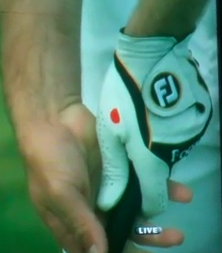
It worked for King Louis (and the red dot) in the Open Champioship and it can work for you. Work on your visualization skills for your golf and for your life and I can promise that you will start to attract the shots and the things that you want in your life and your golf game…….It has worked for me and I know it will work for you

See you on the lesson tee and don’t forget to breathe as you paint the picture,

Guru