I went to the Carolinas P.G.A. show this past Monday and Tuesday to attend our annual meeting and to see Hank Haney speak at our section teaching summit. I thought it was great to hear from one of our premier instructors who teaches the best player on the planet (Tiger Woods) and the worst (Charles Barkley). This post is as much for the teachers (if any teachers read this I am flattered) as for the players. I think understanding what makes a great teacher can help you in your search for a teacher to work with. If your teacher or coach doesn’t have these qualities or isn’t working to improve, find another teacher! This post is also for the student that hasn’t worked with me and wants to get some insight on what to expect. Here are some hightlights from Hank Haney ; Continue reading “Hank Haney and My New Favorite Training Aid”
This show topic goes with my June column that I just submitted to Golf Illustrated. Title: “The D Plane” and The importance of the club face. Did I mention that I have an article in the February issue of GI? See you on the lesson tee,
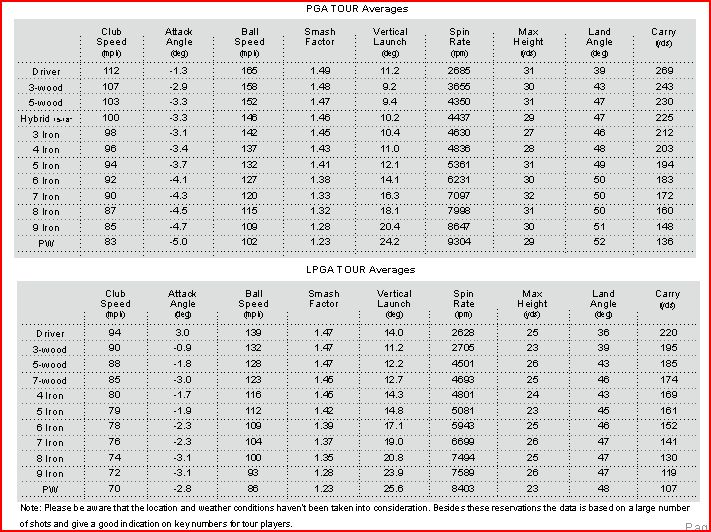
Club fitting has always been a high priority for me as a teacher. An expert fitter has the ability to make the teacher look like a genius by giving the student a tool that fits him or her and allowing them to reach their golfing potential. At the Dana Rader Golf School, we have one of the best fitters in the country in Stan Roach. He not only is extremely knowledgeable but blends a customer service touch that is second to none. Spending time with Stan is like hanging out with Harvey Penick. He hands you a few clubs, makes a recommendation or two and the next thing you know you are striping it like never before. You leave the a session with Stan and wonder “what just happened”. His style is so smooth and effortless, that he just slips it in your food……to steal a line from Harvey. As we say in the teaching business, Stan understands the club fitting business like Homer (Kelley) and explains it like Harvey (Penick). I couldn’t do my job as well if I didn’t have Stan supplying my students with clubs that work for their build and swing. If you are trying to improve your game and are playing clubs off of the rack or hand me downs, you may as well run a marathon with shoes two sizes too small. Stan uses the Zelocity launch monitor to fit players which gives you plenty of data and information. Come and spend some time with Stan before purchasing golf clubs and I promise you won’t be sorry. Here is trackmans data for tour players that might give you some insight when you visit your club fitter. For more info, check out trackman.com. This is the only way to maximize you distance and play what is going to work for you. Check out Stan’s Blog for the latest in equipment and fitting info at clubfitterstan.wordpress.com.
Here is a drill that I use with students that tend to roll the club too far inside on the takeaway. I filmed another show today that goes with my upcoming Golf Illustrated Article in June called “The D-Plane and the Importance of the club face”. It will be up in the next few days.
One of the most important thing that I do as a teacher is help my students understand why the flies the way it does or accurately read their ball flight. As a young (younger, haha) instructor, I was trained in the nine ball flights (possibilities)and the 5 ball flight laws. It stated that the a. path that the clubhead was traveling determined the starting direction and b. the face angle created the curve of the ball or deviation yet having a smaller influence on the flight pattern. This is NOT TRUE. Which brings us to the “D Plane“.
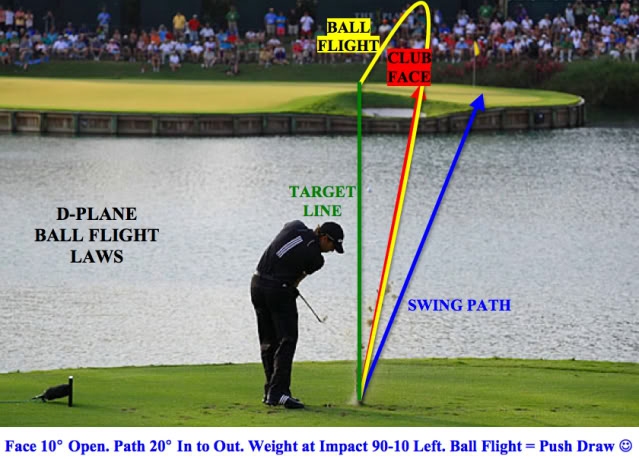
THE D PLANE FOR GOLF: This is a term that was coined by Theodore Jorgensen in his book “The Physics of Golf.” In his book he says something to the effect that two intersecting lines determine a plane. Basically this is where the(true) club face angle and the (true) path the club head is traveling create this plane. He calls it the D plane because of it is description of the collision between the club head and the golf ball. The D Plane shows that the ball almost starts where the club face is pointing (approximately 85% of the direction) and only curves if the path is going a different direction than the club face. In simpler terms, if the club face is a bigger influence on the starting direction than the path. The D plane also illustrates that the trajectory of the ball will be slightly lower than the true effective loft of the club. Have you ever hit a shot that started to the left of your target only to look down and see that your divot is pointing way to the right. You probably thought that you swung the club outside/in, right? The truth is, your d-plane was pointing too much to the left or your club face was pointing way to the left. This is what I have often called club face override. When the club face is closed or open approximately twice as much as the direction that you are swinging. So why is this so important? It explains true ball flight and this will help you to truly diagnose why you ball does what it does. Now you still will need an educated instructor to help to swing the club the way you need to and get you the ball flight you want. Check out the diagram below for further visual explanation. Two things we are assuming are: 1) you are making solid contact and 2)you are hitting the ball at the bottom of your swing arc which is very difficult. Check out the illutration below. You see the target line, the true path(club head direction for a perfectly low point strike), club face normal(3 dimensional direction face is pointed) and initial ball directon(horizontal ball velocity direction). You can see that the true path(club head direction) is to the right of the club face and the initial ball direction is just right of the club face normal. This is a D Plane for a push draw. This is enough for you to chew on for now. Click to Enlarge for Better View
Here is a picture of Sergio Hitting a push draw and a great visual of the D Plane in action.
In order to regain some of my old form, I hit a few ball this week in the cold Charlotte weather. I have always been a very solid ball striker but over the years I have lost a few yards. In order for me to compete I need to hit it further so this is what I have been working on. I have always been fascinated by the fact that some guys on tour hit it a lot further than other guys, yet they don’t look that much different. What separates a guy like J.B. Holmes and a guy like Brian Gay? They are relatively the same size. I spend a large majority of my teaching time trying to shorten players swings. The average golfer has the belief that a long backswing creates distance. This could not be farther from the truth. On the priority list, length usually ranks about 10 for me. It is much more important to create width in your swing. Width is the distance between your hands and your sternum. The bigger your swing circle is throughout your swing, the more speed you can create. I have always set the club early in my swing and in my younger days my shoulders turned a bit more. I have a ton of downswing lag in my swing but my circle tends to get too small and narrow which causes me to lose speed. I have worked extremely hard on my fitness so I know I am strong enough to hit it longer. I made one simple change and feel and started to hit it 10 to 15 yards longer with a seven iron. Here is what I did Continue reading “Width is Better than Length”
The 4 areas of your golf game that you must work on are: 1)The full swing 2)the short game/putting 3)The mental game and 4)YOUR FITNESS
What does your fitness regimen include? Are you working on your weak areas? Do you know where your weak links are? Find a ceritified TPI Instructor and get an assessment today. Enjoy the video.
Steve Stricker takes a six shot lead into the Northern Trust Open, shoots 70 and hangs onto a 2 shot victory over Luke Donald. This moves him into the 2nd place in the world rankings and is currently the best player in the world that is actually playing golf. I have heard that Tiger is out of sex rehab and is making his début at the World Match Play but can anyone confirm this? I don’t know? Phil Mickelson continues to be a little rusty as he shoots 73 in the last round and finishes 45th. Phil currently has Butch on speed dial as well he should. Will this be the year that Stricker wins his first major? He is full of confidence and with this positive attitude and his steady game, I would not be surprised if he won several more tournaments and even a major. What major would his game be suited for? Masters, U.S. Open maybe? As simple as his golf swing appears, he really held it together coming down the stretch with a wonderful short game and rolling the ball beautifully. So what can we learn from Steve Strickers technique?
Here is my analysis of why his swing works: 1) A simple one-piece takeaway with a very late wrist hinge. His shoulders and torso must rotate properly to set the club at the top. Great shoulder turn and perfect spine angle tilted slightly away from the target. But this is only the half of it.
2) An excellent transition as his body unwinds in the proper sequence in the forward swing. Lower body starts as the upper resists and hands remain passive. This is his key to success. If Strick had a passive body rotation or the upper body was too fast, the club head would surely pass the handle too soon and he would lose power. So mental note: One piece takeaway with limited wrist hinge must be coupled with a strong body rotation in the forward swing (his main power source).
Strickers Pitching and Putting:
Steve incorporates his one piece move in his pitch shots as well. He controls his distance with the length of his swing on both sides (symmetrical) with passive hands. The Key Move: He leads with his lower body and allows the arms and hands to follow suit. Without this key move, he would break down at impact. Again, you must have a good body pivot to be an effective pitcher of the golf ball but especially if you have none or limited wrist hinge.
Putting: Strick is a straight line putter. This is not my preference but it works for him because he does too things: 1. sets up with his wrists arched and the heel of the putter off the ground. This sets the shaft more vertical to the ground which is critical for this type of style. 2. rocks his shoulders a little steeper than most players on tour which creates a straight line path.
So the number one thing we can learn from Mr. Stricker is to match your style to what your body will allow. Be consistent from full swing to short game to putting. But the most important thing is to be Confident and To Own It. See you next time and don’t forget to breathe, preferably in your backswing like Steve Stricker or when you hold the trophy over your head. Oh and don’t forget to thank your instructor in your victory speech.
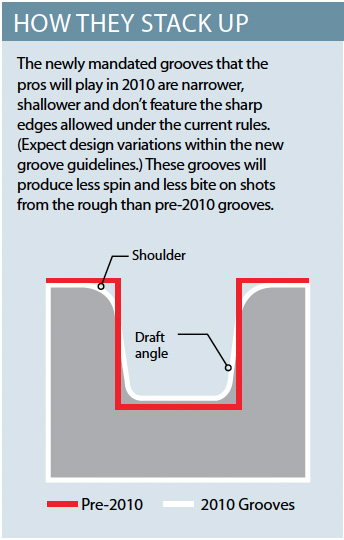
With all the talk this weekend about” Groovegate” and some professional golfers getting called cheaters, I thought I would weigh in on this new groove situation. Do you understand the rule?What is this loophole that Ping is involved in? What does all this mean for the recreational golfer. I will attempt to answer all of these questions as I see it and help to simplify it for all of you players out there in Guru Nation. First off, The new grooves essentially cut down on the amount of spin that a player can create out of the rough. This will put a premium on straighter driving rather than the old “Bomb and Gouge.” The new condition of Competition concerning grooves applies to play on the professional tours and a small selection of other elite tournaments in 2010. For the vast majority of the golf played around the globe, the grooves in your current clubs are authorized by the ruling bodies until at least 2024. So unless you are reading this and are playing a professional tour, you can relax for a bit longer.
THE LOOP HOLE– As you probably already know, The Ping Eye 2 wedges before 1990, are considered legal because of the box groove law suit won be Karsten in 89′. This is what some of the pros have in their bags (namely Mickelson) because they are considered legal for the time being. I think that Mr. Karsten should just go ahead and write the letter allowing the USGA to make these illegal as well, just my opinion (and apparently Johnny Miller as well). Make it equal across the board and lets see who is the best. It was nice to see that Scott Macarron did apologize to Phil about calling him a cheater for using this wedge. He is not using it this week however. It will be interesting to see if and how this changes the game. One thing is for sure, we will see the pros working on there short game and their driving. Here is a picture of the difference in the old and the new grooves to give you a better understanding of what we are dealing with. See you on the lesson tee and oh, don’t forget to breathe.
I have had a few days to review and discuss what myself and my colleagues liked at the show. I have been going to the show for about the last 10 years and it has definitely changed in the fact that some of the companies have pulled out but there was still quite a buzz and excitement about new products and a new golf season. Here are a few things that I thought were worth looking at and the sites where you can find them. I will be purchasing a few of these to try with my students this season.
1. eyelinegolf.com– great putting and training aids. I liked the Hank Haney impact putting system, the dual plane putting system and the impact putting ball.
2. pivotpro.net – interesting aid for swayers and pivot problems
3. flightscope.com – a 3d doppler radar system (like trackman) but half the price.
4. K-vest.com – I thought the k trainer- The most intuitive training system in golf, from the developers of the k-vest. k vest is awesome but not new.
5. pro-stance.com – helps you improve your dynamic balance
6. morodz.com – great alignment aids for ball position as well
*****golfaroundtheworld.com – a site where we get most of our training aids. For all my students that ask me “where did you get that”
For those of you that haven’t been to the show, you need to go at least once. Your pro at your club can get guest passes. Here is a small taste of what you will see and a portion of a TPI seminar that is very good. Please excuse the camera work as it is not easy to walk and film. Click the link below to view the film



 The Golf Guru Show